


HR processes in times of digitalization and automation
The digital transformation has had a major impact on the way people work and collaborate. Companies that fail to keep up will be left behind in the long term. This can also be seen in the HR sector: if you want to be successful in the future, there is no way around digitalization and automation in the long term. In this article, we show you exactly what this means, what advantages it brings and what HR digitalization can look like in practice.
What does digitalization mean and why is it classified as a trend?
Digitalization describes the increased use of digital media and their integration into work-related and social processes. In the corporate context, this means converting analog values into digital formats and automating processes and measures in order to work even more efficiently.
However, digitalization is more than just a trend. After all, these are usually only relevant for a certain period of time and are often replaced by a new trend shortly afterwards. If anything, it is therefore a megatrend that will have a fundamental impact on society and the economy as we know it today.
The coronavirus crisis has also shown that progressive digitalization was long overdue in many companies. Starting with their own marketing measures, such as a website and online bookings, through to data analysis and HR processes: Those who have not already taken the first steps in this area will still find it difficult to assert themselves on the market today.
Digitization grants for small and medium-sized enterprises
In order to drive digitalization forward, the Federal Ministry for Economic Affairs and Climate Protection (BMWK) supports SMEs with special funding as part of the “Digital Jetzt – Investitionsförderung für KMU” programme.
While many companies were unable to introduce and implement digitalization measures at all or only very slowly during the crisis due to a lack of funds, there are now numerous opportunities for SMEs to make the best possible use of the economic potential of digitalization. According to the BMWK, the financial subsidies are intended to encourage companies to invest more in the training of their employees and in digital technologies. This also includes the implementation of HR software and other digitalization measures in HR management.
What does digitization of HR mean?
One thing is clear: digitalization is continuing to advance – and is not stopping at HR departments and other internal and external company processes. But what does the digitalization of HR actually mean?
Definition: What is HR digitization?
In relation to HR teams and departments, the term “digitalization” describes the transformation of analogue structures and processes into digital ones. The use of communication and information technology therefore plays a major role in areas such as recruitment and personnel development.
What are the goals of HR digitization?
The main goal of HR digitalization is to digitalize, standardize and automate recurring processes in such a way that the workload of HR management employees is reduced. Once this has been achieved, there is more time for things other than the simplified administrative area, such as interviews with applicants and employees, personnel development, team building and other important strategic tasks. HR software and automated processes should also …
- Simplified organizational structures created,
- performance and skills of individual teams and employees can be measured and
- simplify collaboration in an agile style.
What advantages can digitalization bring for human resources?
It’s clear: digitization saves time. But there are other advantages to using HR software:
- A digital system is being created in which the data obtained can be stored centrally and better analyzed.
- Tedious operational tasks such as planning vacation days based on vacation requests received are simplified.
- Recurring processes are automated to a high standard.
- Time-consuming tasks such as payroll accounting or applicant management, which would otherwise have to be done manually, are reduced to a minimum.
- Applicants are processed more efficiently.
- Decisions can be implemented more quickly thanks to real-time reporting.
- Simplified working results in increased employee satisfaction and greater employer attractiveness.
- Digitalization accelerates interaction, e.g. through chatbots and online appointment booking options.
- Digitized HR departments save resources and money.
- Collaboration is also made possible across temporal and spatial boundaries (e.g. through shared access to documents and virtual meetings).
The last point in particular plays a major role in today’s world. After all, flexible working models and processes are also becoming increasingly important for employees. For many employees, hybrid working and the option to carry out their tasks in a permanent home office are already part of the requirements for applying for a job.
This is what HR digitization can look like in practice
While HR teams were previously mainly responsible for administrative tasks (according to the HR study by the University of Halle-Wittenberg, this accounted for 52% of working hours), digitalization is not only changing the work processes themselves, but also the areas of responsibility. As a result of the time gained, HR managers are increasingly focusing on employee support and organization.
Which HR areas can be automated?
HR software solutions can be used to simplify and improve the various areas of application through digitalization. This is also confirmed by the HR Software Report 2021: a full 92% of employers surveyed already use HR software – in the following areas, among others:
- Recruiting
- Applicant management
- Personnel requirements and deployment planning
- Vacation planning
- Management of digital personnel files, documents and employee applications
- Working time management
- Personnel development
- Project management
- Feedback and meetings
- Employee and knowledge portals
- Personnel controlling
- Automated communication using HR chatbots
- Digital employee communication
- Display of fluctuation and skill sets
- Employee retention
- Onboarding, transfer and departure processes
- Potential analysis and talent management
- E-learning
- Payroll accounting
- Accounting
8 trends in HR digitization that you should know about
Anyone who wants to digitize their own HR department and its processes will sooner or later be faced with the question of where to start. We have therefore put together eight exciting trends for you, most of which can even be implemented within a very short time and with relatively little effort:
1. active sourcing
Sourcing tools can already be used to define skills in advance, whereupon the software automatically searches the internet for suitable candidates. This means that HR staff only have to handle the actual contact and communication – but no longer the active search – which saves a lot of time in the long term.
2. pre-selection of applicants
HR software can also be used to digitize the pre-selection and evaluation of applicants. For example, you can use an online form to query skills and criteria right at the start of the application process. The automatic evaluation in the form of a scoring value allows you to see at a glance which candidate meets the most important requirements.
3. video applications and online job interviews
To get a realistic first impression of potential new employees, more and more companies are turning to video applications. In addition to the CV, candidates can also upload a video in which they can present themselves convincingly. If it might be a good fit, an online interview to save further resources.
4. virtual rooms
Virtual teamwork has never been easier: a large number of HR processes can be easily coordinated within virtual rooms. They are therefore ideal for the joint processing of job advertisements or for exchanging information about candidates with team members. Thanks to an interface with your career site and job boards, HR software can also be used to post ready-made job advertisements directly via multiposting.
Long meetings and endless e-mails with dozens of employees in the CC are now a thing of the past!
5. video conferencing
Hybrid working models mean that it is not always easy to bring all employees together in one room. Fortunately, it is now possible to hold video conferences. But interviews can also be conducted with less effort – and even with a time delay: Using an applicant management system, recruiters can simply record their questions in advance and have the next one sent automatically once the candidate has answered. This is also ideal for applicants in other time zones.
6. online team events
In addition to meetings, team events can now also be organized online. This has the advantage that the team-building measure is also possible for employees working from home and can promote cohesion among employees despite possible temporal and geographical separation.
7 Employer self-service
Integrating employees – a trend that is likely to continue for a long time to come. After all, this measure makes administrative tasks much easier. Using a personal log-in, employees can easily log into the portal and manage master data themselves.
Depending on their access rights, employees have the option to change their own address or bank details, for example. But also Sick days incl. online sick notes and vacation planning can be managed by the employee themselves with just a few clicks. As an employer, you can also make documents such as the income tax statement or the latest payslips available for viewing or downloading. The work of HR staff is therefore simplified many times over.
8. e-learning
Another advantage of digitalization is that personnel development is becoming more efficient. Learning apps and company portals make it easy and flexible for employees to train online.
Crisp video tutorials and live seminars, which you can even provide with an additional PDF containing all the important information, are ideal for this. Or how about a quiz as an alternative? Linked to your data management, you can also track learning progress and skills and then analyze them within the database.
7 steps you should consider when digitizing HR processes

The digitalization of human resources processes can be quite complex. We have therefore outlined the seven most important steps for you:
1. composition of the digitization team
To implement the digitalization project, you should first put together a team to plan and implement the next steps. However, this does not necessarily have to be a homogeneous team of HR employees: Team members from other areas can also be of help and bring in a different perspective to develop the right strategy. The only important thing is that a kick-off meeting is held at the beginning so that everyone knows what exactly is at stake and what goals are being pursued with the digitalization of human resources processes.
2. define processes
Once all team members have been briefed, step 2 involves analysing the current situation and defining the processes to be digitalized. So start by listing all the tasks that regularly occur in HR. A look at the possible areas of application for HR software above in this article and the use of mind maps can help here. Once collected, the next step is to record the individual steps to be taken by the person responsible in order to complete the respective process.
In onboarding, for example, this could look like this:
Welcome email → Introduction video with insight into the corporate culture → Additional email with PDF containing basic information about your company → Appointment booking link for a meeting with the line manager and the team → Log-in data for the employee portal → Introduction of important tools → First small task → Feedback opportunity
3. set priorities
In order not to lose track and effectively implement HR digitalization, all collected processes and tasks should be sorted according to time and resource expenditure in step 3.
Are certain processes carried out more frequently than others? And how much time do they currently take? Identify the most time-consuming ones and put them at the top of your priority list. You will see the first improvements after a short time and how much time is saved.
Example: While staff scheduling makes up a large part of the tasks for hostess agencies, time recording could play a more important role for catering companies.
4. plan resources
Step 4 involves planning the budget and human resources for your project. Can your own employees implement digitalization themselves or do you need external advice? Do employees still need to be trained? What budget do you want or can you plan for your HR software on a monthly or annual basis? How many euros will the total costs amount to?
5. select HR software
Now that you know who will digitize which processes and in what order, it’s time to choose the right human resources software. Questions that can help you in this step:
- Do you want access via smartphone?
- Can all desired processes be realized with one software or do you need additional tools? And if so, which interfaces should definitely be available?
- What is the data protection status of the selected software?
- Is the operation intuitive or does it possibly require a familiarization phase for users?
- Can all predefined types of role and access authorizations be assigned?
6. digitization of data
Once one (or more) software has been selected, step 6 involves integrating the existing data – either manually or by importing data. This includes basic information such as employees’ personal data, working hours and areas of activity.
7. involvement of employees
Almost done: Step 7 is all about using the new software solution. An introduction for the Human Resources department and a short training course in HR digitalization can be helpful here to develop the necessary digital skills. This way, everyone involved knows why and how to work with the new software.
Successful digitalization of your HR processes with Teamhero
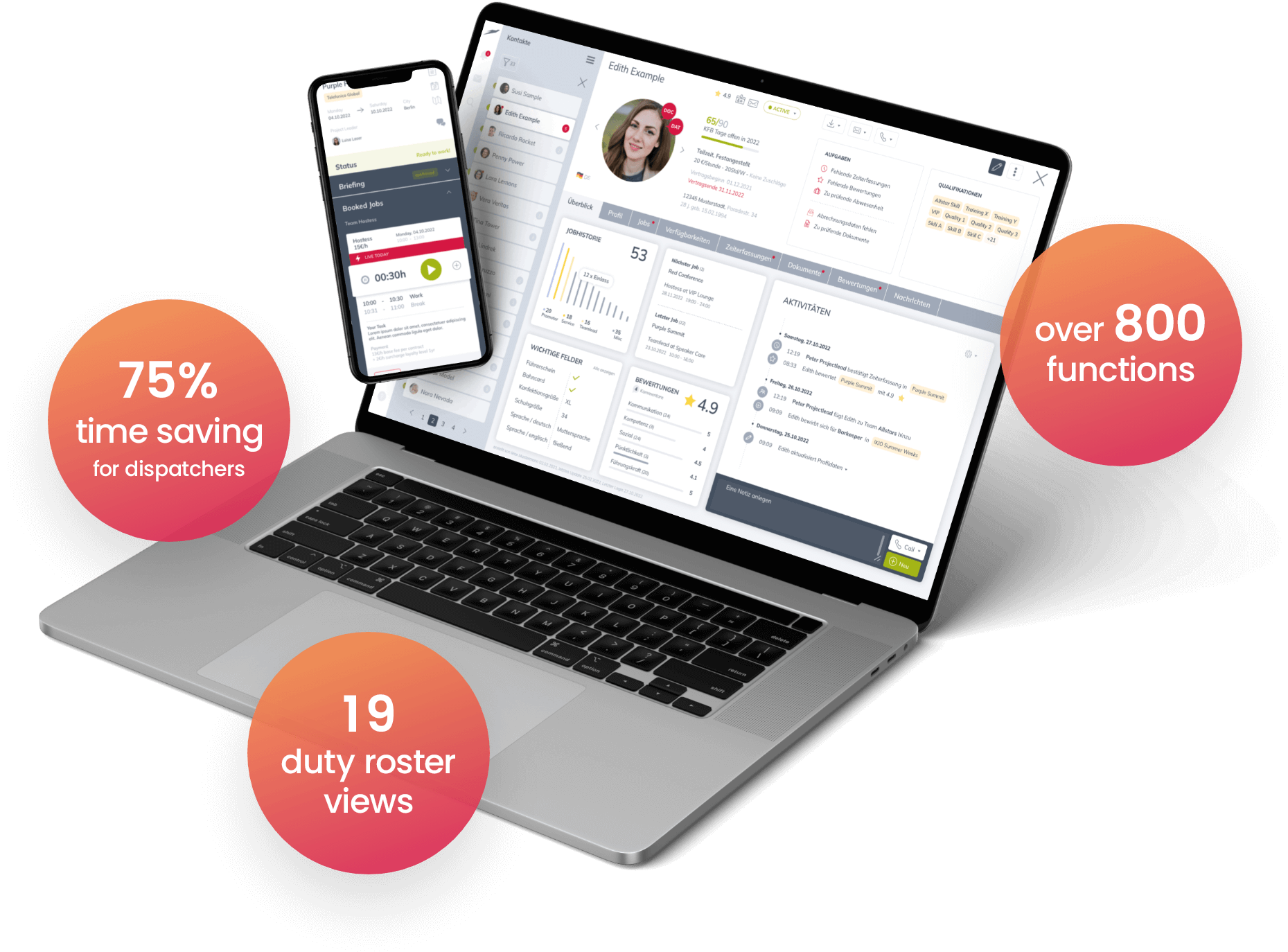
It should be clear by now at the latest: In the long term, there is no way around digitizing your own human resources processes to increase efficiency. Our aim with Teamhero is therefore to offer software that supports personnel-intensive companies in particular in optimizing their business processes.
As a tailor-made HR software solution for comprehensive personnel planning, Teamhero therefore enables you to plan and sustainably perfect personnel deployment in real time – centrally, digitally and seamlessly across all end devices – from applicant management and personnel management to preparatory payroll accounting. Try Teamhero now for free.