


Personnel controlling: definition, tasks & objectives
Personnel controlling is an important factor in achieving corporate goals. But how exactly is this done? Which methods are used and what are the relevant key figures? In this article, we answer the most important questions about personnel controlling – simply and concisely.
What does personnel controlling actually mean?
Personnel controlling defines an important point within HR and corporate management. It consists of the primary aspects of planning, management and control within HR. The procedure mainly consists of collecting relevant, personnel-related data, preparing it accordingly and analyzing it.
The final key figures serve both to support personnel-related decisions and to achieve the strategic goals of the respective company. International HR controlling is also playing an increasingly important role.
What are the methods of personnel controlling?
A distinction is made between different types of personnel controlling within the evaluations carried out in the personnel area, which we will now present:
Quantitative personnel controlling
Data that has already been recorded is used here, such as data on the personnel structure or personnel costs.
Qualitative personnel controlling
Here, “soft factors” are recorded and evaluated, such as employee satisfaction, employee loyalty or the development of new innovations in the company.
Strategic personnel controlling
The focus here is on the long-term strategy of HR management and measures to achieve the company’s goals.
Operational personnel controlling
Within operational HR controlling, opportunity and risk comparisons are carried out, trends are observed and potential investments are evaluated for their benefits. Target achievement here is in the short to medium term.

What are the objectives of personnel controlling?
The Deutsche Gesellschaft für Personalführung e. V. (German Association for Personnel Management ) describes one of the objectives of personnel controlling very well on its website: “Strategic personnel planning helps to prevent personnel bottlenecks in a targeted manner and to ensure the competence of the workforce.” It also makes it possible to plan personnel requirements at an early stage and thus helps to save money on recruitment.
These sample questions play a role in personnel controlling
The finished analysis should be able to answer the following questions, among others:
- How many employees does my company have?
- What is their employment status?
- What are the salary costs per employee?
- Who fulfills which functions?
- What expertise do the individual team members have?
- How satisfied are my employees?
The main objectives of personnel controlling in detail
The overarching goal is always to achieve the company’s objectives. The individual main objectives of personnel controlling can be broken down into the following points:
Inform
Strategic decisions to be taken and decisions made must be prepared and followed up. The cost structure within HR work should be communicated transparently between the selected persons. All processes are discussed and documented in detail.
Coordinate and integrate
All HR and operational decisions should be well coordinated with the individual departments.
Planning
This is about forward-looking planning within human resources management. Ongoing developments and trends must be monitored and evaluated. This allows opportunities and risks to be weighed up and potential problems to be identified and eliminated as early as possible. An efficient planning tool provides valuable support here.
Control
At this point, suitable software is used to record the relevant values, draw up key figures and monitor them in the long term. Various types of control are used here.
Taxes
The management system discloses the contribution made by HR to achieving the company’s long-term goals.
What are the tasks of personnel controlling?
The objectives mentioned in the previous section go hand in hand with the tasks of personnel controlling.
General personnel planning tasks
All processes, procedures and individual projects carried out in the HR department must always work towards achieving the company’s objectives. Continuous monitoring and risk assessment of all measures is therefore an essential component. This applies, for example, to personnel planning or the recruitment of new employees.
Preparation of relevant KPIs and quality control
One of the main tasks within personnel controlling is the provision of relevant, personnel-related KPIs. These provide management with valuable support for important strategic management decisions. Quality control also includes the task of ensuring the direct flow of information through all relevant departments.
Collection and provision of personal data
Another crucial point within personnel controlling is the evaluation of data relating to personnel. This includes the number of employees, their deployment times, locations and costs, as well as the relevant characteristics of employee groups in terms of their training and (special) skills. We also keep a constant eye on overarching developments in the HR area.
What are the instruments of personnel controlling?
Various approaches are used in personnel controlling. The most important instruments include the following:
Surveys of employees
When used correctly, this classic instrument allows meaningful conclusions to be drawn about the mood in the company and the satisfaction and loyalty of employees.
Benchmarks and comparisons
This tool is used to carry out target/actual (deviations from plan), actual/actual (time), actual/actual (forecasts) or actual/actual (assumptions) comparisons. Internal and external comparisons, for example with other departments, locations or companies, serve as a basis.
Time series
They are used to evaluate measures and strategies. Forecasted trends and developments are analyzed.
Human resource due diligence and HR audits
This tool is used to compare human resources with regard to business development. This includes work processes or facts within the corporate culture. This in turn allows opportunities and risks to be weighed up. Example questions could be: “Are all key positions optimally filled?” or “How motivated are my employees?”
Balanced scorecard
The balanced scorecard is specifically geared towards the HR area. It is used to define relevant KPIs in the HR area.
It is important to note that although HR controlling always focuses on the individual level, it deliberately does not focus on the data of individual employees. Only relevant employee groups or the entire workforce are decisive for data collection.
What are the most important key figures in personnel controlling?
The following is an excerpt of the most important KPIs, broken down by process:
Recruiting
- Duration of the application process (average)
- Number of applicants
- Costs of the recruitment process
Personnel requirements
- Net personnel requirements
- Proportion of women employed
- Proportion of employees with special needs
Personnel deployment planning
- Average overtime worked
- Average time worked to achieve required KPIs (e.g. sales targets)
Employee retention
- Fluctuation rate
- Average salary
- Sickness rate
- Profit-sharing per employee:in
Personnel development
- Age groups
- Training quota
- Salary development
- Training structure
Which data is collected in detail can vary from company to company, as the focus is ultimately on the individual company objectives.
Conclusion
Nowadays, no company can do without personnel controlling. It provides management with important key figures without which the implementation of measures to achieve the company’s objectives would hardly be possible. Within personnel controlling, information is provided, coordinated, planned, monitored and controlled.
Teamhero offers noticeable relief in personnel controlling
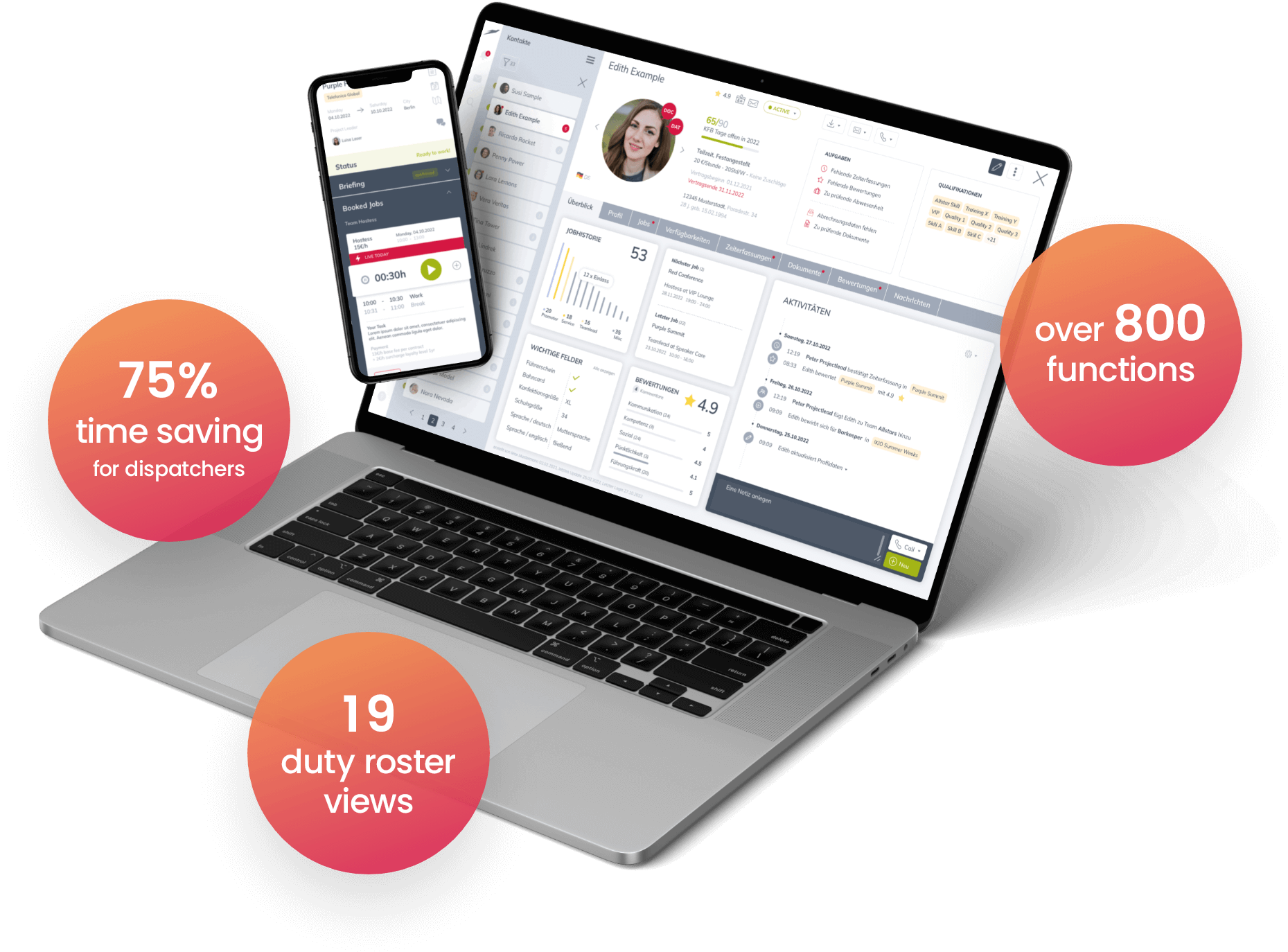
As a basis for the evaluations, it is necessary to record and process large amounts of personnel data. This can be a time-consuming challenge, especially within personnel-intensive companies such as security companies, promotion, hostess or event agencies. But not any more.
Teamhero’s modern and uncomplicated HR software solution is worth its weight in gold. It provides you with reliable support for project management and a wide range of individual tasks such as master data planning, personnel administration and recruitment. You get all the statistics you need at the touch of a button. Find out what our customers have to say about Teamhero or book your free demo version now.