


Social selection before and social plan after dismissal
New at work, young, unmarried and childless – are these the criteria for the number one candidate for dismissal?
It’s not quite that simple, because there always has to be a personal, behavioral or operational reason for a dismissal to be legally valid. Depending on the size of the company, whether there is protection against dismissal and whether there is a works council, different rules and regulations apply as to how employers must proceed in the event of dismissal and whether or not they must negotiate a social plan, for example. Even if all the conditions for a legally valid dismissal are met, employees still have the option of taking legal action or demanding a higher severance payment.
What is a social plan after a dismissal?
A social plan is a binding agreement concluded between the employer and the works council that takes effect after a dismissal. It consists of various provisions to support dismissed employees in the period following their dismissal and to mitigate the disadvantages associated with their involuntary departure. A social plan is therefore a good thing for employees.
What does the social plan regulate?
A social plan following dismissal stipulates, for example, severance pay, payment of application costs or allowances for relocation and travel costs resulting from the terminated employment relationship. The agreement also contains provisions on retraining measures and leave of absence. The contents are not predetermined and the employer and works council can individually formulate how employees are supported after termination. In most cases, however, severance pay is part of the social compensation plan in order to avoid lengthy legal disputes and get the redundancy process over with as quickly as possible.
How is the severance payment calculated in the social plan
The total amount available to the company for severance pay is not distributed evenly among all dismissed employees. Instead, the amount is calculated according to a points system based on social aspects. The more points, the higher the severance payment. The calculation is generally based on the following criteria:
Length of service
The longer an employee has worked for the company, the more points are added to the severance account. In this way, loyalty to the company is rewarded.
Marital status
Married employees are more likely to receive a higher severance payment.
Severe disability
It is often more difficult for severely disabled employees to find a new job. The social plan therefore provides for more money as part of their severance pay.
Maintenance obligations
Employees who have children usually receive a higher severance payment so that they can continue to meet their maintenance obligations after their dismissal.
Years of life
Opportunities on the labor market deteriorate with increasing age. Older employees are therefore given preferential treatment. Unless they retire soon anyway and their state pension will not be too long in coming.
Can an action be brought against severance pay and dismissal under a social plan?
Yes, and many employees make successful use of this. As the weighting of the individual criteria and therefore the calculation of the severance payment is not prescribed by law, it is worthwhile for employees who have been dismissed in accordance with the social plan to have the calculated amount checked by a lawyer and, if necessary, to file a lawsuit. However, it is also possible to take legal action against the entire dismissal for operational reasons.
Is a social plan agreed after every dismissal for operational reasons?
Not every dismissal for operational reasons entails the right to a social plan. The obligation only exists under certain conditions, which are set out in the Works Constitution Act. These include, for example, if a large company wants to close down all or part of its operations and has to lay off many employees as a result. If the conditions are not met, negotiating a social plan is voluntary.
Conditions for a social plan after termination
If these conditions are met, a social plan is mandatory for employers following dismissal:
– There is a works council.
– The employer employs at least 20 employees entitled to vote.
– The company has been in existence for at least 4 years.
– The company is about to be restructured or closed down and employees have to be made redundant.
What role does the balance of interests play?
As with the social plan, the reconciliation of interests is an agreement concluded between the works council and the employer. It stipulates whether, when and how a change in operations will take place. Depending on the type, scope and extent, a change in operations can look very different. For this reason, there is no blanket regulation for the content of a reconciliation of interests. However, its basic task is to provide and record answers to the following questions:
– When will the company or parts of the company be closed?
– How many employees are to be made redundant?
– What is the earliest date from which redundancies can be announced?
– What are the criteria for redundancies?
– Will there be short-time working and if so, how is this regulated?
– What retraining or further training programs are offered?
All regulations relating to compensation for disadvantages are to be regulated in the social plan.
When may notice be given and who is first in line?
Employers may not dismiss their employees without good cause. In addition to dismissal for personal and behavioral reasons, ordinary dismissal can also be for operational reasons. These include urgent operational requirements such as the restructuring of a company, relocation or cost savings. Furthermore, the Dismissal Protection Act must be observed in the event of dismissal for operational reasons and the correct social selection must be carried out in advance. A dismissal must not be made at the employee’s own discretion or based on personal preferences.
What does social selection mean?
Social selection precedes a dismissal in accordance with a social plan. It is subject to statutory criteria and is used if several people who enjoy protection against dismissal are eligible for dismissal for operational reasons. This includes employees who have been working for a company for more than six months, which in turn has more than ten employees. The background to this procedure is that the need for social protection is to be taken into account in the dismissal. Among other things, it relates to the length of service, age, maintenance obligations and the existing severe disability of an employee. The aim is to dismiss those who are least in need of social protection first.
Which groups of people are excluded from social selection?
Employees who have been with the company for less than six months are no longer included in the social elections. This is because they are not yet protected against dismissal. Mothers who are on maternity leave at the time of the social selection and severely disabled employees are also excluded, as they cannot be dismissed by law. If the entire company is shut down or only a single position is eliminated for which there is no comparable candidate in the entire company, no social selection must be carried out prior to the ordinary dismissal for operational reasons in accordance with the social plan.
How does the social selection process work?
Not only must the social selection precede an ordinary dismissal, but it also takes place according to a fixed scheme and legally defined criteria. Employers have to take these three steps in the social selection process:
Creation of a comparison group
First, all employees who are eligible for a position in the same company hierarchy and therefore also potential candidates for dismissal are identified. All employees who are interchangeable with each other are assigned to this so-called “comparison group”.
Determining the need for protection
From all persons in the comparison group, those who are least in need of social protection are filtered out on the basis of the statutory requirements. The criteria used are length of service, age, maintenance obligations and a person’s severe disability.
Examination of the exemption
If there is a special operational interest in the continued employment of a person from the comparison group, this person can be excluded from the social selection after examination and application of the exception rule. This may include employees with special knowledge, skills and performance.
Social plan after dismissal and social selection: Summary
A dismissal – no matter how many parameters it is based on and social justice is applied – is an unpleasant thing for all sides. The company has to react to unplanned operational changes or unsatisfactory performance. In turn, the employee concerned is forced to look for a new job, which can prove difficult depending on age, health or family circumstances. It is therefore important that there are laws and regulations that stipulate exactly when and whether an employee can be dismissed, and that ensure that the dismissed person receives the greatest possible support for the time afterwards. While social selection prior to an ordinary dismissal for operational reasons ensures greater fairness in the selection of potential candidates, a social plan mitigates the disadvantages associated with the loss of a job. This can take different forms, and severance pay is only one option.
Conclusion: Social plan after termination
Ideally, there would be no dismissals in the first place. But for this to happen, the company must be doing well economically at all times and only perfect employees can be hired who are guaranteed to always perform well and enjoy the best of health – this is almost utopian. There will always be operational changes and employees who do not meet expectations or who misbehave. Very few employers can avoid dismissals in their company history. But it’s also about HOW.
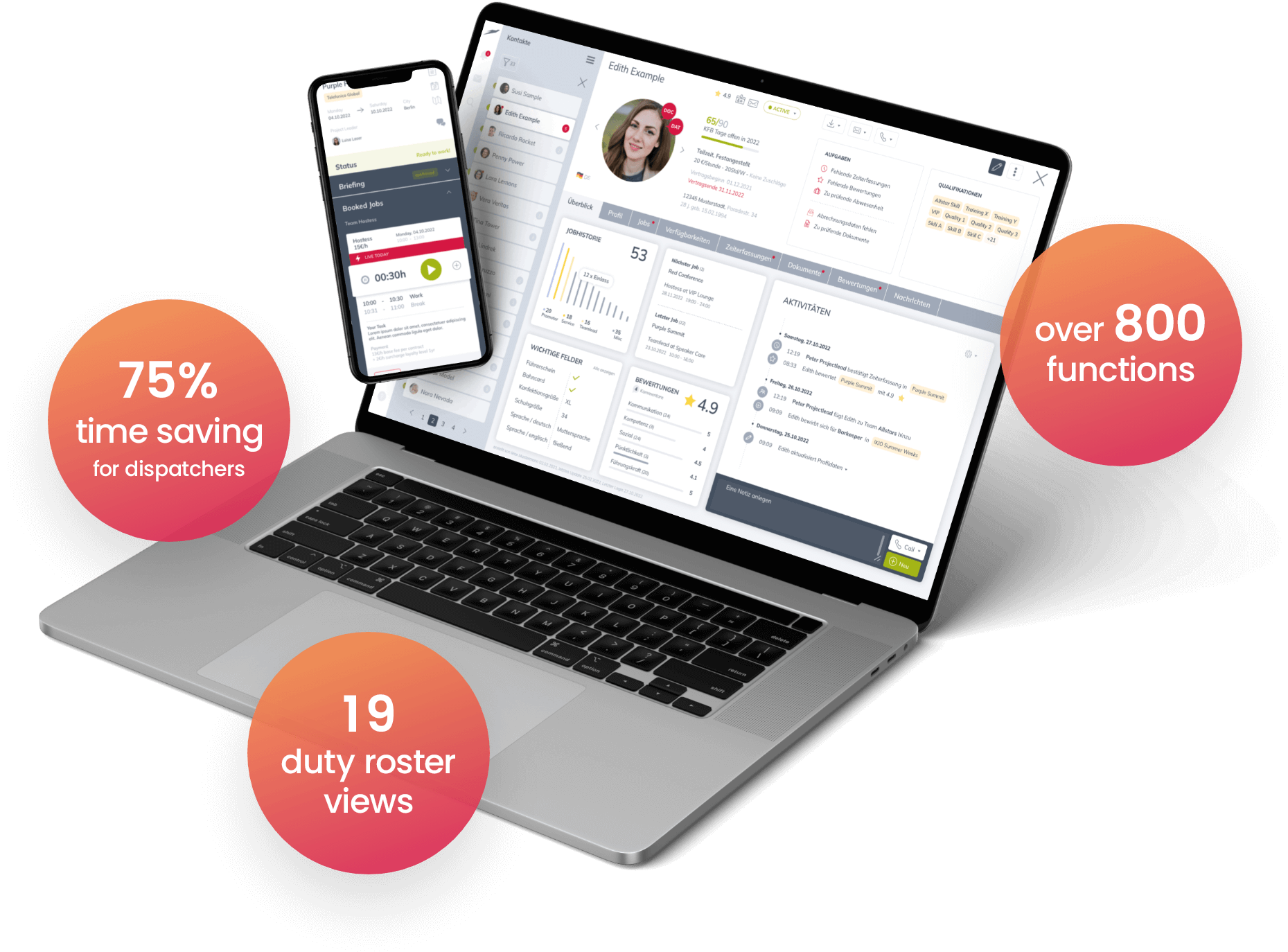
A deployment and personnel planning software such as Teamhero helps to correctly record employee data, such as working hours and absences, outstanding vacation days or unpaid overtime. In this way, the departure of an employee can be prepared for without a forgotten remaining vacation entitlement or an unpaid public holiday allowance causing additional displeasure. Last but not least, a digital employee database provides insight into all contract data at any time and from anywhere, for example approved vacation absences or information on all starting, ongoing and terminated employment relationships.
Disclaimer
Please note that the texts on this website and the related contributions are provided for general informational purposes only and do not constitute tax or legal advice in the proper sense. For individual cases, we always recommend seeking specific legal advice tailored to the circumstances of the situation. The information is provided to the best of our knowledge and belief, without any guarantee of accuracy, completeness, or validity.