


What are the tasks of the HR department?
In many people’s minds, the HR department still has the outdated image of a purely administrative body. However, this view falls dramatically short in today’s business world. The tasks of the HR department are more far-reaching than ever.
Human resources (HR) management has long been a success factor, particularly for personnel-intensive companies whose success depends directly on the quality and availability of their employees. Industries such as security services, catering, events and chauffeur services are under enormous pressure.
The HR department provides support in various ways.
Human resources department: Definition
The HR department, also known as Human Resources, is the central organizational unit responsible for all tasks relating to the most important resource: employees.
Their area of responsibility covers the entire employee lifecycle. The cycle can be divided into phases:
Recruiting attracts new talent, onboarding ensures their smooth integration, ongoing support and development promotes their growth and retention, and offboarding ensures an appreciative and professional departure.
In its modern form, the HR department acts as an interface between company management, executives and the entire workforce.
Structure of a personnel department
Small and medium-sized companies in particular often have very lean human resources structures. Often a few people are responsible for the entire employee cycle. This underlines the need for an integrated all-in-one software solution. A powerful tool that bundles all core functions is the basic prerequisite for both small and large teams to be able to manage their diverse tasks efficiently and without constant overload.

Typical tasks of the HR department
The spectrum of the HR department is broad and has expanded considerably in recent years. It can be divided into several interlinked core areas, which together make up the success of HR management.
Recruitment: The constant race for the right talent
The basis of all successful HR work is forward-looking planning and procurement. For personnel-intensive industries, this is a continuous, high-volume business.
A slow recruiting process leads directly to understaffed projects, overburdened core teams and, in the worst case, to quality deficiencies that annoy customers and jeopardize follow-up orders.
Applicant management, as offered by Teamhero, enables the rapid processing of many applications, filtering according to necessary qualifications – such as the security certificate §34a in security services – and the creation of a qualified talent pool for future inquiries.
Staff scheduling: mastering the daily puzzle with confidence
Staff scheduling is the biggest daily hurdle for many companies. When scheduling employees, manual planning using Excel spreadsheets not only harbors the risk of double bookings.
The potential compliance violations are much more serious: If a person is inadvertently deployed without the required qualifications or the mandatory rest periods under the Working Hours Act (ArbZG) are disregarded, there is a risk of legal consequences.
Imagine a dispatcher at a security service provider on a Friday afternoon. A major customer reports a need for 20 additional security guards for the weekend at short notice. At the same time, three scheduled employees call in sick and five others have not yet confirmed their shifts. The dispatcher juggles several Excel lists, countless emails and a constantly ringing phone to ensure that all positions are filled with qualified personnel. The consequences of this chaos are: Stressed-out schedulers, frustrated employees who are contacted on their own time, and the high risk of shifts going unfilled, which can lead to contractual penalties or the loss of the customer.
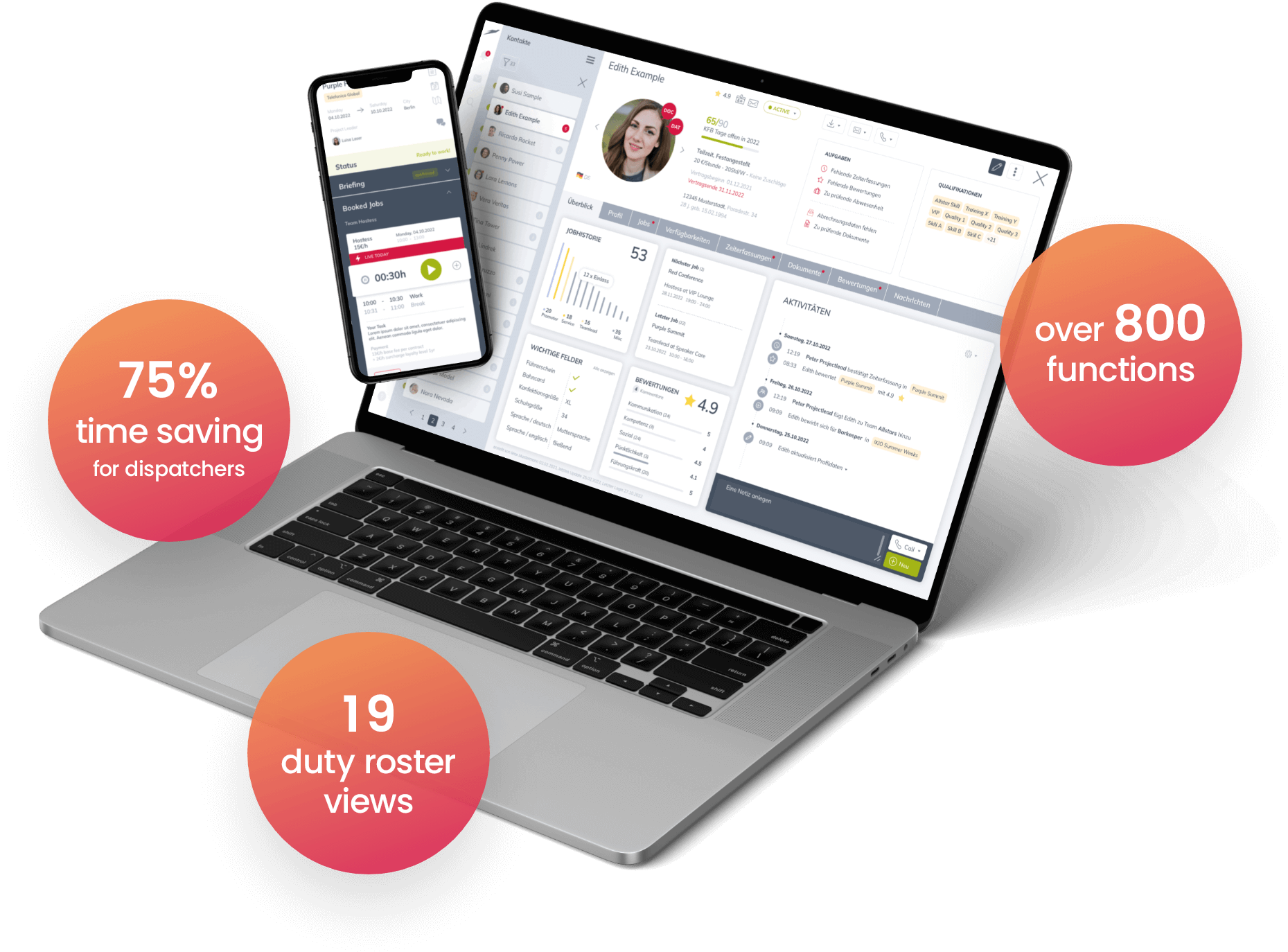
Teamhero addresses this complexity with visual deployment planning, automatic conflict alerts and real-time updates. Features such as geolocalization to verify presence on site offer significant added value, especially for field services.
Personnel administration and payroll accounting
Personnel administration includes the creation of contracts, the management of digital personnel files, the processing of vacation and sick leave and the preparation of payroll accounting. Managing documents such as employment contracts and certificates can be a challenge, especially with high staff turnover.
Automating these processes frees up valuable resources. Digital personnel files in Teamhero provide an overview, while mobile time recording increases the accuracy of payroll data and speeds up payroll processes.
Employee retention and development: promoting and retaining talent
Employees who feel valued remain loyal to a company for longer. This feeling is not only created through praise, but above all through functioning and fair processes. Transparent planning and punctual payroll accounting are fundamental elements of appreciation.
The feeling of being just a number in a confusing list is one of the biggest drivers of resignation. An employee portal that allows employees to enter their availability independently helps by promoting autonomy. An integrated evaluation system also enables fair feedback and shows development prospects, which strengthens loyalty.
Personnel controlling: data-based decisions
Many companies still manage their HR processes based on gut feeling. Modern HR management uses data-based HR controlling to evaluate the effectiveness of measures.
Relevant key performance indicators (KPIs) such as the fluctuation rate or the time it takes to fill a position are systematically recorded and analyzed in order to turn pure data into actionable insights and make well-founded strategic decisions.
What role does the HR department play?
While the costs of HR administration were traditionally visible, the contributions to value creation often remained hidden. Today, it is clear that in a service-based economy, the skills and commitment of the HR department directly determine the quality of the service and therefore the profitability of the company.
The biggest strategic task of the HR department in personnel-intensive industries is to stop a dangerous downward spiral.
- Inefficient planning leads to frustration:
Employees whose schedules are chaotic and at short notice, who are constantly contacted on days off or whose overtime is not recorded correctly do not feel valued. They are stressed, dissatisfied and more likely to resign.
- High staff turnover exacerbates the planning chaos:
Every departure leaves a gap. The HR department and schedulers have to find replacements under time pressure. New, inexperienced staff are often hired, who require more intensive training and further increase the complexity of planning. The remaining staff are put under additional strain, which in turn increases dissatisfaction.
This cycle is costly and undermines the overall operational stability of the company.
The true cost of staff turnover: more than just a key figure
The costs for a replacement are immense, but the pure figures only represent the tip of the iceberg. To understand the urgency, you have to look at the concrete effects:
- Direct costs:
These are the obvious expenses that are incurred immediately. These include severance payments, costs for job advertisements on job portals, fees for recruitment agencies and the considerable administrative effort involved in preparing resignation documents and certificates.
- Indirect costs:
This is where the far greater, often invisible damage lies, which has a lasting impact on profitability:
- Valuable loss of knowledge:
The departing employee knew the specific security protocols of a key customer or the exact procedures of a recurring event. This implicit knowledge is lost with the departure and has to be painstakingly rebuilt.
- Loss of productivity:
It takes weeks or months for a new employee to reach the efficiency of an experienced colleague. During this time, shifts may have to be filled twice, or tasks may take longer and eat up the project’s margin.
- Declining morale in the team:
The remaining team members have to absorb the extra work, which leads to overwork, stress and resentment. When they see colleagues leaving the company, they start to think about a change themselves. High turnover can be contagious.
- Potential loss of quality for the customer:
This is the most dangerous consequence. A new, stressed security guard may be less attentive. An overworked catering team may appear less friendly. The risk of service failures leading to customer complaints, reputational damage and loss of business increases significantly with each departure.
HR department: an important backbone for companies
A digitalized and strategically aligned HR department can break this vicious circle and become the strong backbone of the company. A comprehensive software solution is the decisive tool here.
The tool for a strong backbone: a central software solution
Teamhero acts as a “single source of truth” and replaces the fragmented chaos of Excel lists, email histories and memos with a central, standardized platform. All relevant information is bundled in one place.
Thilo Schüle, Head of Human Resources at WildparkTaste Stadion-Catering, sums it up: “In Teamhero, everything is simply in one central location. The days of Excel files are finally over.”
How Teamhero strengthens your human resources processes
The platform digitally maps the entire HR process and delivers targeted solutions:
- For recruiting:
An accelerated process from application receipt to contract signing that ensures no talent falls through the cracks.
- For resource planning:
A visual and interactive planning tool with intelligent filters and automatic conflict checking that minimizes compliance risks.
- For time recording & payroll accounting:
Mobile, digital recording that prevents manipulation and guarantees smooth data export to payroll systems.
Creating scope for strategic work
Ultimately, it is the “human” factors that determine employee loyalty. Teamhero promotes them through greater transparency and fairness. The employee portal gives employees control over their data and availability. Integrated communication tools ensure that all team members are always informed.
Your HR department as the driving force behind your company’s success
The difference between successful and failing companies often lies in the efficiency of their HR processes. While inefficient human resources structures lead to a costly downward spiral of chaos, fluctuation and loss of quality, well thought-out systems enable a positive dynamic: satisfied employees remain loyal to the company, planning processes become more stable and the quality of service increases continuously.
Teamhero offers you an integrated all-in-one solution that transforms your HR processes from the ground up. From automated applicant management to intelligent resource planning and mobile time recording. Experience how digital excellence can revolutionize your HR work.