


Guide to GDPR-compliant employee data
This guide provides an overview and practical tips for GDPR-compliant management of employee data and gives recommendations for its implementation in day-to-day business.
After all, employee data is the be-all and end-all in the busy day-to-day running of a company with a large workforce. But mistakes in complying with the General Data Protection Regulation (GDPR) can be costly and can also shake the trust of employees and customers.
Understanding employee data:
What is included and what is permitted?
The term employee data refers to all information that relates to an identifiable person in the context of the employment relationship and that is collected by a company: Beginning with the application through to leaving the company.
Think of contact and contract data, wage and salary information, time recording data, qualification certificates and much more. The sheer volume and variety of this data in personnel-intensive industries make structured administration an absolute necessity.
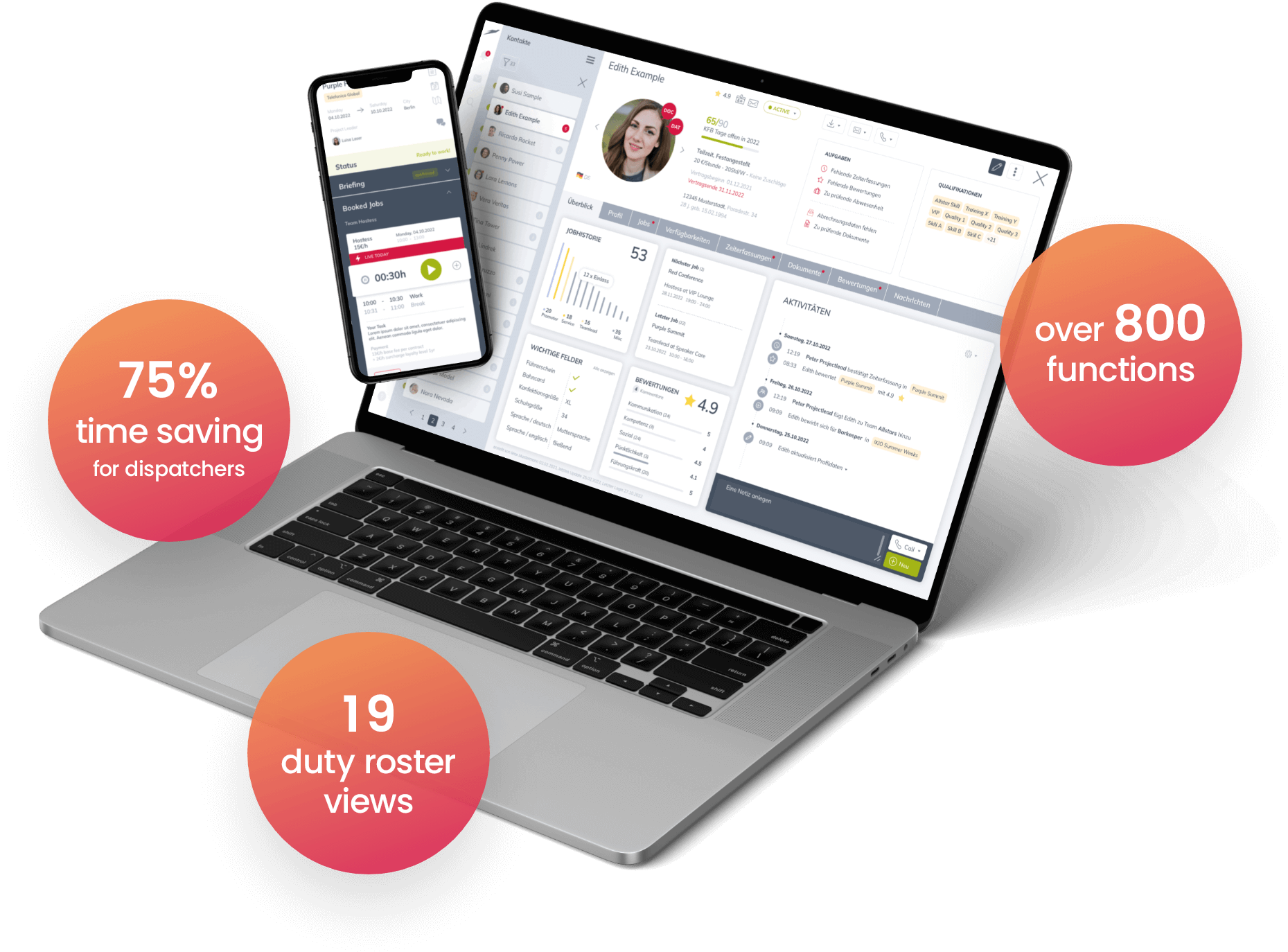
A centralized employee databaseas offered by modern HR software such as Teamhero, helps to manage master data, qualifications and even individual fields clearly and to maintain an overview.
Examples of employee data:
- Personal master data (name, address, date of birth, gender, nationality)
- Contact details (private telephone number, e-mail address)
- Contract data (start date, position/job title, department, contract type, notice periods)
- Bank details (IBAN, BIC for salary payments)
- Social security data (social security number, health insurance company)
- Tax data (tax identification number, tax class, religious denomination, child allowances)
- Working time data (recorded working hours, overtime, vacation requests/days, sick days)
- Remuneration data (salary/wage, allowances, bonuses, salary development)
- Qualification data (proof of education, certificates, further training, language skills, driver’s license)
- Performance and behavioral data (employee appraisals, target agreements, warnings)
- Organizational data (personnel number, cost centre, access authorizations)
- Data on company pension schemes
- Photos/videos (e.g. for employee ID cards, intranet, website – often subject to consent)
- Application documents (CV, certificates from the application phase)

The basis:
When you may (and must) collect data
A lot of data is simply necessary in order to be able to carry out an employment relationship at all. Without your name, address, bank details or social security number, you can neither pay your salary nor report to the authorities. The General Data Protection Regulation and the Federal Data Protection Act (BDSG) permit the processing of this required employee data (§ 26 BDSG).
Nevertheless, always check critically: Is this information really necessary for the purpose (e.g. contract fulfillment, legal obligation)? This principle of necessity and data minimization is your first touchstone.
Special care with sensitive data
Certain categories of employee data enjoy special protection in accordance with Art. 9 GDPRas they encroach deeply on privacy. This includes health data, religious affiliation or trade union membership. Their processing is generally prohibited unless a clear exception applies.
Particularly in personnel-intensive sectors such as event organization, care or the security industry, health data or specific proof of suitability (e.g. certificates, certificate of good conduct) may well be relevant in order to meet legal requirements or ensure suitability for certain assignments. This makes strict purpose limitation all the more important: This data may only be used for the clearly defined, legitimate purpose.
Strict access protection is also a prerequisite: make sure that only absolutely authorized persons can view this sensitive information.
When consent is required
If the data processing goes beyond what is necessary, you need the express consent of your employees. Typical cases include the publication of employee photos on the website or the use of data for purposes that are not directly work-related.
For such consent to be effective, it must be voluntary, informed (about the purpose, right of withdrawal, etc.) and ideally verifiable in writing or electronically. In the employment relationship, voluntariness must be examined particularly critically.
The practical challenge often lies in managing consents (e.g. for photos at events, data transfer to customers for sedcards) in an audit-proof manner, especially with a large number of employees, who may also change frequently.
Digital tools such as Teamhero help here by means of clear document storage modulesto centrally track the status of each consent and important documents such as enrollment certificates and store the documents directly in the digital personnel file.
Legal basis:
The foundation of your compliance
In addition to the central German standard for employee data, Section 26 BDSG, you must always keep an eye on the basic principles of the GDPR (Art. 5) regarding the management of employee data in the context of data protection in the workplace:
- Purpose limitation: Use data only for the purpose for which it was collected.
- Data minimization: Only collect and store as much data as is really necessary.
- Accuracy: Keep data up to date and correct.
- Storage limitation: Delete data when it is no longer required and there are no retention periods to the contrary.
- Integrity and confidentiality: Actively protect data through appropriate technical and organizational measures (TOMs).
The obligation to provide active protection is not an option. Systems such as Teamhero, which Data security in the focus of your software make compliance with the guidelines much easier.
Specifically, Teamhero relies on various measures for the data protection of employee data: Your data is hosted exclusively in a multi-certified (including ISO 27001), redundant high-security data center in Germany. In addition, all access to the system and data transfer is consistently SSL-encrypted, while daily, automated backups on redundant storage systems additionally safeguard the integrity and availability of your data.
Practical implementation:
Data protection in the workplace
Legal knowledge must be translated into practice. To do this, implement a robust security concept. This includes technical precautions (encryption, secure software) and organizational rules (access restrictions). Also think about physical security: locked filing cabinets and secure offices are still relevant.
You should also keep the legally required register of processing activities (VVT). It is your central proof of compliance and must always be kept up to date – consider it a living document that is adapted as soon as new processes start.
Tools such as Teamhero, which offer a central employee database, can support the maintenance of the VVT, as much of the necessary information (data categories, purposes, deletion periods) is stored there in a structured manner.
Focus: Data protection in applicant management
Applicant management is a data protection hotspot, especially in personnel-intensive industries. Pay attention to data minimization and only ask for what is necessary. Inform applicants transparently about data processing.
If you would like to include candidates in a talent pool, you need separate, voluntary consent. Very important: Delete the data of rejected applicants promptly, usually after 6 months at the latest (due to AGG deadlines), unless consent has been given for longer storage.
Clean data management right from the start, supported by functions for applicant managementas offered by good personnel management software is an enormous help here.
Sensitize employees
The human factor always plays a role. Train your employees regularly on the basics of data protection in the workplace, internal guidelines and current threats such as phishing. A sensitized workforce is your best protection against unintentional errors.
Data Protection Officer (DPO)
Check whether you need to appoint a DPO (in Germany often from 20 persons who constantly process data automatically). The DPO advises and monitors independently and is an important point of contact.
Taking employee rights seriously:
Information, deletion & co
Data protection under the GDPR strengthens the rights of your employees with regard to employee data.
Your employees therefore have the right to information about the employee data stored about them (what, why, for how long, who has access?). They can request information, and often also a copy of their data ( Art. 15 para. 3 GDPR ). You can also request the correction of incorrect data and, under certain conditions, the deletion (“right to be forgotten”). This also includes the right to restrict processing or to object.
Establish clear processes to process requests correctly and on time (usually 1 month). Define responsibilities and document everything.
Data life cycle:
Storage and secure deletion
Data must not be stored forever and at the same time there are legal obligations to retain it.
Before you delete data, therefore, check statutory retention periods, e.g. from tax law (often 6 or 10 years for payroll documents). These have priority, but the data must be deleted once the deadline has expired.
Systematic deletion with a concept
Develop a written deletion concept that specifies when which data categories are deleted and how. This is often a cross-departmental task (HR, IT, legal). A good concept prevents data cemeteries and reduces risks.
If possible, use the support of modern HR software such as Teamhero, which offers functions for managing document validity and can remind you when certificates expire or deletion deadlines are due, e.g. through automatic requests to employees for renewed documents.
Data breaches:
Act quickly and correctly
Despite all caution, things can go wrong. A data breach requires quick, structured action.
Evaluate every security breach immediately: Is there likely to be a risk for those affected? If so, you must inform the supervisory authority within 72 hours if possible. Define internal reporting channels and perhaps even practise the emergency plan once so that you know what to do in an emergency.
If there is even a high risk for those affected, you must also inform them immediately.
Conclusion:
Seeing data protection in the workplace as an opportunity
GDPR-compliant management of employee data is a sign of professionalism and appreciation. A proactive approach protects against fines and reputational damage.
Modern HR management software such as Teamhero is a valuable partner here. It helps you to manage the variety of employee data centrally and securely, clearly control access authorizations and manage documents such as contracts, certificates or consents digitally and in an audit-proof manner, including automatic reminders when they expire.
Teamhero also supports you in standardizing processes from recruitment, planning and time recording through to billing and makes it easier to meet compliance requirements such as deletion deadlines. This not only gives you legal certainty, but also valuable time for the essentials: Your employees and your core business.
Ready for worry-free management of your employee data?
Get in touch now!
Disclaimer
Please note that the texts on this website and the related contributions are provided for general informational purposes only and do not constitute tax or legal advice in the proper sense. For individual cases, we always recommend seeking specific legal advice tailored to the circumstances of the situation. The information is provided to the best of our knowledge and belief, without any guarantee of accuracy, completeness, or validity.