


Social media recruiting: Recruiting via social media
The way we communicate, inform and interact has changed fundamentally in recent years. Social media have long since become established, powerful platforms for companies, especially in the field of recruitment.
It is particularly important for companies with high personnel requirements to recognize and exploit the opportunities offered by social media recruiting.
How does this work and what advantages does it bring? Read more about the world of recruiting through social networks.

What is social media recruiting?
Social media recruiting (sometimes also called social recruiting, although there are subtle differences here) refers to the use of social networks such as LinkedIn, Xing, Facebook, Instagram, Twitter (X), TikTok and even industry-specific forums for recruitment.
It comprises a whole range of measures:
- Active candidate search (active sourcing)
The targeted identification and direct approach of potential candidates on the platforms. - Dissemination of job advertisements
Use the reach of social networks to publicize open positions, either organically or via paid campaigns. - Employer branding
Building and maintaining an attractive employer brand by providing authentic insights into the corporate culture, introducing employees and sharing success stories. - Network development and communication
Interaction with potential applicants, development of talent pools and establishment of a direct communication channel.
The channels that were originally discovered by marketing to reach target groups are now being used strategically by recruiters. Many companies even maintain their own career profiles on the relevant platforms in order to place their recruiting messages in a targeted manner.
Why social media recruiting is a permanent fixture in modern companies
The figures speak for themselves: the majority of potential candidates, especially younger generations, are regularly active on social media. According to a YouGov survey (2024), 64% of 18 to 24-year-olds spend more than six hours a week on social media. They use the platforms for entertainment as well as to search for information.
If you are not present here, you are missing a huge opportunity, reach talented people
The advantages of social media recruiting: Why it pays off
The decision to invest resources in recruiting via social media brings with it a number of tangible benefits that traditional methods often cannot offer:
Reach passive candidates
One of the biggest advantages is the opportunity to also approach passive candidates. These are professionals who are currently not actively looking for a new job and therefore avoid traditional job boards. On social media, you can make these talents aware of your company and arouse their interest through targeted content or a direct approach.
Strengthen your employer brand (employer branding)
Social networks are ideal platforms for presenting your company as an attractive employer. Authentic insights into everyday working life, introductions to team members, reports on company events or an emphasis on your corporate culture help to build a positive image and set you apart from the competition. A strong employer brand attracts applicants and at the same time promotes employee loyalty.
Direct communication and network development
Social media enables fast, uncomplicated and often more personal communication with potential applicants. Questions can be answered directly, dialogs can be started and relationships can be built. Over time, you can build up a valuable network of contacts that you can fall back on when you need staff in the future.
Target group-specific approach through data
The platforms provide extensive data about their users (within the framework of data protection, of course). This information allows you to define your target groups very precisely and tailor your recruiting measures to suit them. You can minimize wastage and address exactly the right candidates through targeted advertisements or filtering in the active search.
Potential cost efficiency
Even though social media recruiting is not always free, it can be more cost-efficient compared to some traditional channels. Organic reach is essentially free and paid campaigns can often be controlled with precise budgets and target group settings (e.g. cost-per-click models). This can potentially lead to lower costs per setting.
What you need to consider when recruiting on social media (challenges and disadvantages)
Despite the many advantages, social media recruiting is not a sure-fire success. There are hurdles and potential disadvantages that you should take into account in your strategy:
Time expenditure and resource commitment
Successful social media recruiting requires continuity and commitment. Regularly creating content, maintaining profiles, interacting with the community, replying to comments, processing inquiries: All of this takes time and resources. You should plan this effort realistically.
Choosing the right platform(s)
There are a variety of social networks. Not every platform is equally suitable for every target group or every company. Wanting to be present on all channels at the same time can quickly lead to a lack of attention. A precise analysis of where your ideal candidates are located is the basis for success.
Communication traps and reputational risks
Communication on social media is fast, public and direct. An inappropriate tone, misleading wording or a clumsy response to criticism can quickly provoke negative reactions and, in the worst case, damage your employer image. Sensitivity and clear communication guidelines are a must.
Data protection as a stumbling block
Data protection (GDPR) is a complex and sensitive issue, especially when collecting and processing user data for recruiting purposes. Make sure that your practices are compliant, especially when approaching applicants directly or using applicant data.
Addressing people in a private setting: sensitivity required
On most social media platforms (with the exception of pure business networks such as LinkedIn or Xing), users are primarily on the move privately. An overly brash or impersonal approach with job offers can quickly be perceived as annoying and be met with rejection. Authenticity and an appropriate, respectful tone are crucial.
Social media recruiting: strategies for digital success
To maximize the opportunities and minimize the risks, you need a clear strategy. Here are proven approaches for your recruiting via social media:
Active sourcing: Targeted candidate approach
Use the search and filter functions of the networks (especially LinkedIn and Xing) to proactively identify suitable candidates. Then approach them individually and personally. A well-researched message tailored to the profile is far more promising than mass emails. An experienced social media recruiter has mastered this art.
Employer branding: show who you are
Use your company profile as a showcase for your employer brand. Post authentic content on a regular basis: Employee interviews, insights into projects, events, benefits, development opportunities. Show potential applicants why it’s worth working for you.
Content marketing: creating valuable content
Offer your target group added value beyond just job advertisements. Share useful tips (e.g. on how to apply), industry insights, interesting articles or invite them to webinars. Position yourself as an expert and create incentives for interaction.
Recruiting campaigns and paid ads: increase reach in a targeted manner
Use paid ads on platforms such as Facebook, Instagram or LinkedIn to target your job ads or employer branding content to your desired target group. The targeting options are often very precise and allow for efficient budget utilization.
Use employee recommendations and corporate influencers
Your own employees are your most credible ambassadors. Encourage them to share open positions in their networks (employee-recruit-employee programs). Some companies also specifically rely on “corporate influencers” – employees who actively report on their work on social media and thus authentically convey the corporate culture.
The most important channels for your recruiting via social media
The choice of the right channels depends heavily on your target group and your recruiting goals. Here is an overview of the most relevant platforms:
Business networks: LinkedIn and Xing
- LinkedIn: The largest global business network. Ideal for active sourcing, employer branding for specialists and managers, placing job advertisements and networking on a professional level. Offers detailed filters for candidate searches. Maintain company and personal profiles. Interact actively and personalize approaches.
- Xing: Focused on the D-A-CH market. Similar functions to LinkedIn, often strong in certain industries or with medium-sized companies. Good for targeting local talent. Combine job ads with network marketing and use it for employer branding and employee recruitment campaigns.
The giants: Facebook and Instagram
- Facebook: Huge user numbers despite private focus. Good for employer branding through visual insights (photos, videos, stories), community building and targeted advertising campaigns. Important: Quick response to comments, regular posts with images/videos.
- Instagram: Particularly popular with younger target groups. Perfect for visual employer branding with authentic photos/videos (reels, stories). Pay attention to corporate design, use suitable hashtags and recurring post categories. Pay attention to data protection for employee photos!
Video power: YouTube
Ideal for employer branding videos (company presentations, testimonials, “Day in the Life”). Authenticity is key. Pay attention to professional production and good conception. Paid advertising clips before other videos are possible.
Short and sweet: X
Although the user base in Germany is smaller, useful for addressing multipliers (influencers, journalists), for participating in industry discussions and for short job updates. Tweets are limited to 280 characters. Use current hashtags, images and links.
The young generation: TikTok
The fastest growing platform, especially among Gen Z. Requires creative, short videos that pick up on trends. Ideal for addressing trainees and young talent. The courage to be authentic is required.
Important: You don’t have to be everywhere! Analyze where your target group is really active and which platforms are best suited to your content and goals. It is better to start with one or two channels and build them up consistently before you get bogged down.
3 steps to successful social media recruiting
The following structured approach helps to maintain an overview and make success measurable:
Step 1: Planning and strategy development
- Analysis: Target groups? Need? Active channels? Competition? Resources (time, budget, personnel)?
- Set goals: Define concrete goals (e.g. increase the number of qualified applications via channel X by Y% in Q3).
- Content strategy and editorial plan: What content, when, where? Who is responsible? Plan topics (career tips, stories, insights, jobs, etc.).
Step 2: Implementation and presence setup
- Create/optimize profiles: Set up professional profiles (branding, information, visuals). If necessary, separate career profiles.
- Content creation and publication: Produce content (authentic, channel-specific) and post regularly. Link channels.
- Interaction and community management: react promptly, promote dialog, actively build a network. Coordination with marketing.
Step 3: Control and optimization
- Measuring success: Monitor KPIs (reach, interaction, CTR, applications/channel, quality, followers).
- Use analysis tools: Use platform dashboards (Insights, Analytics) and web analytics (Google Analytics). Where do the best candidates come from?
- Adaptation: Optimize strategy based on data. Adjust content, formats, channels and budgets.
7 tips for successful recruiting via social media
To help you get started or optimize your recruiting social media, here are some practical tips:
- Communicate personally and authentically:
Avoid stiff phrases. Be approachable, use clear language (depending on the target group, use “you”) and show genuine insights. - First impressions count:
Make sure you have a professional design with high-quality images and videos. - Get inspired and be creative:
Observe other companies and try out new formats. - Use expertise:
Do not underestimate the effort involved. If necessary, get support internally or from a social recruiting agency. - Define clear roles and rights:
Define responsibilities. - Keep approval processes lean:
Enable fast reactions through efficient processes. - Think mobile first:
Optimize all content and processes for mobile devices.
What does social media recruiting cost?
Organic posts are free, but paid ads (job ads, sponsored posts) are often necessary for significant reach. The costs vary here.
The biggest cost factor is usually the working time for strategy, content, community management and analysis. Costs may also be incurred for service providers (e.g. social recruiting agency), freelancers or special tools.
Consider the costs in relation to the benefits. Faster staffing, better candidate quality – the investment can be worthwhile.
How Teamhero simplifies your social media recruiting
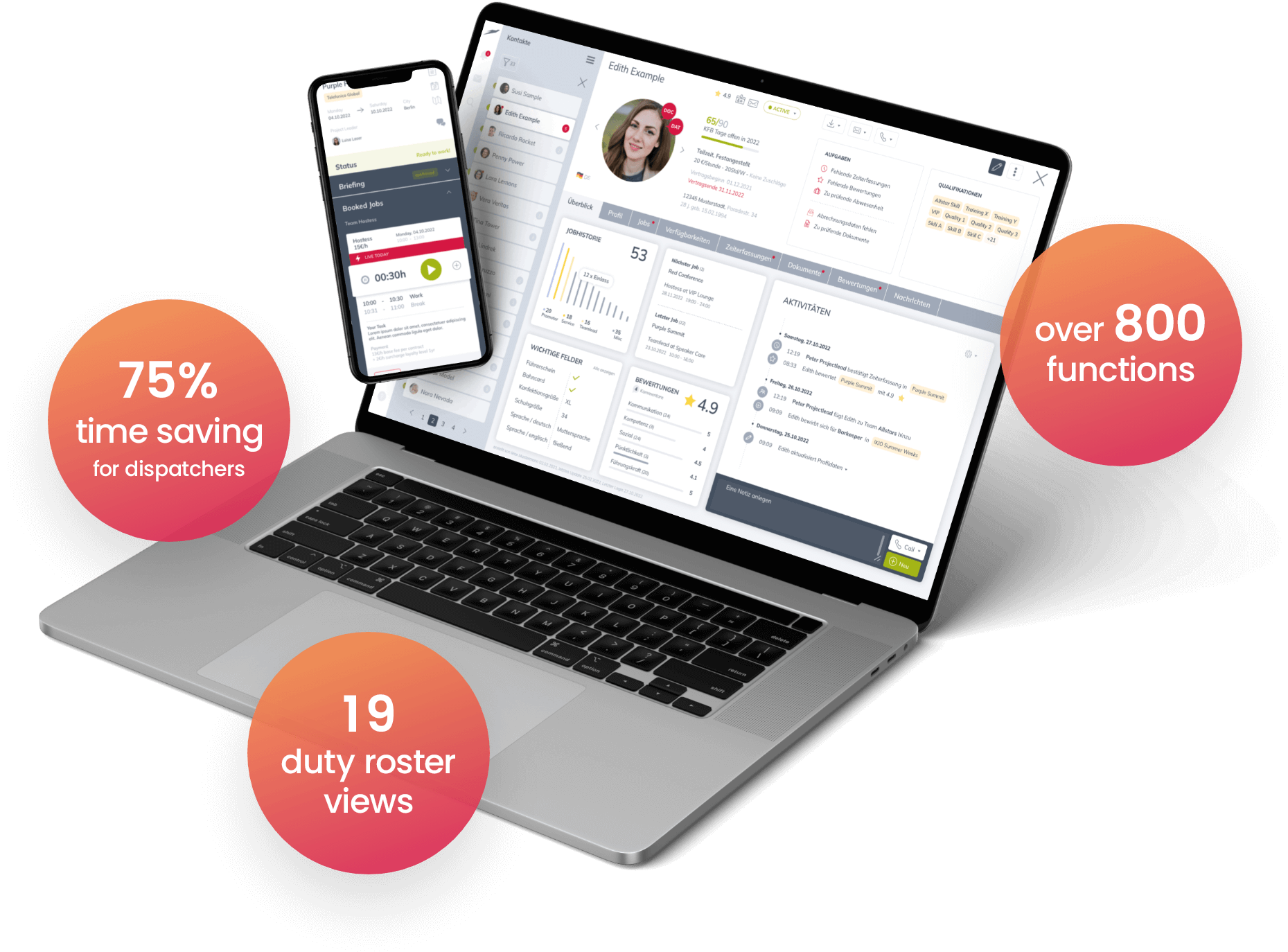
Managing the many activities in social media recruiting can quickly become complex. This is exactly where we help with our Teamhero personnel management softwareand make your life easier. In keeping with our motto: save time for the really important tasks.
Central applicant management: everything in one place
Imagine applications from various social media channels converging automatically and centrally in one system. With the Teamhero applicant module, you can control your entire Applicant management from a single source. Put an end to the chaos of emails, messages and spreadsheets!
Focus on the essentials: Saving time for people
By automating and simplifying many administrative tasks in the recruitment process and personnel administration, Teamhero saves you valuable time. Time that you can use to focus on what really matters in recruiting: building relationships, conducting good interviews and selecting the best talent for your company.
Conclusion: Social media recruiting – a strategic advantage
Social media recruiting is a strategic necessity for companies that want to compete for talent. It offers unique opportunities to reach passive candidates, strengthen the employer brand and make direct contact with potential employees.
Yes, it requires a well thought-out strategy, resources and continuous commitment. But the benefits far outweigh the difficulties.
If you would like to make your recruiting via social media more efficient and successful, we would be happy to tell you how Teamhero can support you. Let’s work together to ensure that you reach the best employees.