


Employee referrals: Employees recruit employees
Suitable employees are hard to find these days and even harder to retain. Companies are faced with the challenge of recruiting suitable specialists without incurring astronomically high costs for headhunters and elaborate recruiting campaigns. A tried and tested principle can help here: word of mouth.
Employee referral programs use the potential of the existing workforce to attract new talent. Large companies such as Deutsche Bahn, Siemens and Targobank have long recognized and successfully implemented the benefits of “employees recruit employees” programmes.
Utilize the potential of your employees and turn them into ambassadors for your company.
Employees recruit employees: Word of mouth as a recruiting tool
Employee referral programs are an increasingly popular method for companies to attract new talent. The concept is simple: existing employees recommend people from their personal environment for open positions in the company. If a referred person is hired, the employee often receives a bonus or perk.
Employee acquisition through word of mouth has many advantages for employers. Candidates have already been pre-selected, training can take place more quickly and the risk of a bad hire is often lower, as the recommending employees can usually assess the skills and personality of their acquaintances well. But there are a number of other advantages to employee referrals.

What are the advantages of employee recruitment models?
Cost-effective and efficient personnel recruitment
Employee referral programs are generally more cost-effective for employers than hiring external recruitment agencies or headhunters. The pre-selection of candidates is based on employee recommendations, which reduces the effort and cost of screening applications.
Better “cultural fit” of applicants
Referrals strengthen the sense of community within the workforce. When employees bring their friends and acquaintances into the company, this improves the working atmosphere and promotes a positive working environment.
Since employees often know people with similar skills, values and personalities, there is a high probability that recommended candidates will fit in well with the corporate culture. This often shortens the induction period and increases the chances of a long-term, successful collaboration.
Employee recommendation strengthens employee loyalty
The opportunity to participate in the HR marketing process can increase engagement and retention. retention strengthen the relationship between employees and their employers. They feel valued and team cohesion can benefit if new colleagues already have contacts in the company.
Positive effects on employer branding
Successful employee referrals improve a company’s image. Recommendations from trustworthy people in the community are generally more credible than traditional marketing measures.
Access to passive candidates
Employee referral models also allow companies to reach candidates who are not actively looking for a job. These so-called passive candidates
can be motivated to consider a change of job by means of personal speeches and the authentic presentation of the workplace by their acquaintances.
Developing an employee referral program: how it works
Setting goals and creating framework conditions
In order to set up a successful employee referral programme, the organizational prerequisites must first be created.
Before companies introduce employee referrals, they should define clear objectives. Which positions should be filled by referrals? Which departments will benefit the most? Clear goals help to measure the success of the program later and make any necessary adjustments.
If your applicant management runs on digital channels, employees can easily be informed about new job vacancies, e.g. by email or via an online platform. This allows them to share job offers in their networks with just a few clicks.
Transparent communication and rules of the game
Employees recruit employees only works if all employees
are informed about it and know the rules of the game. Explain how the program works: How can recommendations be made? What rewards are available and when are they paid out? This information should be easily accessible and understandable.
Create incentives
Determine in advance which employees are allowed to make recommendations, for which positions the program applies and what rewards are available.
These can be financial bonuses, additional vacation days, free further training or non-cash rewards such as vouchers. Companies must decide whether a fixed amount or a pro rata bonus is more appropriate and when the reward is paid out – whether immediately on recruitment or after the end of the probationary period.
It is important that the incentives motivate employees to make high-quality recommendations. Immediate financial bonuses can be motivating in the short term, but can often lead to random referrals of acquaintances.
Define success factors and KPIs
Define suitable key performance indicators (KPIs) that you can use to measure the success of your program. Examples include the number of referrals, new hires through referrals or how long referred employees stay with the company. Adjust your strategy regularly based on the results.
Training and support for employees
Employees should be trained and informed about the program at regular intervals. This can be implemented through workshops, training sessions or information events. Managers should also actively encourage their teams to make recommendations and support them in identifying suitable candidates.
Digital support and integration
A digital employee referral program makes it easier to manage and track referrals. Use HR management software such as Teamhero to simplify the process. Such platforms not only facilitate the recruitment process, but also automate the notification of employees about new vacancies and make it easy to share job advertisements via social networks.
Feedback and monitoring
Not every recommendation leads to a hire. It’s important to give employees the best possible advice.
Provide feedback on why certain candidates were not selected. This prevents frustration and continues to motivate high-quality recommendations. In addition, the program should be regularly reviewed and improved based on the experience gained and feedback from the workforce.
How to encourage employee referrals
- Financial rewards: Monetary rewards for successful referrals are an obvious incentive. They can be structured as a fixed sum or a pro rata bonus, e.g. as a percentage of the newly hired person’s annual salary. Financial bonuses often have a very motivating effect, but there is a risk that employees are primarily interested in the payment and make indiscriminate recommendations. In addition, cash bonuses are subject to taxation.
- Non-cash rewards and experiences: Instead of cash, attractive non-cash rewards such as technology devices or travel vouchers can also serve as rewards for employee referrals. Experience offers such as city trips or restaurant visits can specifically strengthen employee motivation and loyalty. However, the value of such rewards is often very individual and not everyone likes the same offer.
- Vacation days: Employees greatly appreciate additional vacation days. These “time off bonuses” are attractive because they add value without having a negative impact on salary. However, such incentives are not equally attractive for all employees, e.g. not for part-time employees or people who already have an above-average number of vacation days.
- Free further training: Free training is an attractive reward for employees who make recommendations. They not only promote motivation, but also the personal and professional development of employees. A major advantage is that the company invests in the qualifications of its workforce at the same time. A disadvantage could be that not all employees are interested in further training or perceive it as an additional workload.
- Status symbols and recognition: Some employees are more motivated by incentives such as public recognition, awards as “Recommender of the Month” or small status symbols such as a special parking space or similar. These intangible rewards are inexpensive to implement and can strengthen the sense of belonging. However, they are also less attractive to many than financial incentives.
- Donations to charitable organizations: Instead of direct bonuses, companies can also offer to make a donation to a charitable organization in the name of the employee making the recommendation. This particularly appeals to employees who are socially committed and value social responsibility. The advantage is the positive impact on the company’s image and the promotion of social commitment. The disadvantage could be that this does not motivate all employees, as there is no direct personal benefit.
- Gamification elements: The integration of gamification elements, such as leaderboards or competitions, can make the “Employees recruit employees” program more exciting. Employees can collect points and challenge each other, which stimulates the competitive spirit. One advantage is the increased participation and fun factor.
- Combined models: The most effective incentive models are usually a combination of different types of bonus. For example, part of the bonus could be paid when the recommended person signs the contract and another after the trial period has been completed. This prevents a pure “money focus”, but still ensures financial and emotional incentives.
Employees recruit employees – Attracting new staff sustainably
Employee referral programs are not just a short-term recruiting measure, but part of a forward-looking personnel strategy. By utilizing the referral network of their own workforce, companies build a solid foundation for long-term employee retention and attractive employer branding.
Recommended new colleagues are motivated, share the company’s values and fit in well with the corporate culture. This reduces staff turnover rates and ensures team success in the long term. It is crucial that employee referral programs are set up systematically and with the right incentive systems.
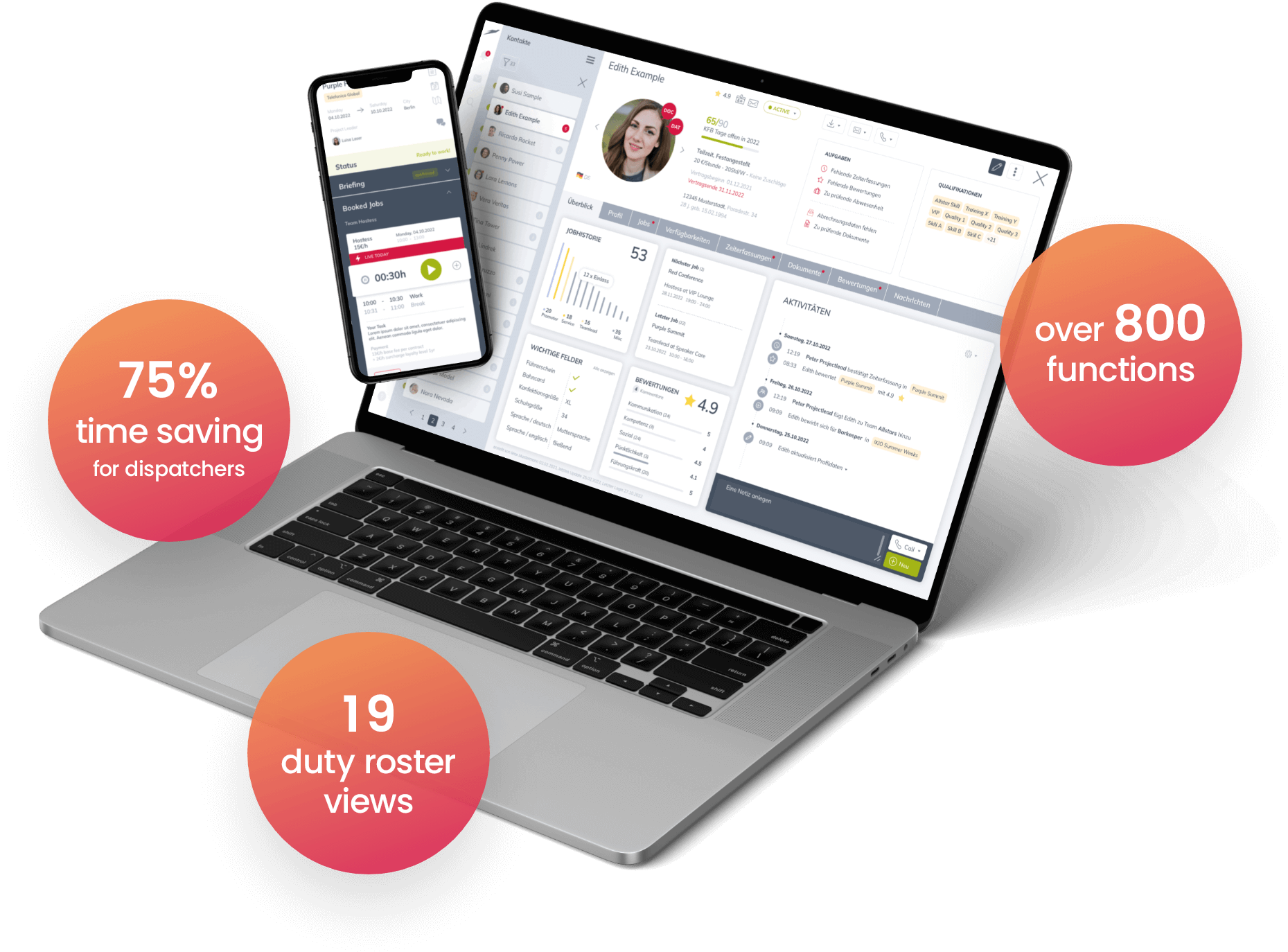
With the all-in-one personnel management software Teamhero, you can make the recruiting process efficient and simple. Teamhero offers a wide range of functions that are specially tailored to the needs of personnel-intensive companies, such as applicant management, personnel planning, employee databases and much more.
Test Teamhero yourself and establish your “employees recruit employees” model stress-free!