


Obligation to record working hours: to whom does it apply?
We will give you the answer to this question in advance: the obligation to record working time applies to all companies and all sectors.
In the following article, however, we would like to take a closer look at how the legal situation on this topic has developed, what options you have as an employer for documenting working hours, whether the good old timesheet still exists or whether electronic time recording systems have already taken over completely, and what needs to be considered with regard to data protection. The fact is that the obligation to record working hours is intended to prevent violations of the Working Hours Act and help to ensure that the requirements for working time protection, i.e. the legally stipulated maximum working hours and rest breaks, are complied with.
Working time recording – what exactly does that mean?
As the name suggests, it is about recording working time. Whether this is done using time sheets, time clocks, time clocks or digital time recording systems is of secondary importance. Working time recording is used to record and document the hours worked by employees so that it can be checked whether all employees are fulfilling their contractually agreed duties. It is also used to properly record overtime and ensure that rest breaks are taken. The start, end and duration of the working day are recorded. The obligation to record working hours is set out in the Working Hours Act (ArbZG) and is used for both monitoring and verification purposes.
But why is it necessary to record working hours at all? The regulation primarily serves to protect employees. In the modern working world, it is becoming increasingly difficult to separate work and private life due to working from home and the possibility of being able to reach anyone at any time. This results in phone calls after work, email correspondence during vacation and unbalanced overtime. To ensure that exceeding the maximum working hours does not become the norm, the Federal Ministry of Labor has addressed the problem and recently presented a revised draft law.
What is the legal situation regarding working time recording?
Both the Working Hours Act and the Occupational Health and Safety Act are in a constant state of flux and are continuously being developed. Experience has shown that this does not happen overnight; a draft law is followed by a phase of coordination – and this can sometimes take some time. Let’s take a look at the path that the obligation to record working hours has taken so far:
Until 2019: Working Hours Act regulates maximum working hours and rest periods
Since 1994, uniform regulations have applied to employment relationships in Germany, which are set out in the Working Hours Act (ArbZG). They define, for example, the maximum permitted working hours and the required rest breaks to protect employees. Until 2019, however, only overtime and work on Sundays or public holidays had to be documented under this law, but not all working hours.
Exceptions: Occupational groups in certain sectors, such as chief physicians, members of a ship’s crew, employees in the public church service, managing directors and managers in senior positions, are exempt from the working time guidelines set out in the Working Hours Act.
May 2019: European Court of Justice rules on full working time recording
The topic of working time recording first came into play in May 2019. The trigger: a lawsuit filed by the Spanish trade union CCOO, which resulted in the European Court of Justice (ECJ) ruling on time clocks. It obliges employers to fully record the actual hours worked by their employees and not just overtime. The ECJ ruling also stated that working hours must be measured using an objective, reliable and accessible time recording system.
September 2022: BAG ruling confirms obligation to record working hours
And what is the German legislator’s position on the ECJ ruling? In September 2022, the Federal Labor Court (BAG) confirmed that all employers are now obliged to systematically record all working time and to introduce and use a working time recording system. Furthermore, it is not enough to simply record the data; it must be stored for a certain period of time. As a rule, the obligation to retain timesheets is two years. There are still exceptions: There is no obligation to record working hours for groups of people such as chief physicians or senior executives.
2023: When is electronic time recording coming?
The regulations on recording working hours will be tightened further in the future. A draft bill has been available since April 2023, according to which working hours must be recorded daily and electronically. An amendment to the Working Hours Act is expected before the end of this year. Depending on the size of the company, different transition periods will apply for the changeover to an electronic time recording system: from one year for companies with more than 250 employees to five years for companies with fewer than 50 employees. Small businesses with a maximum of ten employees may continue to record working hours on paper for the time being.
What options are there for recording working time?
As already mentioned, the ECJ and BAG refer to an “objective, reliable and accessible” working time recording system. But what exactly does this mean? As long as electronic working time recording is not yet mandatory, employers have a certain amount of leeway as to how and when they record the working hours of their individual employees. Depending on the size of the company, industry, working time model and degree of digitalization, different time recording systems are available.
The classic timesheet
It used to be commonplace – the timesheet! It is still common today. Supervisors or the employees themselves enter the start and end of work as well as rest breaks or other absences by hand. Either everyone fills in their own timesheet or there is a sheet in the entrance area on which everyone notes when they enter or leave the company.
Time clock or time clock
Working hours can also be recorded using a time clock. As with the time sheet, this is an analog method of time recording. Time is clocked in and out. The clock prints the time or the current time interval on a special time card. The time clock is usually located directly near the entrance to the workplace.
Stationary time recording system
If working time is recorded via a terminal, we are already in the electronic realm. The individual employees log in and out using a personal card, a chip or their fingerprint. The stationary equipment stores all data generated via check-in and check-out.
Software for recording working hours
Whether via desktop or smartphone, a digital time recording system has the great advantage that the start and end of working hours can also be entered accurately by employees working from home or on the move. In most cases, a mouse click or the press of a button is all it takes to start, pause and end the recording of working hours. The recorded data can be automatically summarized and evaluated using the software.
Data protection and working time recording – how do they go together?
The principles of Article 5 GDPR naturally also apply to digital working time recording. This means that the recorded data may only be collected for its clear purpose, i.e. to record working hours. Processing and evaluation beyond this is not permitted. In addition, only as much information as is necessary may be recorded. All data must be irrevocably deleted after the legally prescribed retention period, which is two years in the context of working time recording. In a company, the data protection officer or the works council, if present, are the right contacts for questions relating to the security of personal data.
The following precautionary and control measures are recommended:
– Access control: Unauthorized persons must not have access to the time recording system.
– Input control: No one may subsequently change the data without good reason.
– Transfer control: The recorded information cannot be copied or deleted.
– Availability control: Recorded data must be protected against loss and destruction.
Working time recording in practice: advantages and disadvantages
Who benefits most from the obligation to record working hours? Provided that the time recording system is used correctly, there are benefits for both sides – employers and employees. To ensure that employees do not feel controlled and monitored, it is important to proceed sensitively when introducing working time documentation and to make the input, recording and evaluation as transparent as possible.
Advantages for employers
As a manager, it is your responsibility to ensure that your employees do not exceed the maximum working hours and comply with the prescribed rest periods. If the start, duration and end of a working day as well as break times are recorded precisely, you can check exactly who has worked how much and whether the contractually agreed working hours have been fulfilled. At the same time, you can use the recorded working times to identify at an early stage which areas of your company are well or less well utilized. Last but not least, time recording contributes to fairness, as the data of all employees is recorded and evaluated.
Advantages for employees
Time recording means that employees always have an overview of their hours and a record of any overtime. This is because a lack of appreciation or the lack of compensation for additional hours worked often leads to conflicts and dissatisfaction. Thanks to the recorded data, overtime is stored in the system and can also be viewed and tracked by the management. They form the basis for accurate payroll accounting. In many cases, a time recording system also ensures more flexible working time models, such as the option of working from home or trust-based working.
Conclusion: electronic working time recording with Teamhero
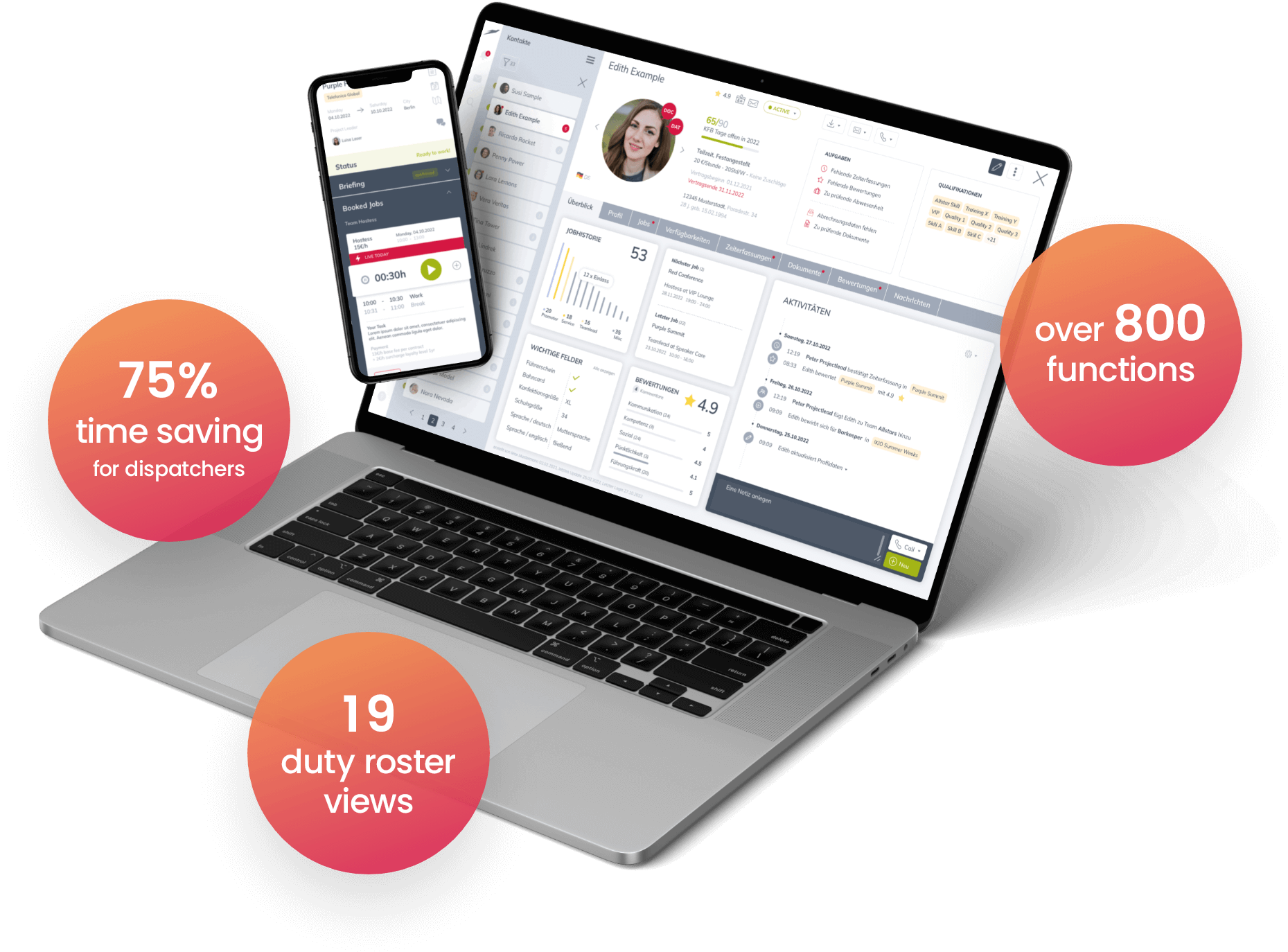
Switching to a modern system is not only recommended in view of the imminent obligation to record working hours electronically. Our Teamhero personnel planning software is an ideal solution for small and large companies looking for a digital, centralized and efficient time recording system. You can use the program to record your employees’ working times to the minute. Regardless of whether your company relies on fixed working hours, flexitime or trust-based working time models, the working time recording functions can be individually adapted to your needs and can also be accessed from home or on the move via a mobile device. As you can assign input and access rights individually, the recorded data and its further processing are protected to the maximum.
However, Teamhero is not just a tool for monitoring compliance with maximum working hours, but a comprehensive HR software with which you can also plan assignments, create duty rosters, manage applicants and bundle employee communication. The tool meets all legal requirements for tamper-proof and legally compliant working time documentation and personnel planning.
Disclaimer
Please note that the texts on this website and the related contributions are provided for general informational purposes only and do not constitute tax or legal advice in the proper sense. For individual cases, we always recommend seeking specific legal advice tailored to the circumstances of the situation. The information is provided to the best of our knowledge and belief, without any guarantee of accuracy, completeness, or validity.