


How to calculate your personnel requirements correctly
Have you ever wondered why some companies struggle to achieve their goals despite having excellent products or services, while others seem to succeed effortlessly?
Sometimes the answer actually lies in the way companies plan and manage their staffing requirements. After all, the correct calculation of personnel requirements is a factor that should not be neglected when it comes to a company’s productivity.
In this article, we show you how you can now calculate your staffing requirements precisely. So that you can not only optimize costs, but also increase the satisfaction and motivation of your employees. With practical tips, we will equip you for successful personnel planning that will put your company in the fast lane.
What are personnel requirements?
Personnel requirements is a key concept in the field of HR management that encompasses the number and qualifications of employees a company needs to achieve its goals. This planning is crucial in order to avoid both overstaffing and understaffing and to keep personnel costs under control.
Quantitative personnel requirements planning focuses purely on the number of employees required. A distinction is made between deployment requirements, i.e. the number of employees needed for daily tasks, and reserve requirements. The latter is used to cover absences due to vacation or illness without any loss of performance.
A careful analysis of the current situation and foreseeable requirements in the near future helps to determine the gross personnel requirements.
Qualitative personnel requirements planning, on the other hand, refers to the skills and qualifications that employees must have. This includes analyzing future requirements for staff, such as special foreign language skills or IT skills that will be required due to the company’s expansion or technological innovations.
Personnel requirements planning is a dynamic process that must be regularly reviewed and updated in order to be able to react to changes in the company or the market. It requires close cooperation between the HR department, department heads and management.
The aim of personnel requirements planning is to initiate measures in good time, whether through personnel development, further training for existing employees or the recruitment of new talent, in order to meet future challenges.

This is why the calculation of personnel requirements is important
The precise calculation of personnel requirements is a strategic lever that significantly influences the long-term success of a company. This calculation forms the basis for a multitude of benefits, both for the company and its employees.
Optimization of operating costs
One of the most obvious effects of correctly calculating staffing requirements is the optimization of operating costs. By determining the exact number of employees needed to achieve the company’s goals, companies avoid both the financial burden of overstaffing and the risks associated with understaffing, such as costs for overtime or quality deficiencies in production or service. This leads to a more efficient use of resources and strengthens the financial health of the company.
Increase in employee satisfaction
Precise workforce planning contributes significantly to employee satisfaction. By avoiding overstaffing and understaffing, employees feel neither underworked nor overloaded. This promotes a positive working atmosphere and increases motivation. Satisfied employees are more committed, more productive and contribute to a positive corporate culture. In the long term, this has a positive effect on employee retention and reduces staff turnover, which in turn lowers the costs of recruiting and training new employees.
Flexibility and competitiveness
Companies that calculate their personnel requirements precisely can react more quickly and flexibly to market changes. They are able to implement new business strategies by investing in the recruitment or further training of employees in good time. This ensures continuous adaptation to technological developments and changing market conditions, which promotes the company’s competitiveness.
Promotion of personnel development
The calculation of personnel requirements also includes an analysis of the required qualifications and skills. This enables companies to make targeted investments in the training and development of their employees. By promoting personnel development, companies can not only close existing skills gaps, but also support the career development of their employees. This increases job satisfaction and binds talent to the company in the long term.
Maintaining service quality
For companies that work directly with end customers, calculating staffing requirements is crucial to ensure a high quality of service. Only with adequate staffing can customer inquiries be processed promptly and efficiently, which leads to higher customer satisfaction.
Satisfied customers are the basis for repeat business and positive word of mouth, which in turn promotes sales and company growth.
The various factors of personnel requirements
Gross personnel requirements
The gross personnel requirement indicates the total number of employees needed to fulfill a company’s tasks and objectives. It includes both the current headcount and the additional skilled workers required. For example, if a company currently employs 25 people and needs 3 additional skilled workers for the coming year in order to process all orders, the gross personnel requirement is 28 employees.
Net personnel requirements
The net personnel requirement, on the other hand, is the difference between the gross personnel requirement and the updated headcount (the current headcount plus planned staff additions minus fixed staff departures). If, in the example above, 5 employees retire at the end of the year and 2 more go on parental leave, while 3 trainees from other departments join the production department and one new employee has already signed their contract, this results in an updated headcount of 22 employees. The net personnel requirement is therefore 6 new employees, as the gross personnel requirement is 28 and the updated headcount is 22.
To summarize and simplify, it can be said:
- Gross personnel requirements = total number of employees required (current employees + additional specialists required).
- Net personnel requirements = gross personnel requirements – updated headcount (current employees + planned additions – fixed departures).
Calculate personnel requirements: Formulas for an efficient overview
By using specific formulas, HR managers get a good overview of the current and future need for employees. Here we present two key formulas that are important for calculating staffing requirements.
Formula for quantitative personnel requirements
The quantitative personnel requirements can be determined using a simple formula that takes into account the current headcount, projected departures (e.g. due to dismissal or retirement) and future additional requirements:
Quantitative personnel requirements = current headcount – forecast departures + future additional requirements
This formula gives companies a clear overview of how many employees will be needed in the future to maintain operations and realize planned expansions or projects.
Formula for qualitative personnel requirements
Qualitative personnel requirements focus on the skills and competencies required within the company. This calculation is more complex, as it must take into account the development of the market, technological trends and the strategic orientation of the company. A general formula for this is:
Qualitative personnel requirements = future skills requirements – existing skills
This formula helps to identify which specific skills and qualifications need to be developed or acquired in order to successfully master future challenges and tasks.
Application of the formulas
Using these formulas enables companies to act proactively. The quantitative calculation makes it clear how many employees are needed, while the qualitative calculation shows in which areas further training or new hires are required to close the skills gaps.
Calculating your own personnel requirements – an important tool for companies
Calculating staffing requirements therefore enables companies to be proactive rather than reactive. This calculation forms the foundation for a flexible and future-oriented organization that is able to adapt quickly to changing market conditions without losing sight of employee satisfaction and productivity.
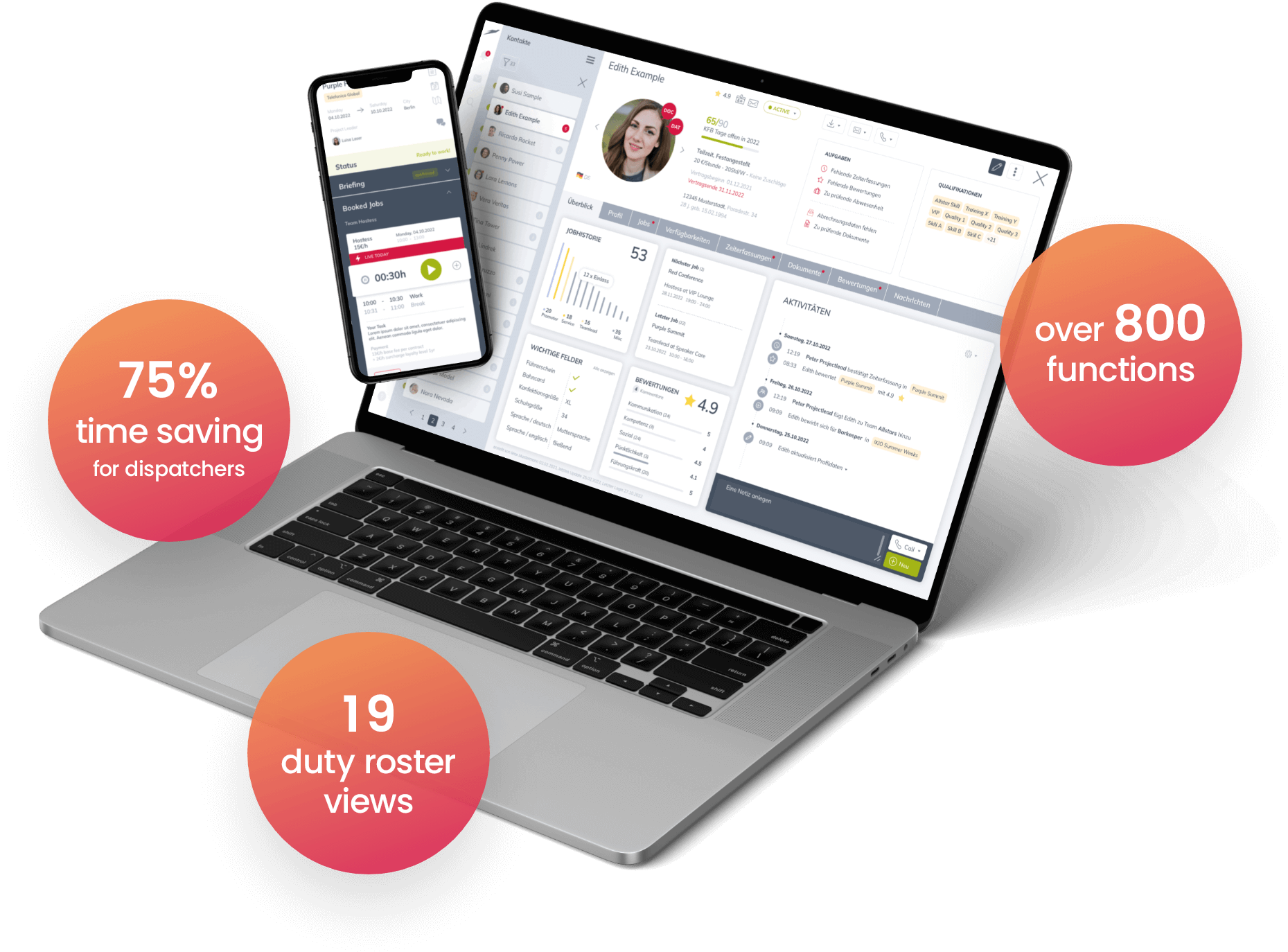
Personnel planning software simplifies the calculation of personnel requirements by providing a simple overview of projects and teams. One example of such software is Teamhero.
Teamhero is specially designed to calculate and manage the personnel requirements of personnel-intensive companies. The software is characterized by a range of functions that simplify and optimize the entire personnel planning process:
- Applicant management: Teamhero makes it possible to recruit applicants in a targeted manner and transfer them efficiently to the employee database. This not only facilitates the search for suitable personnel, but also the management of applications.
- Shift planning: Teamhero makes it easy to plan qualifications, times, locations and deployment areas. This ensures a transparent and clear organization of assignments, which in turn enables targeted coverage of personnel requirements.
- Digital time recording: The ability to record working hours and breaks digitally provides an accurate overview of work performance and supports fair and accurate payroll accounting.
- Employee databaseA central platform for managing all relevant employee information, from master data to working time accounts and qualifications. This enables a 360-degree view of employees and facilitates personnel planning and management.
- Employee portalA tool that enables employees to actively participate in the planning process by indicating their availability, applying for jobs and recording their working hours.
If you want to calculate your personnel requirements even more easily in the future, test the demo from Teamhero.