


Employee turnover: reasons & consequences
An upturn in the economic situation generally promises something very positive. At the same time, however, it also means that companies need to be on their guard against unwanted staff turnover. This is because a relaxed economic situation encourages employees to look around the market for new prospects.
In this article, we will tell you exactly how employee turnover is defined, what reasons lead employees to resign and how you can achieve a healthy turnover rate with flawless employee retention.
What does employee turnover mean?
Employee turnover refers to the departure of employees. Employee turnover is often used to describe the entire process from the termination of an employee to succession planning. The term initially covers all types of dismissals. Employee resignations in particular should be analyzed more closely, as they can indicate dissatisfaction and insufficient employee retention.
How the fluctuation rate is calculated
The fluctuation rate is usually analyzed by companies once a year. Two standard formulas for simple calculation are as follows:
- (Staff departures / (headcount at the beginning of the reporting period + new hires in the reporting period)) * 100
or
- (staff departures / average headcount in the reporting period) * 100
What types of employee turnover are there?
Within employee turnover, it is important to distinguish between the different types. These are the following:
Natural fluctuation
Natural employee turnover includes dismissals due to various life circumstances. This can include retirement, parental leave or the death of an employee. Leaving at a contractually agreed date in the case of temporary contracts also falls into this category.
Company-internal fluctuation
Internal company fluctuations include job changes within the company. This can be a change of position to another department or a change of role within an existing team. A change to a management position is a classic example.
Non-company fluctuation
Non-company turnover includes terminations of employment by employees. In most cases, they lead to a move to another company. Termination agreements also count as non-company turnover if the request for termination is made by the employee.
Early fluctuation
Early employee turnover is a sub-category of external employee turnover. It refers to resignations submitted by employees within the first year of employment. As an employer, you should delve deeper into the analysis here, because although the reasons may be varied, the existing personnel selection and onboarding process may not be optimally managed.
What are the reasons for employee turnover?
There can be many reasons why an employee leaves the company. Let’s take a look at a few factors.
Private reasons
Typical personal reasons why people leave their job include family planning, a change of location or because they have to look after a sick family member. They may also want to change a full-time job to a part-time job or work from home, which is not possible at their current company.
Economic situation
While it used to be common to stay with the same company for a long time, things are quite different nowadays. In many industries, employees change jobs quite quickly when a profitable offer arises. The more vacancies there are, the greater the temptation to look for a job with employee benefits. At times or in areas with a higher unemployment rate, on the other hand, employees are understandably more reluctant to take the risk of changing jobs.
Working conditions
Permanent unpaid overtime, high pressure to perform or a below-average salary are just some of the reasons why employees sooner or later take flight. Not to be underestimated these days is the desire for flexibility, be it in the form of a hybrid working model or – for project staff, for example – the opportunity to express their preferred working hours. Another point is a difficult order situation in the company, which is why staff are leaving the company out of existential fears. Differences or even bullying are also serious reasons for staff turnover.
Emotional reasons
If employees feel they are in a bad working environment or if they have problems with their manager’s leadership style, this often causes them to leave the company. Other employees change employers because they feel more comfortable in a different area of responsibility or cannot identify with the corporate culture. The issue of further development is also an important aspect: if employees feel that their efforts are not sufficiently appreciated or they see no development prospects, this can sooner or later lead to them leaving the company.

What are the advantages and disadvantages of employee turnover?
Especially when long-serving employees leave the company, a great deal of expertise is lost with them, which is difficult to make up for with a new hire. In the event of termination without notice, activities may even come to a temporary standstill if a key position cannot be quickly filled internally. In addition, every employee turnover is associated with very high costs and time: Whether it is severance payments, recruitment or extensive induction processes. A high turnover rate can also lead to uncertainty – both internally and on the customer side.
Fluctuations also have advantages
A high fluctuation rate is unpleasant. But you can also see the good side of the coin. Because every new employee brings in new ideas and encourages others to think outside the box and create new innovations. The applicant will also be able to contribute new specialist knowledge. At the same time, fluctuation also creates internal movement, as your existing staff have the opportunity to apply for the vacant, sometimes more senior position.
What measures help against staff turnover?
Countermeasures can be taken against a high fluctuation rate. The most important point here is to invest in employee retention. Here are some concrete suggestions:
- Hold regular appraisal interviews and listen carefully – even between the lines.
- Revise your recruitment criteria (e.g. better focus on employees who fit in with the corporate culture/team).
- Invest in good onboarding.
- Offer your staff sufficient opportunities for further training.
- Create individual development prospects.
- Make sure you have an excellent working environment (e.g. modern work materials, health-promoting seating).
- Pay a competitive salary.
- Offer benefits such as hybrid working, remote working models, a dog-friendly office or allowances for public transport.
- Promote a positive working atmosphere and “connect” your employees with each other (e.g. at seminars, team events).
- Pursue open and honest communication at all hierarchical levels.
A positive farewell interview is also an important part of a termination. If possible, never let employees leave your company with a bad feeling and check the reasons given for termination.
Simple and centralized personnel planning – with Teamhero
Do you want employees who enjoy working for you and preferably don’t even think about quitting? Then invest your time in the most important thing you have – the people who work for you – and leave your personnel planning to one of the most innovative SaaS solutions on the market.
Centralized and all-round uncomplicated handling
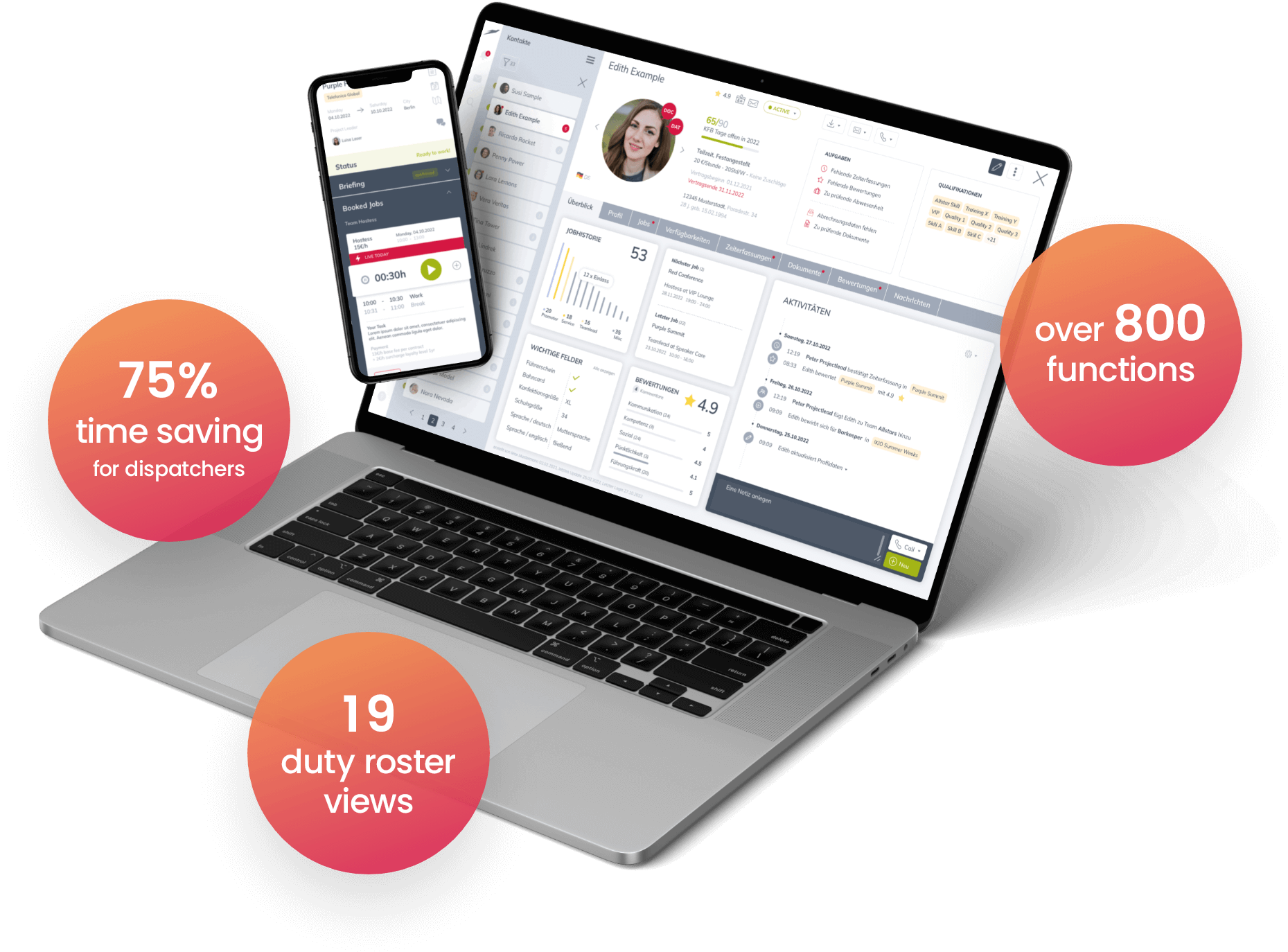
With the Teamhero personnel planning software, all processes can be managed centrally, simply and innovatively from a single platform. Teamhero was primarily programmed for personnel-intensive companies such as event, promotion, hostess and personnel agencies.
The functions include the following aspects:
- Recruitment
- Communication
- Employee portal
- Time recording
- Interface management and data exports
Actions speak louder than words: just take a look at our success stories. If you have any questions about Teamhero, please feel free to contact us at any time.
Conclusion
Employee turnover refers to the departure of employees from the company. The number of voluntary resignations on the part of employees is one of the most important indicators within the fluctuation rate. While there are many personal or external factors that cannot be influenced, employers have the opportunity to promote employee retention with various measures and thus keep the fluctuation rate healthy.
This includes promoting a good working atmosphere, comprehensive further training opportunities and creating a good work-life balance. Modern personnel planning software such as Teamhero can provide valuable assistance in all of these processes. Request your live demo today and see for yourself.