


Succession planning: definition, process & implementation
When employees leave the company, there is more than just a personal gap. Particularly in key positions, a great deal of expertise goes with them, taking years of know-how with them. In order to be prepared for such situations, a forward-looking HR policy is important for every company.
In this article, you will receive a round-up of compact knowledge on the topic of succession planning. We explain what it involves, how it works and which tools can be of great benefit to your HR department. We also look at the most common mistakes that are made in succession planning.
What does succession planning mean?
Succession planning or succession management is the controlled process of finding successors for vacancies in the company who have a key function. Possible reasons for leaving may be relocation, the transition to retirement age, occupational disability or simply a deliberate change of company.
Succession planning is a long-term process
A succession plan consists of several important individual points that require corresponding measures. These include
- The discussion of key positions in your own company
- Risk assessment taking into account external factors (such as retirement age, average fluctuations, external market circumstances)
- Internal talent management in your own company and development of a talent pool
Whether and how extensive succession planning is for a particular position depends, among other things, on how closely an employee’s skills are linked to their job.
Why is succession planning so important?
Imagine an exemplary employee in one of your key functions. He has acquired his skills over many years. Colleagues are happy to seek advice from him, you yourself now trust his decisions almost blindly and he has an exemplary relationship with customers.
Now this employee informs you that he will unfortunately have to leave the company soon for personal reasons. For many, this is exactly the point at which the question of why long-term succession planning is so crucial arises. In the worst-case scenario, the loss of a manager can jeopardize the continued existence of the company, especially in small family businesses.
But the stakes can also be high for medium-sized and large companies. When do customers react more positively: when your contact person can already present his successor to them or when he only appears months later? Last but not least, succession planning always saves time and money.
Succession planning: the 8 biggest advantages at a glance
Securing the company’s goals
A termination that is not unexpected and has been agreed in advance does not lead to a vacant position.
Secure knowledge transfer
Valuable knowledge is passed on through targeted training of the successor by his predecessor and thus remains in the company.
Pursuit of strategic corporate goals
With enough time, an employee with the same key qualifications can be found who can fulfill the achievement of the set strategic goals.
Increased employee satisfaction
Every employee is happy to be appreciated, which is also expressed in a smooth onboarding process.
Time saving
Long-term succession management not only reduces the time required for recruitment, but also for the induction process.
Manageable costs
The more urgently a position needs to be filled, the more expensive the recruitment costs of an adequate employee often are. This can be avoided with a clear succession concept.
Reduced miscast rate
Long-term succession planning with an internal focus increases the chance of finding a successor who is already familiar with and connected to the company guidelines.
Targeted employer branding
By promoting an internal employee, the company shows both internally and externally that there are opportunities for advancement within the company. This increases the motivation of competitors and the company remains competitive.
How does succession planning work?

When drawing up a succession plan, it makes sense to follow a certain pattern. Here is a small step-by-step guide in seven steps:
Step 1: Identify the key positions in your company
Think about which qualifications or specialized knowledge are directly related to achieving your business goals.
Step 2: Determine the need
Create an overview of all foreseeable factors that indicate the departure of a person in a key position (e.g. retirement age, number of years with the company, etc.).
Step 3: Create and revise the requirements profile
Create a requirements profile from the most important points. However, also look at the position in question from a future perspective. Ask yourself what skills will be required for the job in the coming years.
Step 4: Implement recruitment measures
It is often advisable to advertise the position both internally and externally. Creating a talent pool of suitable employees can also be useful. Be clear about the date by which the new employee should be found.
Step 5: Test your applicants
Professional qualifications can often be discussed well through a trial job. This also gives you an immediate impression of how the employee will fit into the team. Consciously include the opinion of future team colleagues here.
Step 6: Prepare the onboarding process
How smoothly the handover goes often determines how quickly the new employee can carry out their new tasks independently. At the same time, a smooth onboarding process strengthens employee loyalty.
Step 7: Reflect on the process
Once you have found a successor, think about whether and where there were any stumbling blocks in the recruitment process. Clear these out of the way before the next time.
What are the most common mistakes in succession planning?
Finding a successor for an outstanding employee is not always easy. This is precisely why it is important to avoid mistakes in succession planning from the outset. These two are among the most common:
The time required to fill a vacancy is underestimated
Many staff losses are foreseeable – for example, when a long-serving employee will retire. Nevertheless, many companies start looking for a suitable successor too late. In the worst case scenario, the position then remains vacant for some time, which can have devastating consequences within a key role.
Also bear in mind that even your ideal candidate with the ideal background will need proper onboarding. They also need to be given time to familiarize themselves with the company, get to know all internal processes and integrate into their specific tasks.
No thought is given to short-term staff shortages
There can be many reasons why an employee leaves the company at short notice. Perhaps they unexpectedly have to look after a sick family member or are unable to work themselves – the list of things that can happen is long. Companies that do not think about such things in advance and develop solutions for a “worst-case scenario” are hit hard by such a loss of staff. The position often remains vacant for the time being, which can lead to processes slowing down or coming to a complete standstill in management roles.
Instead of simply waiting in such a situation, interim management is the better choice. In this case, an internal, experienced employee temporarily takes over the position of the person who has left until a successor is found.
Are there tools for succession planning?
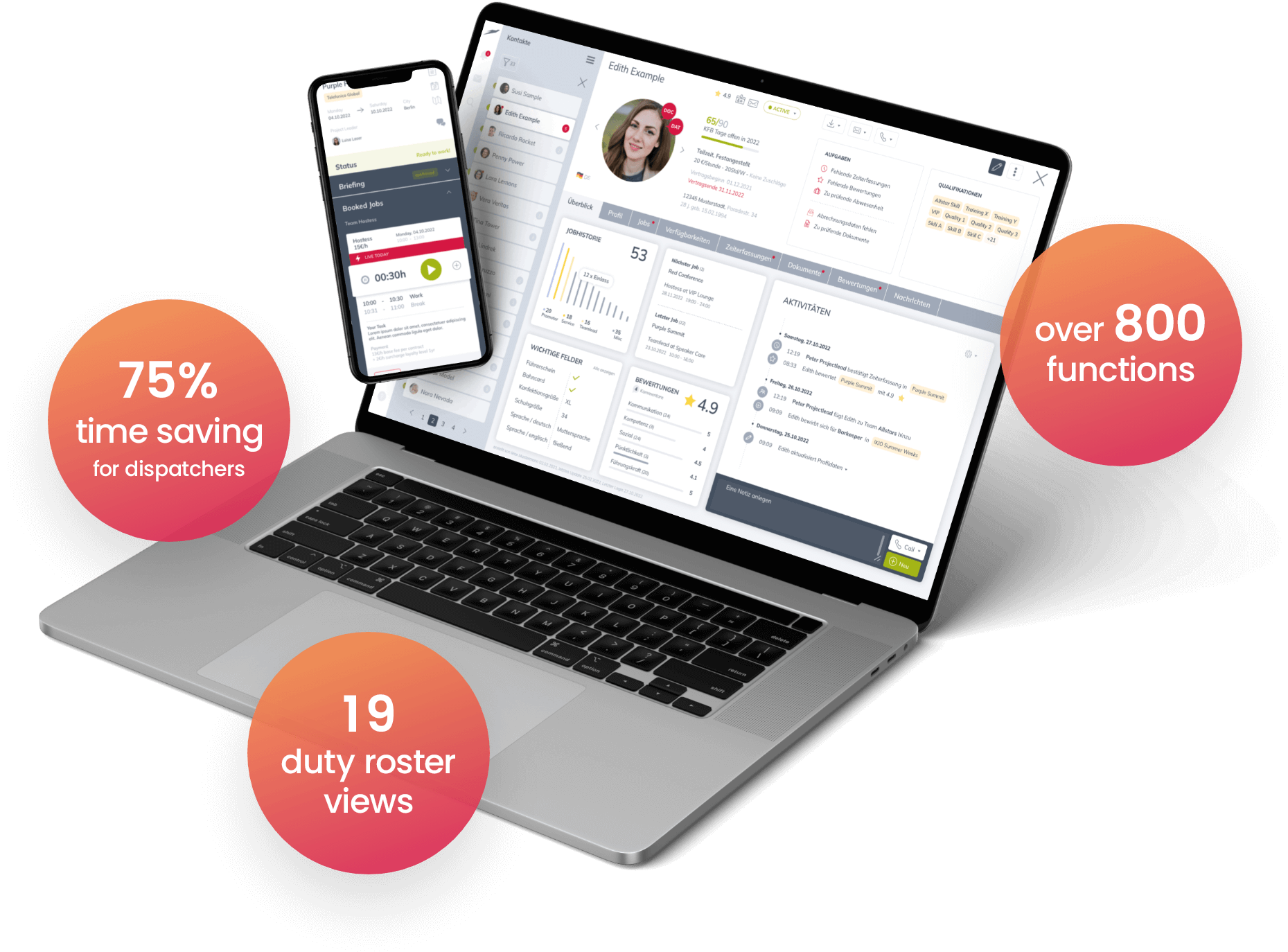
As a modern and powerful personnel management software, Teamhero guides you skillfully through the entire recruitment process. It has been specially tailored to the needs of personnel-intensive companies such as event, promotion and recruitment agencies. With the help of our software, you can save time, money and stress in your succession planning.
Teamhero: Selected features for succession planning at a glance
- Get an overview of your current employees and their qualifications and costs with just one click.
- Create a job advertisement in the applicant module with just a few clicks, which you can also publish immediately.
- Easily evaluate your applications using the statistics area.
- Export master data, applicant data and other evaluations at the touch of a button.
- Create and manage your casting and interview appointments via one and the same portal.
- Transfer new employees to the employee database quickly and easily.
Would you like a free demo of Teamhero?
Nothing could be easier. Arrange an introductory phone call with us and let’s talk about whether our software can meet your requirements. If so, we will be happy to send you a free demo version for testing.