


Capacity planning – definition, advantages & application
Personnel-intensive companies in particular, with frequently changing projects and tasks, have the mammoth task of having to react flexibly and quickly to changes. Consistent quality of their work performance is just as important as keeping a constant eye on internal costs. For them, capacity planning is a must in order to remain competitive.
But what exactly is capacity planning? What types of capacity planning are there, what advantages do they offer and how are they implemented? You will find the most frequently asked questions and answers on this topic below. You will also learn about the crucial role played by the acquisition of good HR software.
What does capacity planning mean and when does it make sense?
Capacity planning ensures that you not only have enough resources available during a large project, but also the right resources in the right place at the right time. Resources here include both employees (even if we don’t think the word is adequate) who have the skills required for the project and …
- the budget,
- the time,
- the material resources,
- the premises and
- the machines,
necessary for the fulfillment of the order.
These companies benefit particularly from capacity planning
Capacity planning is particularly useful in companies where the order situation changes rapidly and new projects often have to be set up or rescheduled quickly. At the same time, these companies often have a large workforce. Typical sectors for this include the entertainment and event industry, such as event and promotion agencies, caterers or hostess agencies.
Optimum capacity planning ensures that orders can be carried out to the full satisfaction of the customer without you having to compromise on employee satisfaction (e.g. due to repeated overtime and overload) or budgeting.
Capacity planning, resource planning and other terms
The terms capacity planning and resource planning are so fluid in terms of strategies that they are often used as synonyms within project management. One of the small but subtle differences is that resource planning focuses a little more on the employees and their current and future deployment. In capacity planning, the – for example seasonal – project request status is placed at the beginning of project planning and the supply-demand ratio is usually considered in the long term. Another colloquial term for capacity planning is capacity planning or simply capacity planning.
What types of capacity planning are there?
In capacity planning, a distinction is primarily made between two different types of planning. On the one hand, there is strategic long-term capacity planning. Among other things, it deals with the cleverest possible management of personnel deployment, taking into account current and future requirements.
The aim is to have enough capable employees, even with high demand, while remaining cost-effective and being able to react flexibly. Over- and undercapacity must be skillfully managed through capacity planning. Short-term operational capacity planning is used in particular when there is an increase in project demand and the result must be on-time delivery without any loss of quality.
What are the advantages of capacity planning?
Capacity planning creates many advantages. The following are among the most important.
Increase motivation and employee satisfaction
Optimally managed capacity planning gives not only employers but also employees planning scope. Work overloads are ruled out – if overtime does occur, it can be compensated for. At the same time, not too many project employees are left completely without work for long periods of time. This balance ensures healthy and motivated employees and a good working atmosphere.
Planning security and satisfied customers
Capacity planning provides the clear advantage that services can be provided punctually and reliably at all times. Just the way customers want it. The company knows when the peak of inquiries will arrive and can prepare for this situation in good time. Even requests at short notice can be handled confidently and with less risk of a loss of quality.
Maintaining competitiveness
Many companies have a high-quality service capability. Maintaining this, even if there are short-term project changes, staff shortages or other unforeseen events, is an art that sets you apart from the competition. Capacity planning makes it possible for company management to know at all times where they stand internally, which orders they can accept and where their capacity limits lie. Ultimately, this also turns the challenges of change management into a positive experience, for example when new markets are to be opened up or the portfolio expanded.
Saving time and costs
The more long-term planning is possible, the more optimized a company’s cost structure will be. Capacity planning helps to maintain an overview of gross and net capacities at all times. With this support, companies rarely find themselves in the predicament of having to turn down profitable projects due to a lack of qualified personnel or no longer being able to carry out tasks with the usual professionalism. In addition, a lot of time is saved if there is no need to hire project staff at short notice due to an unforeseen staff shortage.
What can be the consequences of a lack of resource allocation?
Proceeding without a structured allocation of resources means accepting high risks for your company. As soon as unforeseen changes occur, such as staff absence due to illness or rescheduling of the event, it is not possible to react appropriately and confidently. As a result, deadlines can no longer be met, quality suffers or a lot of money has to be spent on replacement employees who are needed. It is not uncommon for companies to even have to reject projects due to too many requests. All of this can quickly damage a company’s image and lead to a loss of customers and competitiveness.

What is important for capacity planning?
For capacity planning, it is essential to have a relevant and reliable database in order to carry out the necessary analyses. As a result, sophisticated resource management is at the heart of every capacity planning process. A transparent overview of all employees, including their availability, costs and special expertise, should form the basis. Good capacity planning regularly compares demand and supply, adjusts them with foresight and sets a healthy buffer zone.
The magic triangle
The magic triangle is not a dream, but rather a clever approach to project management and capacity planning. The triangle symbolizes the following three dimensions:
- Time
- Costs
- Performance
These are in conflict with each other throughout the entire course of the project. An example: The customer wants to put on a high-quality and extensive event that is as cost-effective as possible. Is that possible? Probably not so easy – and this is exactly what describes the work towards the center of the magic triangle.
The challenge for those involved in the project is to reconcile the three key points and ultimately land in the target core of the triangle. This stands for the continuation and achievement of the project objective in harmony with all possible measures. Customer satisfaction could be seen as the fourth dimension.
A long-term view is important
Capacity planning allows a long-term view and can be viewed across departments. To be on the safe side, it should be possible to control processing rights individually so as not to jeopardize the corporate goal at any time. It is also important to fill vacant positions with suitable people and promote them accordingly. Modern software programs such as Teamhero can provide targeted support for capacity planning and save companies a lot of time and money.
What are the prerequisites for successful capacity planning?
As already mentioned in the previous sections, resource planning comes first in capacity planning. It is therefore important to first determine your personnel requirements by calculating personnel requirements. This is followed by a comparison of gross and net capacity. In this case, this means that the hours to be worked are adapted to the number of employees. Current or possible future irregularities should already be apparent here.
Ideally, you should now go one step further and include the average absence rate and a current, statistical sickness rate in the capacity planning. This gives you realistic vacation planning, which is deducted from the gross capacity for the final result.
You have now reached the point where solutions should be discussed and challenges addressed with foresight. For example, a possible high sickness rate can be solved by cross-departmental substitutions so that you do not have to accept unplannable losses in the budget, quality of work or time management.
How is capacity planning successfully implemented?
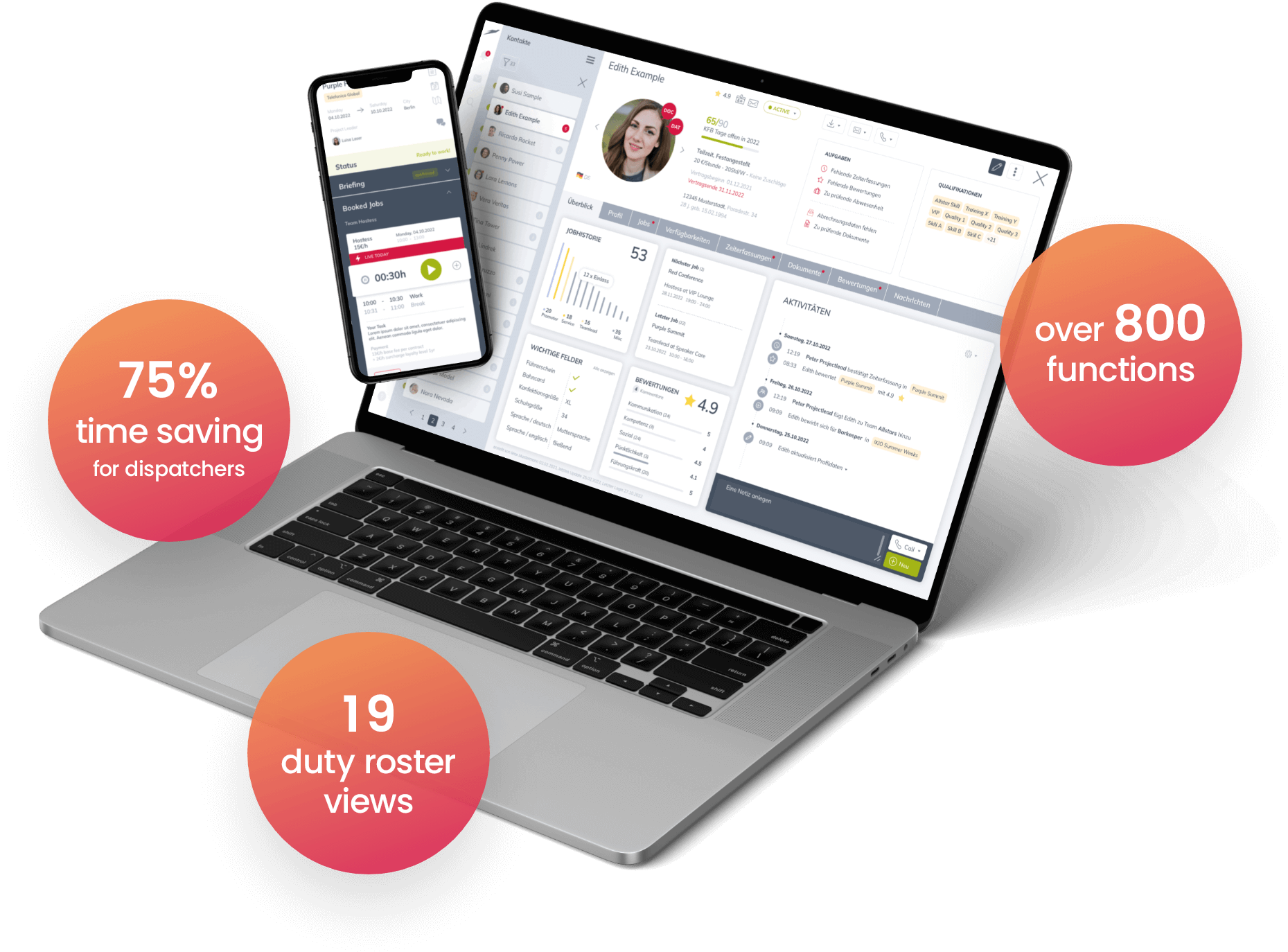
The easiest way to carry out capacity planning nowadays is with modern personnel management software. This gives you the transparency and flexibility you are looking for without costing you a disproportionate amount of time. An innovative PM tool such as Teamhero has been specially programmed to enable you to access and manage all relevant personnel parameters transparently and at a glance – using just one tool and without the need for extensive IT knowledge. And this is what digital capacity planning looks like:
Master data management and resource planning
With just one click, you get a structural overview of all employees as well as their areas of responsibility, qualifications, work locations and their current availability. You can easily filter according to various parameters and download work, project structure and time schedules. Furthermore, standardized documents can be quickly recreated, open documents can be viewed and everything can be stored centrally for cross-departmental access.
Effort analysis
Operational data can be determined quickly and easily and future tasks can be planned and coordinated on a personalized basis using one and the same tool. In this way, the planned and actual workload can be offset against each other and result in the remaining workload, which can be adjusted if necessary. Important conclusions can then be drawn from the results analysis between original planning and reality and the course for optimization can be set.
Tracking and capacity planning
Thanks to the modern live time recording system, you always have an overview of the current workload as well as the vacation and sick leave status of your employees in the teams. Specific tasks can be assigned directly to individual employees and they can be informed about them with the help of a briefing. This applies both in the pre-planning phase and live on site, for example when one employee has to quickly take over the tasks of another or times have to be swapped. This enables optimal scheduling and ensures that employees have neither too little nor too much to do.
Capacity planning with Teamhero – your biggest advantages
- Clear employee database
- Integrated employee portal
- Order overview
- Intuitive creation of work plans
- Overview of past and future project activities
- Live time recording to the minute
- Statistics at the touch of a button
- Overview of absences
- Communication solution for teams
- Inventory management
- Recruitment and digital onboarding
If you would like to know why other companies have opted for Teamhero’s software solution, simply browse through our success stories. You can get a free demo version to test some of the functions yourself after a no-obligation initial consultation. We look forward to getting to know you and helping you achieve your goals!
Conclusion
Capacity planning is an essential tool for companies to be able to act innovatively and economically, regardless of their size. It is particularly suitable for personnel-intensive companies whose order situation fluctuates seasonally and can include unexpected highs and lows. These include event and hostess agencies, stand builders and more. Capacity planning also offers decisive advantages within production.
Capaplanning provides a clear overview of available resources and makes it easy to manage them. Tasks can be distributed in such a way that employees have enough to do without having to do unnecessary extra work. This not only leads to motivated teams and a good working atmosphere, but also to the decisive advantage of being able to quickly find a solution and deliver consistently high quality even in the event of high demand or unexpected staff shortages.
Nowadays, Excel spreadsheets are no longer an option for optimal capacity planning. The effort involved would be immense and the potential error rate correspondingly high. Instead, personnel software tools offer the decisive advantage.
Teamhero’s HR software was designed with the aforementioned companies in mind. The interface and operation of Teamhero is intuitive – with just a few clicks of the mouse you can get an overview of your employees and their tasks, manage them live and download the required statistics in just a few minutes. These are unbeatable added values that speak for optimal resource management and can mean immense time and cost savings.