


Reducing personnel costs: strategies for sustainable savings
Personnel costs are among the largest ongoing expenses for many companies. Rising wages and salaries, social security contributions, overtime or high recruiting costs can quickly put massive pressure on margins.
When companies want to reduce their personnel costs, the first thing they often look at is headcount. But cutting jobs is a drastic measure with long-term consequences. If skilled workers are missing later on, companies have to find and onboard new staff. At the same time, the workload on the remaining team often increases.
It makes more sense to start by examining day-to-day processes: Where does overtime occur? Where does capacity go unused? Does personnel planning match actual demand? And how much working time goes into manual coordination and administrative tasks?
Key takeaways
- If you want to reduce personnel costs, first analyze where unnecessary costs arise in everyday work.
- Overtime, idle time and inaccurate personnel planning often increase labor costs.
- Better planning helps you deploy employees according to actual demand.
- Digital tools reduce manual effort in planning, communication and time recording.
- Short-term savings should not result in employees being permanently overloaded or important knowledge being lost.
Direct and indirect personnel costs
To reduce personnel costs in a targeted way, you first need to know what they consist of. Many companies primarily look at gross wages and salaries. However, the actual cost per employee is higher.
Direct personnel costs
Direct personnel costs are attributed directly to individual employees. They include, among other things:
- Wages and salaries
- Surcharges and allowances
- Overtime pay
- Bonuses and incentives
- Commissions
These costs arise directly for the work performed.
Other personnel-related or indirect costs
In addition, there are costs related to employment and personnel administration. These include, for example, employer social security contributions, recruiting, onboarding, further training and costs due to absences.
If you regularly have to find staff at short notice because absences or staff shortages are only noticed late, additional recruiting and onboarding costs arise. If employees regularly work overtime, this may indicate that planning is too tight.
So before deciding on cost-cutting measures, you should look at your own concrete figures. For example, compare planned working hours with the hours actually worked and check for which projects or periods discrepancies regularly occur.
Effective strategies to reduce personnel costs
Inaccurate personnel planning can cause unnecessary costs and effort in both directions.
If you schedule too many employees, idle time occurs. If you plan too tightly, overtime increases or you need additional staff at short notice.
That’s why you should regularly look at your actual utilization:
- How many employees do you need for a specific job?
- How many hours does it typically take, based on experience?
- At what times does utilization drop or rise?
- Which qualifications do you need for individual tasks?
- Where do short-term bottlenecks regularly occur?
Companies with changing projects or seasonal fluctuations in particular benefit from planning that brings together staffing requirements and available capacity.
Using personnel deployment planning software helps companies keep quantitative, qualitative and seasonal aspects in view and take them into account with ease.
Don’t look at overtime and idle time separately
If part of the team regularly works overtime while other employees have spare capacity, the problem often isn’t just the number of staff. Check how you distribute work and assignments.
| Situation | What you should check |
| Regular overtime | Is the personnel planning sufficient for the actual workload? |
| Idle time | Are too many employees scheduled at the same time? |
| Uneven utilization | Can tasks or assignments be distributed differently? |
| Frequent short-notice changes | Is current data on availability or capacity missing? |
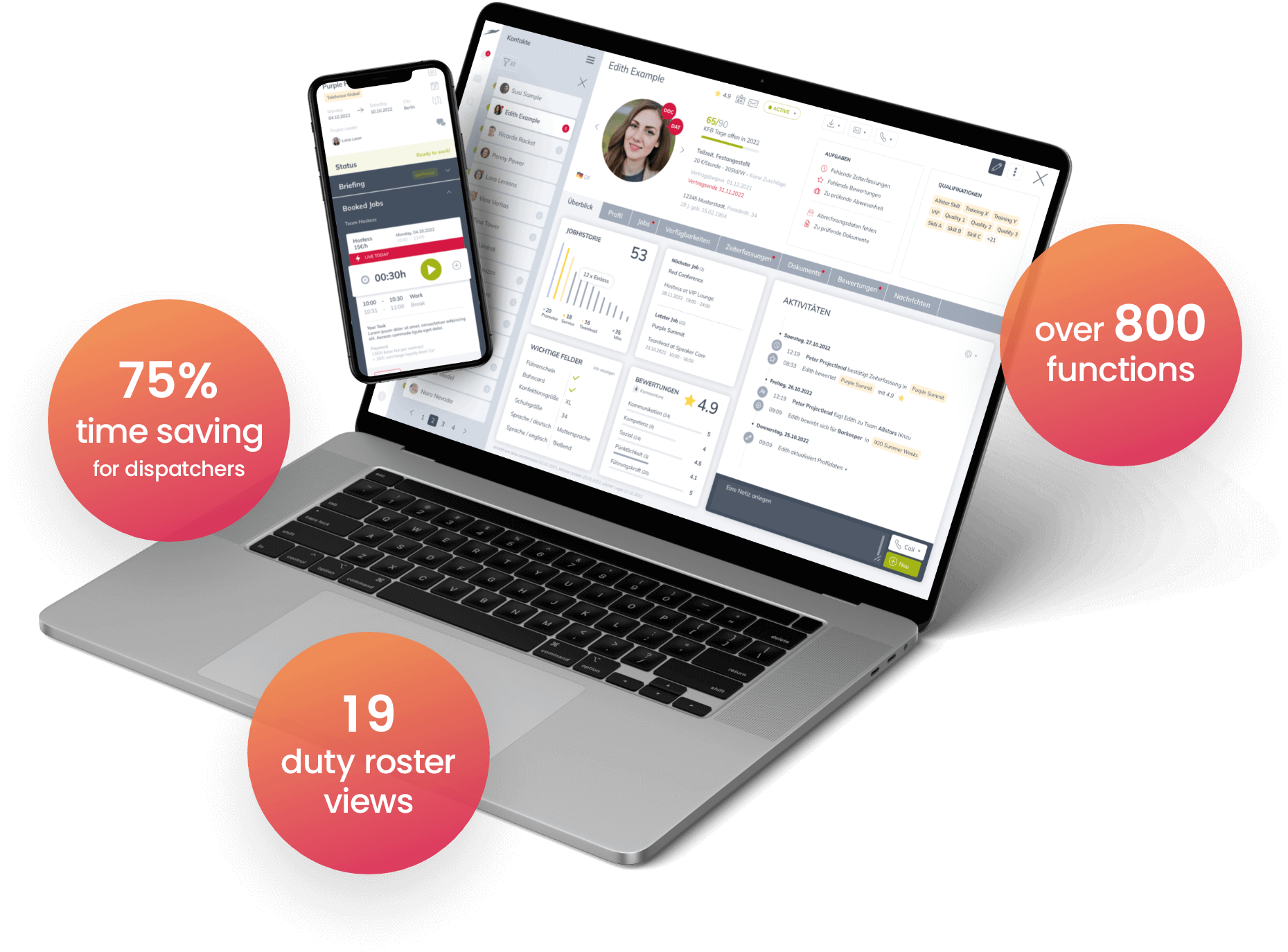
During planning, Teamhero shows, among other things, the working time already planned, booked and used, as well as the utilization of individual employees. This lets you, as a planner, see how heavily individual people are already scheduled.
This way, you can identify during planning whether individual employees are regularly working significantly more than intended.
Take availability into account early on
Short-term staff shortages cost time and money.
An employee drops out, a shift has to be refilled, and you start contacting different people by phone or messenger. The more often this happens, the more working time goes into last-minute improvisation.
So ask for availability early and factor absences directly into your planning.
Teamhero supports personnel planning with stored information on absences and working hours, among other things. The employee portal also gives employees central access to features such as mobile working time recording and an overview of jobs.
Asking early does not prevent absences. But it does ensure that you plan with more up-to-date information.
Make targeted use of qualifications
Costs can arise when employees take on tasks that don’t match their qualifications.
If you regularly assign highly qualified specialists to simple tasks, that capacity may be missing elsewhere. Conversely, a lack of expertise leads to errors, longer work processes or additional coordination effort.
That’s why you should store relevant qualifications and experience centrally and take them into account in operational planning. Among other things, Teamhero offers filter options by availability, qualifications and other employee characteristics.
Reduce planning and administrative effort
Companies don’t save on labor costs only through different staffing.
Check how much working time your HR staff spend on recurring administrative tasks.
A typical process in many companies looks like this: you ask for availability via messages, plan in Excel, communicate changes individually and later transfer working hours manually. Every single step takes time.
Central software can bring these processes together. Teamhero combines features for personnel management, operational planning and mobile time recording on one platform.
You save time when employees and HR managers use the same up-to-date information and don’t have to transfer data multiple times.
Compare planned and actual working hours
Many companies know how many hours they planned for a job. What is often less clear is how many hours were actually worked.
This is often where you’ll find starting points for reducing personnel costs.
Compare regularly:
- planned working hours
- hours actually worked
- overtime
- absences
- workload of individual projects
If certain assignments regularly require more working time than planned, adjust your calculation or personnel planning. If other projects repeatedly manage with fewer staff, you can review their staffing.
The Working Hours Act (Arbeitszeitgesetz, ArbZG) contains, among other things, requirements on daily working hours, breaks and rest periods. You must take these conditions into account when planning.
Teamhero supports the recording of working hours and the management of target hours, overtime and other working time data.
Don’t treat turnover as a purely HR issue
High turnover causes costs. Just how high these costs can actually be is shown by a sample calculation: in addition to the pure recruiting costs, onboarding time and temporarily lower productivity are also factored in.
Companies have to find, select and onboard new employees. At the same time, colleagues and managers invest time in onboarding. You can’t prevent every resignation. Nevertheless, check whether organizational problems are putting unnecessary strain on employees.
These can include:
- frequent, short-notice changes to the schedule
- unevenly distributed workload
- constantly high overtime
- unclear assignment information
- no way to communicate availability early
Especially with flexible teams, more transparent planning can help employees better understand their assignments and working hours.
What to avoid when cutting costs

Cutting staff before you know the causes
Job cuts reduce labor costs in the short term. If staffing requirements rise again later, new recruiting and onboarding costs arise.
That’s why you should first analyze your utilization, overtime and idle time. You will often find measures there before you have to cut jobs.
Making overtime a permanent solution
Overtime can absorb short-term bottlenecks. If it becomes the rule, you should review your planning. Ask yourself why the same employees regularly work longer hours. Is the cause permanently tight staffing? Are you distributing tasks unevenly? Or do planned and actual working hours not match?
Cutting training across the board
Further training initially costs money. However, a lack of expertise can cost more later on if work processes take longer or errors increase.
So don’t cut training budgets across the board. Check which qualifications your company needs for current and planned tasks.
Reducing personnel costs starts with a close look at everyday work
If you want to reduce personnel costs, you don’t automatically have to think about job cuts.
Look at your planning first. Overtime, idle time, unevenly distributed work and manual administrative processes cause costs that you often only notice late.
Especially with many changing assignments, an up-to-date overview of availability, working hours and utilization helps.
Want to reduce your personnel costs and make your personnel planning more efficient? Discover how Teamhero can support you.
FAQs
How can companies reduce personnel costs?
Start by reviewing your personnel planning, utilization and working hours. Costs can often be reduced through less idle time, better distribution of work and less manual administrative effort.
Which measures help reduce personnel costs?
Possible measures include personnel planning that is better aligned with demand, reducing unnecessary overtime, making better use of existing capacity and more efficient processes for planning and time recording.
How can companies save on labor costs?
Avoid overstaffing and regular idle time. At the same time, make sure not to plan staffing too tightly on a permanent basis, as this can lead to overtime and additional strain.
Can we reduce personnel costs without laying off employees?
Yes. Before cutting jobs, you can check whether overtime, idle time, inaccurate planning or manual processes are causing unnecessary costs.
Disclaimer
Please note that the texts on this website and the related contributions are provided for general informational purposes only and do not constitute tax or legal advice in the proper sense. For individual cases, we always recommend seeking specific legal advice tailored to the circumstances of the situation. The information is provided to the best of our knowledge and belief, without any guarantee of accuracy, completeness, or validity.