


Workforce management: Efficiently plan resources and employees
In today’s business world, workforce management is a decisive factor for the success of a company. Especially for personnel-intensive companies, it is the indispensable centerpiece for working efficiently and achieving important corporate goals.
But what exactly is behind the term workforce management – and why is it so important? This article will tell you more about it.
What is workforce management?
Workforce management (also known as WFM) is becoming increasingly important in the corporate world.
The term refers to a comprehensive approach to managing a company’s workforce. It encompasses all activities required to ensure that a company has the right employees with the right qualifications in the right place at the right time. Workforce management includes planning and forecasting staffing requirements, scheduling, shift planning and monitoring working hours.
Effective workforce management brings a breath of fresh air to companies. It enables a flexible and agile response to changes in the world of work, such as the rise of remote and hybrid working models. It also helps to overcome the challenges of complying with labour laws in an increasingly globalized and digitalized world.
Workforce management is therefore a key tool for companies to be successful in the modern working world. It enables companies to manage their workforce efficiently and effectively and thus achieve their corporate goals.
Are workforce management and personnel planning identical?
No, they are not identical. Although personnel planning and workforce scheduling are essential elements of workforce management, they are not identical to the term.
But the more professionally personnel planning is carried out in the context of multi-level workforce management, the more effectively employees can naturally be deployed according to their skills and the company’s requirements.
How does workforce management work?
Workforce management usually takes place in several stages, which can look as follows:
- Demand analysis: This step involves identifying the relevant factors that influence staffing requirements, such as the number of calls to call centers, the number of customers at the point of sale or the number of shipments in logistics. It also analyzes how these factors are distributed over different time periods (days, weeks, months, year) and which special effects need to be taken into account.
- Determining staffing requirements: This involves determining how many employees with which qualifications are needed at which times and in which locations. This can be done on the basis of historical data, the current order situation or future forecasts.
- Personnel structure adjustment: The ideal personnel structure is determined for all teams, divisions and companies and the existing personnel structure is adjusted accordingly.
- Staff scheduling: This includes quantitative staff scheduling, in which staff requirements and future headcount must match, qualitative staff scheduling, in which the skills of the employees must meet the requirements, and temporal and spatial staff scheduling, in which locations and seasonal peaks are taken into account. This can be a challenge, especially in companies with shift work or flexible working hours. Modern workforce management software can help make this task easier by creating automated schedules that take into account both the needs of the business and the preferences of employees.
- Design of working time models: In this step, the working time models required to fulfill the various strategic requirements are determined. The needs of employees are also taken into account.
- Time management: In this step, working times are recorded and evaluated.
- Controlling: Finally, we check whether the forecasts were correct, whether the measures are effective and where there is a need for optimization.
Which industries particularly benefit from workforce management?
Workforce management can be beneficial in a variety of industries. In particular, industries that deal with a large number of employees, changing shifts and complex compliance requirements benefit significantly.
Healthcare
Healthcare facilities need to run around the clock, with staff often working in shifts. Workforce management can help to ensure that there are enough staff to meet patient demand and that staff working hours and breaks comply with labor laws. An illustrative example of this until recently was vaccination centers, which require a large number of staff, often working in shifts and deployed to different locations.
Retail trade
Retail stores often have different peak times and staff need to be planned accordingly. Good WFM ensures that there are always enough staff available to cope with the flow of customers.
Manufacturing
In the manufacturing industry, WFM ensures that sufficient personnel are available to meet production targets.
IT and technology
In the technology industry, where projects are often team-based and have tight deadlines, WFM ensures that the right people are working on the right projects at the right time.
Hospitality industry
In hotels and restaurants, where working hours are often irregular and staff often work in shifts, WFM can help to ensure that sufficient staff are available to cope with variable demand.
Promotion and hostess agencies
These industries, which often work with a large number of employees in different locations and at different times, can benefit greatly from WFM. It is essential to reliably ensure that sufficient staff are available to meet customer requirements.
Security services and sports facilities
In the security industry, staff often work in shifts and at different locations. Here, workforce management can help to ensure that sufficient staff are available to meet security requirements and that staff working hours and breaks comply with labor laws.
Sports facilities also often require a large number of employees who are deployed at different times and at different locations.
7 advantages of workforce management
Some of the most important advantages of an established framework are:
- Maximum flexibility in working hours: By using workforce management tools such as those we offer at Teamhero, companies can achieve the highest possible flexibility in terms of working hours. This makes it possible to react quickly and effectively to sudden changes.
- Increase employee satisfaction through attractive working hours: With our workforce management software, working hours can be designed to meet the needs and preferences of employees. This can lead to greater satisfaction and motivation within the team.
- Cost savings thanks to precise deployment planning: By accurately forecasting personnel requirements and planning deployment accordingly, expensive over- and under-capacity can be avoided. This leads to considerable cost savings.
- Optimization of productivity and efficiency: WFM makes it possible to make optimum use of personnel capacities and reduce unproductive working times.
- Minimization of administrative tasks: By automating processes as part of the workforce management framework, administrative tasks can be reduced to a minimum. This not only saves time, but also resources.
- Better control and lower costs: Accurate forecasting and appropriate staff coverage can limit overstaffing, overtime or planning errors. This leads to better control and lower costs.
- Higher customer satisfaction: By optimizing personnel processes, gaps can be closed and bottlenecks avoided. As studies confirm, this leads to improved service quality and higher customer satisfaction.
In today’s dynamic business world, WFM is therefore an indispensable tool for any modern company that wants to use its resources efficiently.
Using workforce management tools successfully
Workforce management is a complex but crucial element in future-proofing a company. Comprehensive HR software can help to seamlessly cover all HR processes – from recruitment and hiring to personnel administration, payroll and recording working hours. When all processes are centralized and all data is stored uniformly in one place, you lay the foundation for clean analysis and forecasting.
Successful implementation of workforce management tools requires the selection of good software and the right preparation and support during implementation. With Teamhero, you not only receive a comprehensive and efficient solution, but also the necessary support from our team during implementation for your company.

Implement workforce management software in your company | Teamhero
At Teamhero, we know how important it is to have the right tools to run your business efficiently. Our workforce management software is specifically designed to help labor-intensive companies make the best use of their resources and effectively manage their employees.
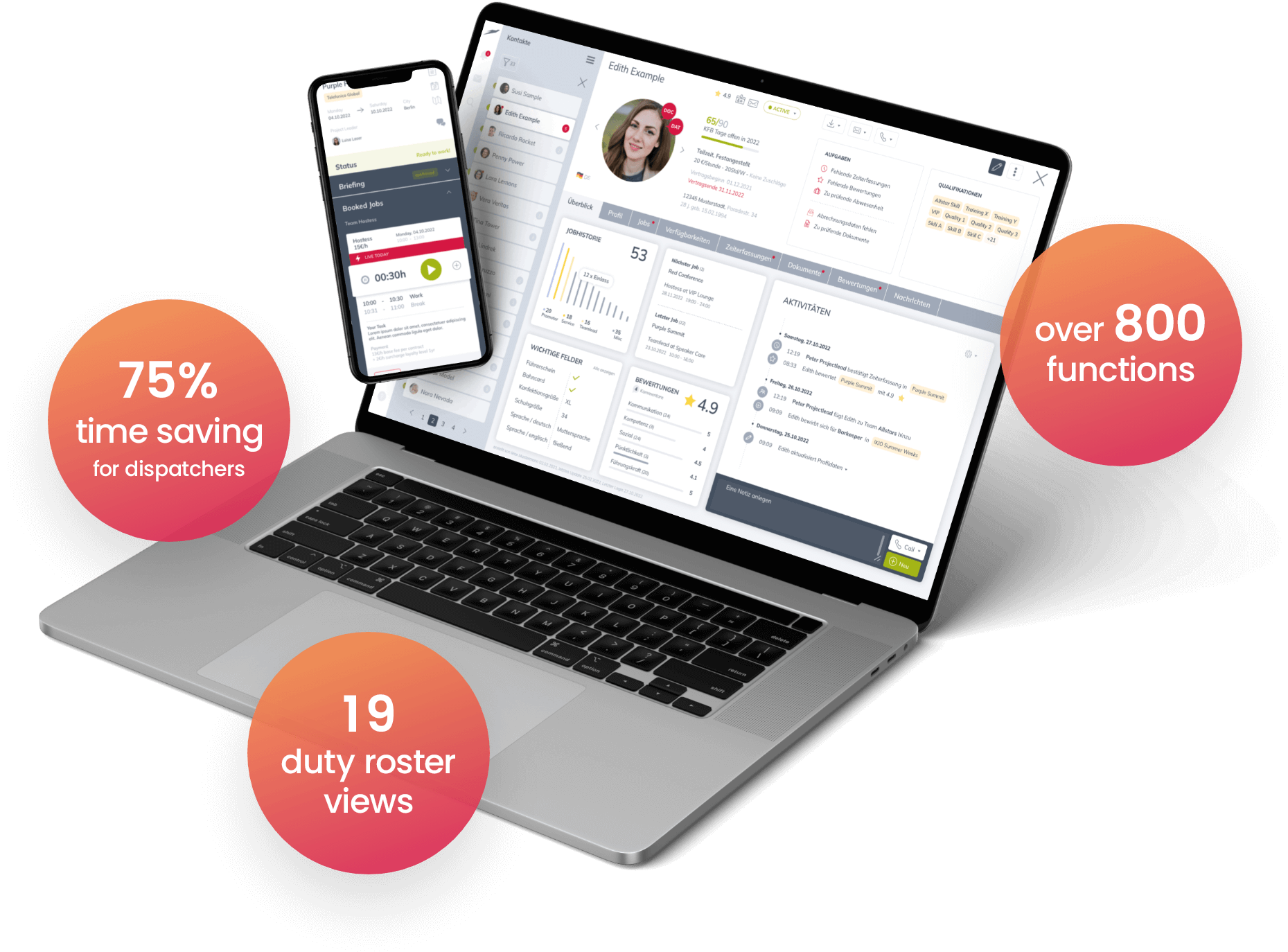
Our software supports you in all steps of workforce management. Not only can you track your employees’ working hours precisely, plan shifts efficiently and ensure that you always have the right people in the right place at the right time – you also have access to a clear employee database including all qualifications.
We believe that the right workforce management software can make the difference between a well-run business and a great business. Try Teamhero and experience the difference for yourself.