


Team development: definition, methods and benefits
In modern companies, employees are increasingly working together in hybrid, interdisciplinary teams. Structured team development is an important factor for the success of such working groups. It enables professionally competent individual talents to form a powerful and functional team.
Such well-coordinated teams can not only achieve better economic results, but also permanently reduce the basic costs of processes. The team development process is therefore central to the success of companies with many employees.
Team development is particularly important in newly formed working groups, as it lays the foundation for a successful project. Good team development defines clear structures, roles and tasks that enable the team to work efficiently and in a goal-oriented manner.
Team development: what does it mean?

Team development is a flexible, dynamic process that a team goes through from its formation to its dissolution. The focus is on group success and increasing efficiency, but it also has many other positive effects for the company and employees.
The main objectives of team development are therefore to increase efficiency and promote cooperation. The necessary sub-goals for this are communication at eye level, the clear formulation of structures and the permanent optimization of processes.
Team development also enables team members to recognize and exploit their potential. It also promotes a positive corporate culture and contributes to employee satisfaction.
In a hospital, for example, doctors and nursing staff are often stressed, which can lead to communication problems, unclear distribution of tasks and misunderstandings. A team development program that focuses on clear communication and understanding of roles leads to a reduction in the error rate and higher patient and employee satisfaction.
The phases of team development
Let’s now take a look at the different phases of team development and how you can use team development to support your new team from the formation phase through to effective collaboration.
Forming: The initial phase in new teams
The forming phase is about forming a new team and laying the foundations for collaboration. At this stage, the focus is on clarifying roles and goals. Team members get to know each other and try to develop a common understanding of the tasks ahead and their individual strengths and weaknesses.
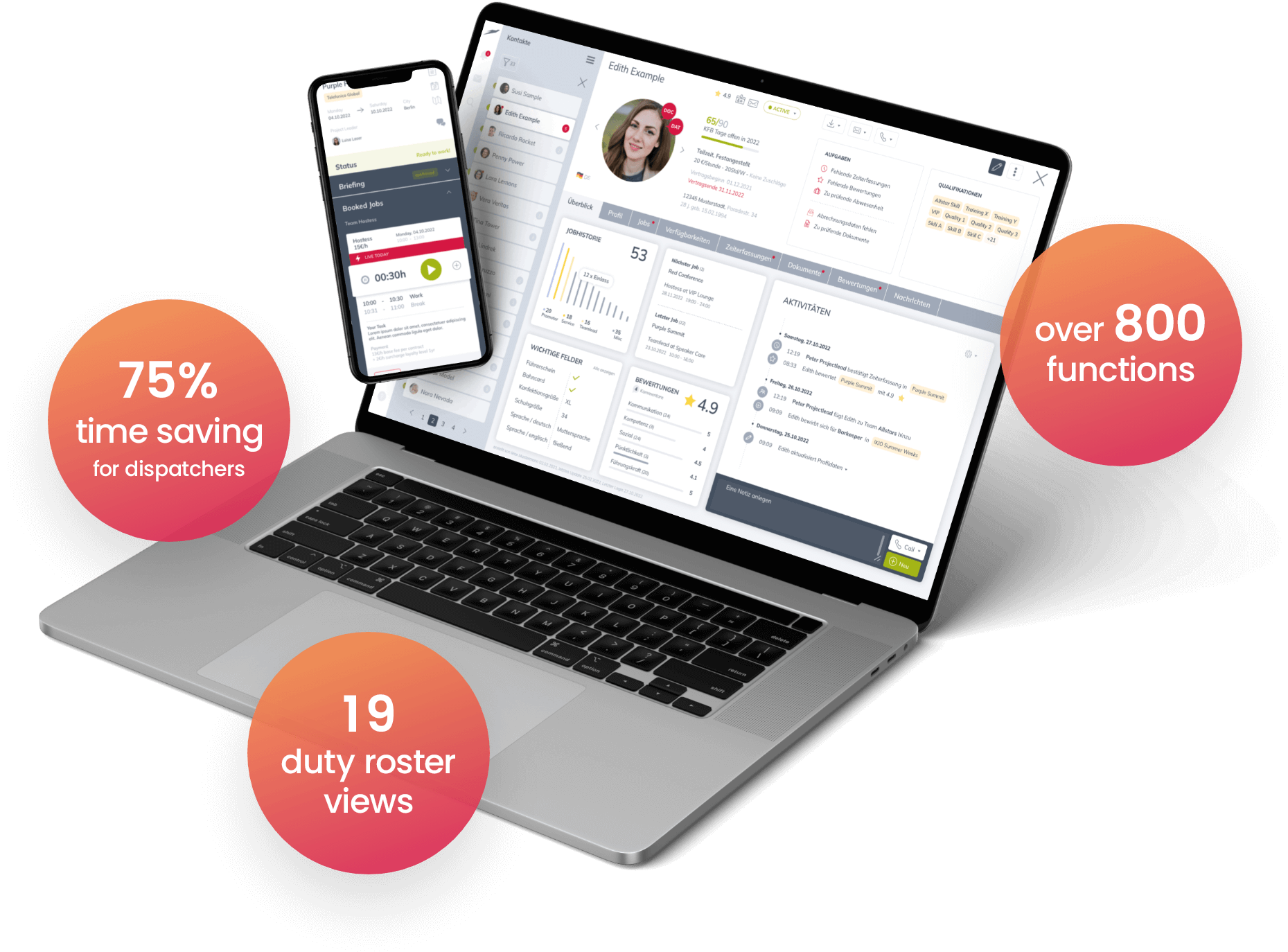
The employee database Teamhero’s personnel planning software can be particularly useful in this phase. It makes it possible to store all relevant information on team members centrally, from master data to individual qualifications.
Storming: Conflicts and initial friction
The storming phase is often characterized by conflict and friction. However, these conflicts are not necessarily negative. If they are dealt with constructively, they can contribute to the positive development of the team by clarifying who has which role in the team.
The communication functions of Teamhero, such as e-mail, SMS and in-app chat, can contribute to efficient conflict moderation.
Norming: The development of rules and standards
In the norming phase, the team develops common rules and working methods. Exercises for team development and strengthening the team spirit can have a particularly supportive effect at this stage.
The personnel planning software from Teamhero can help to establish a common way of working at this stage by simplifying planning and time recording.
Performing: The team in action
The team is now ready to work together productively. The Performing phase is about increasing the team’s work performance and achieving the set goals.
Teamhero’s 360-degree overview makes it possible to keep an eye on all important information about the team members and thus increase the overall performance of the team.
Adjourning: closure and new beginnings
In the adjourning phase, the team reflects on the entire process and prepares for the dissolution or the next task. Knowledge and experience are transferred to subsequent teams.
Teamhero’s data export function can be used here to transfer knowledge and experience.
Methods for team development: an overview
Outdoor team building: learning from shared challenges
Outdoor team building activities are designed to strengthen trust and cooperation within the team. By tackling challenges together in a natural environment, team members can improve their communication skills and develop a better understanding of their colleagues’ strengths and weaknesses.
This method is particularly effective because it takes the members of a team out of their usual working environment and puts them in a situation where they have to rely on each other.
Workshops and seminars: Targeted training
Workshops and seminars provide a structured environment in which teams can receive targeted training in areas such as effective communication, conflict resolution and decision-making. These team development methods are often modular and can be adapted to the specific needs of a team.
They are particularly useful in phases such as setting up a new team or integrating new members.
Team development through experiential education: practical exercises
Experiential education uses practical exercises and activities to give team members the opportunity to learn by “doing”. This method of team development promotes self-reflection and awareness of the dynamics within the team.
By applying mindfulness principles and practices, team members can develop a healthy approach to themselves and clear interactions with others. Such team development exercises help to keep conflicts constructive during the storming phase.
Team coaching: individual support
Team coaching is a more individualized approach and focuses on the specific challenges and opportunities that an existing team faces. The coach can help analyze the team dynamics and make specific interventions to improve the team’s performance.
This method is particularly helpful when it is accompanied by coaching for the company’s managers and key personalities.
Advantages of successful team development
Now that we have learned about the basic phases of team development, let’s look at the specific benefits of this process. Why should a company invest resources in team development? The answer lies in the many benefits it brings.
- Increasing productivity and efficiencySuccessful team development leads to an optimized work structure and a clear distribution of roles. This enables team members to focus on their respective strengths and tasks, which increases the productivity and efficiency of the entire team. Actively managed team development offers companies benefits such as cost reduction through optimized work processes and increased performance.
- Improved communication and conflict resolutionTeam development also includes improving communication and conflict management within the team. Through targeted exercises and team development methods, team members learn to communicate effectively and resolve conflicts constructively. This helps the company to achieve a better working atmosphere and fewer conflicts within the team.
- Increasing employee satisfaction and strengthening employee loyaltyAnother advantage of successful team development is the increase in employee satisfaction. When team members feel valued and can make the best use of their skills, this leads to greater motivation to work. This in turn reduces the fluctuation rate. One study has shown that higher employee retention has a direct impact on productivity and profits.
- Promoting innovation through diverse ideas and perspectives: Team development also promotes a team’s ability to innovate. Bringing together people with different skills and perspectives creates fertile ground for creative ideas and solutions. This leads to increased flexibility and a willingness to innovate within the company.
Conclusion: Do not neglect team development in the company
Team development is not a one-off event, but a continuous process that extends over the entire lifespan of a team. The systematic promotion of team dynamics and skills has far-reaching positive effects on the working environment and the success of the company.
Clear role allocation, effective communication and constructive conflict resolution not only increase productivity, but also employee satisfaction and loyalty. In addition, well thought-out team development promotes the innovative strength and flexibility of the team, which in turn strengthens the long-term performance of the company.
For organizations looking to invest in the long-term performance of their teams, Teamhero offers a range of features and services to support the team development process. Teamhero offers staff-intensive companies everything they need for successful team development. You can directly book online a Demo date request.