


Night surcharge: definition, calculation & regulations
The world of work increasingly demands flexibility and adaptability in order to meet the needs of a globalized and networked society. As a result, work is not only taking place within traditional daytime working hours, but shift work, night work and weekend work are becoming more important again.
The night bonus is an additional payment that employers pay their employees as compensation for work performed at atypical times. It is therefore an essential part of the wage structure for night workers and provides a financial incentive to work the less attractive hours. In addition, it is also intended to reward the special burdens associated with this work.
In this article, we explain the times to which the night allowance applies, when it is tax-free and what else the law says on the subject of night allowance.
What is the night surcharge?
The night bonus is a special form of time bonus and is granted in accordance with individual or collective agreements and statutory provisions. It is usually calculated as a percentage of the normal hourly wage and is paid for the hours worked during the so-called night working hours.
Night work is defined in the German Working Hours Act (ArbZG) as work that comprises more than two hours of the daily working time in the period from 11 pm to 6 am.

The night surcharge according to German law
The legal regulations in Germany regarding night work and night bonuses are set out in the Working Hours Act.
Working Hours Act (ArbZG): When is there a night bonus?
In Germany, the Working Hours Act forms the legal basis for the definition of night work and thus for the entitlement to night bonuses. § Section 2 (3) and (4) ArbZG defines night work as any work that comprises more than two hours of daily working time between 11 pm and 6 am.
Unless otherwise stipulated in collective agreements or individual agreements, employees are entitled to 25 to 30 percent of their gross salary. In principle, employers are obliged to pay special compensation for night work, as it places an increased burden on employees and poses potential health risks.
Collective agreements
Many industries have collective agreements that contain detailed provisions on night premiums. These collective agreements are contracts between trade unions and employers’ associations or individual employers and regulate wages, working hours and supplements. The night bonus is often specified in these agreements as a percentage of the hourly wage and is usually between 25 and 50 percent. However, collective agreements can also stipulate that night work is remunerated with a fixed amount per hour or with other forms of compensation.
For example, some collective agreements stipulate that higher bonuses are to be paid for night work performed on Sundays and public holidays, as these times are considered particularly vulnerable.
Regional variations
Although the Working Hours Act is regulated at federal level, there may be differences at state level, for example through state-specific implementation regulations or exemptions for certain sectors of the economy. In some federal states, for example, there are exemptions for the hospitality industry, which means that night shifts can be handled differently in this sector.
Special features in individual sectors
Due to their specific working conditions, some sectors have their own regulations regarding the night supplement. For example, a higher supplement may be justified in the care sector or for security services because working at night is more stressful.
Bakeries and pastry shops are an exception with regard to the times for the night surcharge: Here, the period between 10 p.m. and 5 a.m. is considered relevant.
EU directives
European requirements, such as the Working Time Directive (2003/88/EC), also influence the regulations on the night bonus in Germany. The directive stipulates that night workers must receive appropriate health and safety protection.
This includes, among other things, the right to appropriate compensation, which, as described above, can also be of a financial nature. The transposition of the Directive into national law must guarantee this protection.
Importance for night workers
The granting of night bonuses not only recognizes the additional physical and mental strain associated with night work, but also helps to improve the income of employees working under difficult conditions. Especially in industries where night work is common, such as care, catering or production, night bonuses represent a significant proportion of total income.
The additional financial compensation makes working at non-standard times more attractive for employees and makes it easier for employers to find staff for these shifts.
Night surcharge: times and calculation
The calculation of the night bonus depends on various parameters. Firstly, the basis for any calculation is the basic wage, i.e. the agreed hourly wage of the employee. Night bonuses are usually calculated as a percentage surcharge on this basic wage for the work performed at night.
Factors that influence the calculation
- Basic wage: The basic wage is the starting point for the calculation. The percentage night surcharge is added to this.
- Percentage of the surcharge: This value is often stipulated in collective agreements or in the company agreement and varies depending on the industry and company. It is often 25 to 40 percent for normal night work.
- Working hours: The number of hours worked during the night directly influences the supplement. The more night hours, the higher the supplement.
- Collective agreements/company agreements: These may contain specific regulations that influence the amount of the supplement or even stipulate certain flat rates.
- Statutory provisions: In some cases, legal regulations may specify the percentage of the supplement or the periods during which the supplement applies.
- Tax aspects: Night bonuses are tax-free to a certain extent. This tax exemption can apply up to a supplement of 25 percent for regular work between 8 pm and 6 am or up to a supplement of 40 percent for work between midnight and 4 am.
Example for calculating the night surcharge
Let’s assume that an employee receives a basic wage of € 15 per hour. The collective agreement provides for a supplement of 25 percent for night work. The employee works 10 hours at night in one week. The calculation of the night bonus for this week would be as follows:
- Calculation of the additional amount per hour:
- Supplement per hour = basic wage x percentage of the supplement
- Surcharge per hour = 15 € x 0.25
- Surcharge per hour = 3,75 €
- Calculation of the total night surcharge:
- Total night surcharge = surcharge per hour x number of night hours
- Total night surcharge = € 3.75 x 10 hours
- Total night surcharge = € 37.50
The employee therefore receives an additional amount of € 37.50 on top of her regular salary for the night work performed.
Differences to other wage supplements
The night bonus differs from other bonuses in that it is paid specifically for work at unfavorable times, in this case at night. Other bonuses such as overtime, public holiday or Sunday bonuses, on the other hand, take into account the additional hours worked outside regular working hours or on statutory rest days.
Each of these supplements has its own calculation method and its own conditions that must be met before it is paid.
Special features in the calculation
Sometimes the night bonus is not set as a percentage, but as a fixed amount of money per hour. This occurs when the employer and the employee representatives stipulate this in a collective agreement or employment contract. Combinations of percentage bonuses and fixed amounts can also be agreed in order to create special incentives.
Another aspect to consider is the combination of night and overtime pay. If an employee works overtime during the night, it is possible that they will receive both the overtime bonus and the bonus for night work. The exact handling must also be regulated in the collective agreement or company regulations.
While night bonuses can be tax-free to a certain extent, overtime bonuses often have to be taxed in full. This leads to complexity in the payroll accountingwhich requires specialized knowledge.
Who is entitled to the night supplement?
Employees who work at night as part of their employment relationship are entitled to the night bonus. Night work is defined in the Working Hours Act (ArbZG) as work that comprises more than two hours of daily working time in the period from 11 pm to 6 am. Night workers are defined as those whose working hours are predominantly at night and who regularly perform night work, i.e. on at least 48 days per calendar year.
Requirements for the claim
In order to be entitled to the night supplement, the following requirements must be met:
- The activity is carried out during the statutory night working hours.
- Employees are not covered by the exceptions set out in the Working Hours Act or collective agreements.
- There is no other compensation for night work in the form of time off in lieu, insofar as this would be possible under a collective agreement or company agreement.
- The claim was not excluded by special provisions in the individual employment contract.
It should be noted that night bonuses must also be paid if the night work does not occur regularly, but to an extent that goes beyond mere exceptional cases.
Assertion of the claim
The entitlement to the night supplement can be asserted in various ways:
- Approach the employer directly: Employees should first seek a conversation with the employer and point out the legal entitlement.
- Involve the works council: If there is a works council, it can provide support in enforcing the claim.
- Legal steps: If discussions remain unsuccessful, the claim can also be enforced by taking legal action before the labor court.
When asserting the claim, it is important to document your own working hours precisely in order to be able to prove your entitlement to the night bonus. It is advisable to keep working time records that show the exact start and end of working hours and breaks.
Expiry of the claim
As with many entitlements under employment law, the entitlement to a night bonus is also subject to an expiry period. This is often regulated in collective agreements or individual employment contracts and therefore varies.
In general, however, claims arising from the employment relationship must be asserted within a certain period, which is often between three months and one year. Otherwise the claim may lapse.
Exceptions to the payment of the night surcharge
Although the night bonus plays an essential role in the remuneration of night work, there are specific conditions under which employers are not obliged to pay it.
Collective agreements
In many sectors, collective agreements regulate working conditions and therefore also the entitlement to night bonuses. A collective agreement may contain provisions that deviate from the Working Hours Act (ArbZG), for example by stipulating lower bonuses or no bonuses at all for night work.
This possibility exists because the ArbZG allows collective agreements a certain amount of leeway. The background to these collectively agreed regulations is often compensation through other benefits, such as additional time off or an overall higher basic salary.
Compensation through free time
Another way in which employers can exempt themselves from paying the night bonus is by compensating with time off. This means that employees receive additional days off for night work performed, which is permitted in the ArbZG under certain conditions as an alternative to the night bonus.
However, this time off in lieu must be appropriate and granted within a certain time frame.
Seasonal and temporary employment
In some sectors, such as tourism or agriculture, there are seasonal workers or temporary employees who only work for the company for a short period of time.
These groups may be subject to special regulations that exclude or modify the entitlement to night bonuses, particularly if a collective agreement or works agreement provides for this.
How Teamhero makes your life easier
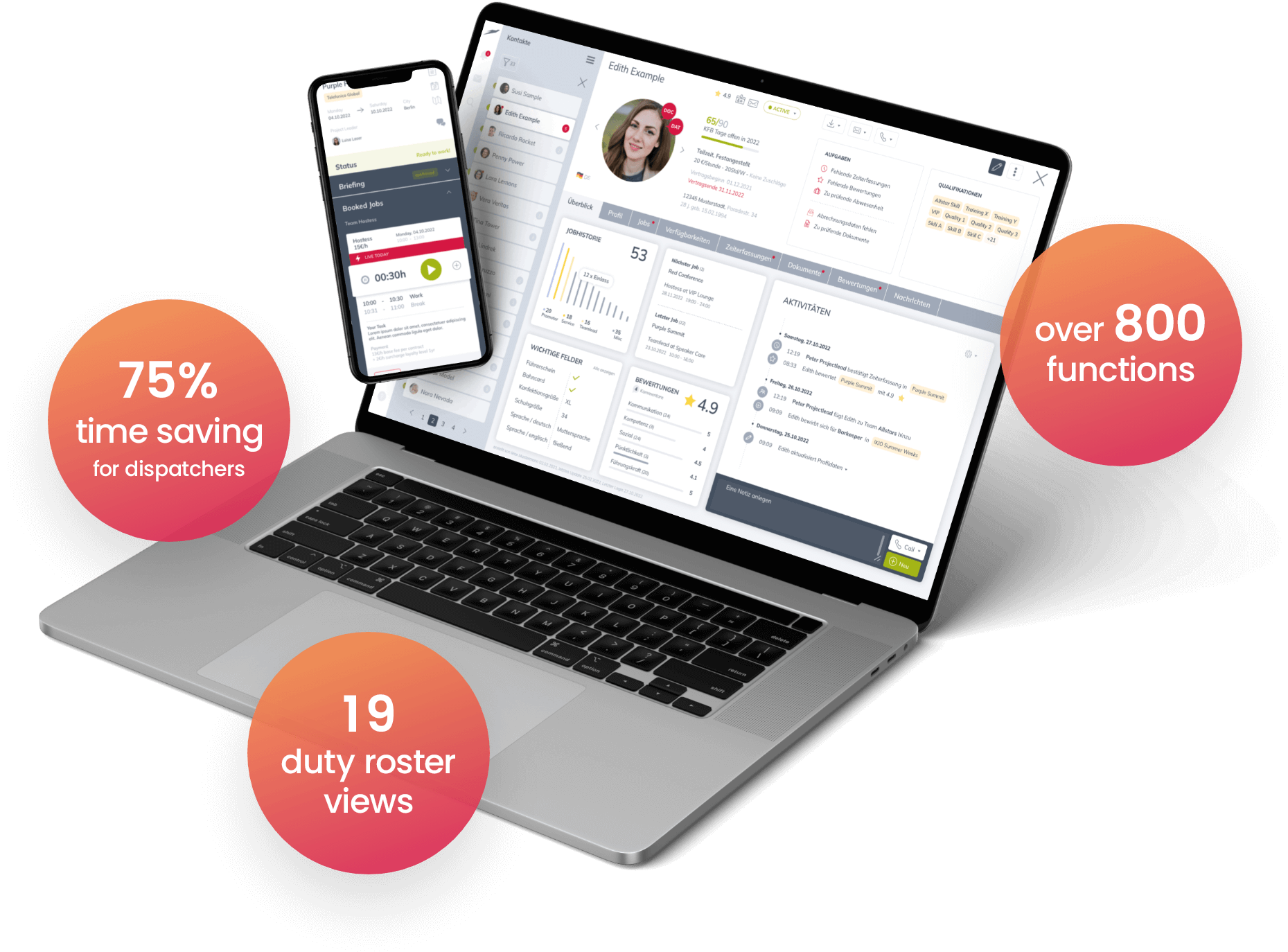
Teamhero makes it easier for you to manage all aspects of night work. Because with software, puzzling over night premiums becomes just a few simple clicks. Teamhero records working times like a pro and juggles the figures so that everything works out in the end: correct bonuses, satisfied employees, less headaches for you. Customizable, clear and efficient – Teamhero is the assistant you’ve always wanted at your side. It doesn’t get much simpler than this.
Find out more with your free initial consultation.