What is deployment planning?
Whether at a trade fair, a promotional campaign, a catering assignment or in security services: as soon as many employees work at different locations and at changing times, the organizational effort increases.
Who takes on which assignment? Who is available? Who has the required qualifications?
Good deployment planning helps here by connecting employees, tasks, working hours and work locations. Companies with flexible teams, short-notice projects and many changing assignments in particular need structured planning.
The key points at a glance
- Deployment planning describes the assignment of employees to specific tasks, projects, shifts or work locations.
- Good deployment planning takes into account availability, qualifications, working hours and the requirements of each assignment.
- Operational and strategic deployment planning pursue different goals.
- Event venues, personnel service providers, promotion agencies and other businesses with changing teams benefit especially from clear planning processes.
- Digital tools can bring together employee information, communication and time recording in one central place.
What is deployment planning?
Deployment planning describes how employees are organized for specific tasks, projects or periods of time.
Available employees are scheduled according to their qualifications and the requirements of an assignment. When it comes to employees, deployment planning is often referred to as workforce deployment planning.
Good deployment planning takes various factors into account:
- Which employees are available?
- Which qualifications are needed for the assignment?
- Where does the assignment take place?
- Which working hours apply?
- What information does the team on site need?
An example:
A hostess agency organizes several trade fair appearances at the same time. One assignment requires employees with certain language skills, while for another, experience in dealing with customers is the priority. Deployment planning helps assign suitable people to each task.
The difference between deployment planning and duty rostering
The terms “deployment planning” and “duty rostering” are often used in similar ways, but they differ in scope.
A duty roster primarily determines who works when. It is often used for fixed shifts and recurring working hours.
Deployment planning also looks at the relationship between employees, tasks and projects. Among other things, it takes into account:
- specific activities
- work locations
- the requirements of the job
- qualifications
- availability
For companies with changing projects and flexible teams in particular, this additional overview is absolutely essential.
The different types of deployment planning
Companies use different forms of deployment planning. Which method is suitable depends on the industry, team size and how work is organized.
Operational deployment planning: organizing current assignments
Operational deployment planning deals with the day-to-day organization of employee assignments.
This includes, for example:
- assigning specific tasks to employees
- planning shifts and working hours
- replacing staff who drop out at short notice
- communicating changes to teams
- providing assignment information
Especially in industries with short-notice changes, the people in charge need to be able to respond quickly.
An example:
A security company receives an additional order at short notice. The person in charge has to check which employees are available and meet the necessary requirements. Up-to-date information on availability and qualifications makes these decisions easier.
Strategic deployment planning: preparing for staffing needs early on
Strategic deployment planning looks at a longer period of time. Companies use it to assess future requirements and prepare their capacities better.
Typical questions here are:
- How many employees will be needed for the upcoming event season?
- Which projects are coming up?
- Where could bottlenecks arise?
- Which qualifications will be needed in the future?
A catering company, for example, can plan early on how many employees will be needed for larger events.
Digital deployment planning: managing information centrally
For small teams, simple lists may be enough. As soon as many employees, projects and work locations come together, managing them quickly becomes confusing.
Digital deployment planning brings important information together in one central place:
- employee data
- availability
- qualifications
- assignment histories
- working hours
- documents
- communication
As a result, the people in charge no longer have to piece together information from various spreadsheets, messages or files.
The key components of deployment planning
Good deployment planning connects several areas. Each factor influences how reliably assignments can be prepared and carried out.
Managing employees and qualifications
The basis of any planning is up-to-date employee information.
The people in charge need to know:
- What experience does a person bring?
- Which qualifications and certificates do they have?
- Which assignments have they already worked on?
- When are they available?
Central employee management makes it easier to keep track. Planners can see more quickly which employees are suitable for certain tasks.
Taking availability and working hours into account
Flexible teams have different working hours, absences and availability. Good deployment planning takes this information into account before a job is staffed.
Various factors play a role here:
- preferred times and available periods
- absences and vacation times
- working time regulations
- assignments that have already been scheduled
This gives companies a better overview of which employees are suitable for a job.
Planning must also take into account legal requirements such as working hours, break rules and rest periods under the Working Hours Act (Arbeitszeitgesetz, ArbZG).
Coordinating assignments, projects and locations
Many companies organize several jobs at the same time. Without a clear overview, overlaps or follow-up questions quickly arise.
Structured planning shows:
- which job is scheduled
- which employees are involved
- where the assignment takes place
- which tasks will be performed
- what information the team needs
Organizing communication with employees
Short-notice changes are part of everyday life in many industries. A work location changes, someone drops out, the weather changes or additional information needs to be passed on.
When information is spread across email, messaging apps and individual spreadsheets, the coordination effort increases.
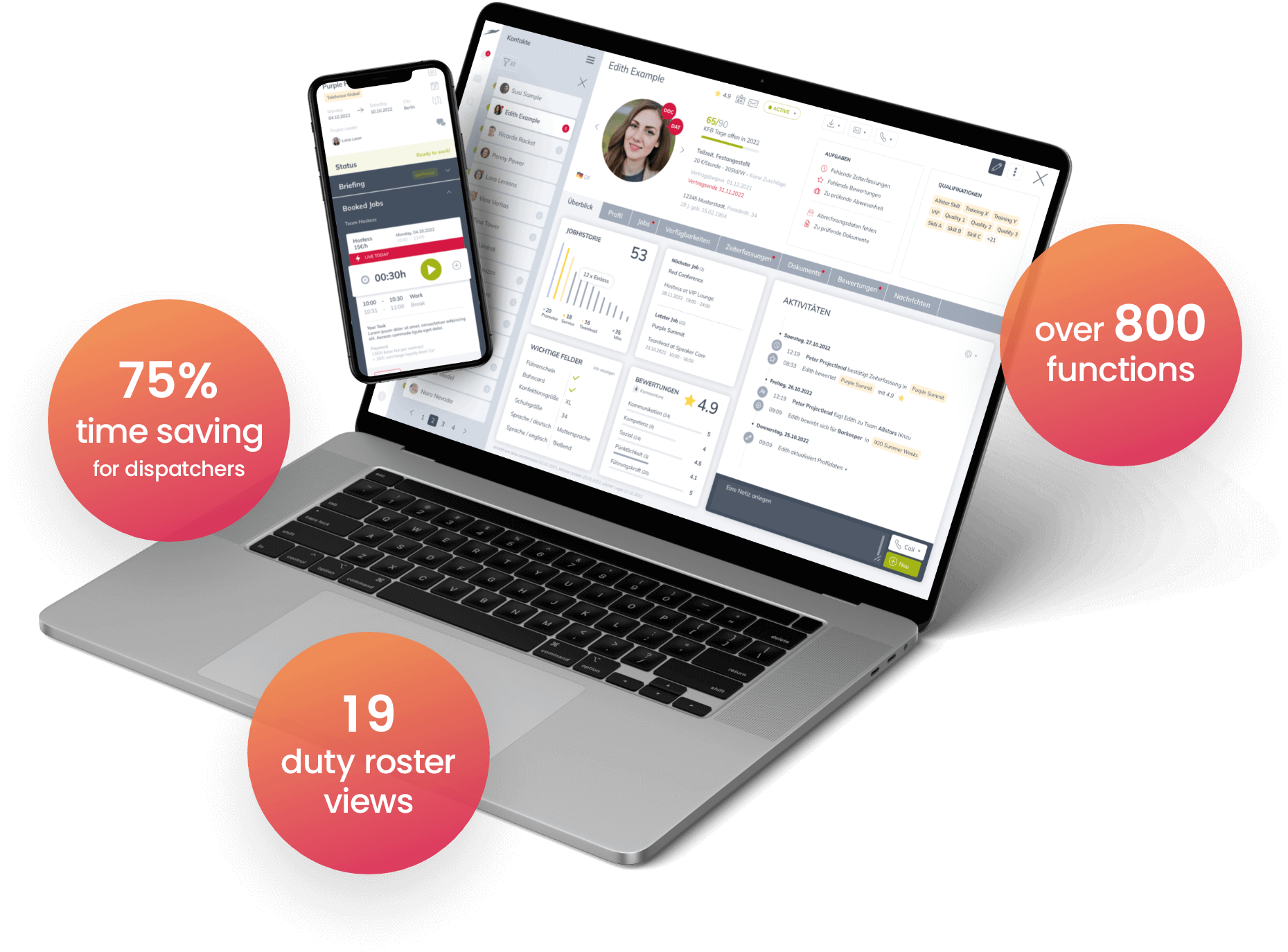
Digital deployment planning with an employee portal and mobile app enables direct communication between the planning team and employees. Assignment details, working hours and important information are available centrally. Employees can enter their availability and stay informed about changes even when they are on the go.
This helps companies reduce follow-up questions and makes coordination easier when short-notice adjustments are needed.
Recording working hours digitally
After an assignment, working hours have to be documented and checked. Especially with many changing teams, this process can be time-consuming.
With digital time recording, working hours can be assigned directly to an assignment. This gives companies a better overview of the hours worked and simplifies the follow-up.
Areas of application for deployment planning
Structured assignment planning is particularly relevant for companies that need to coordinate many employees flexibly.
Event and trade fair industry
Trade fairs, events and promotional campaigns often come with changing requirements. Different work locations, times and tasks have to be coordinated with one another.
Example: At a trade fair lasting several days, reception, visitor support, promotion and service are handled by different teams. Planning has to take into account which people are available when and what experience they bring to each task.
Promotion agencies
Promotional campaigns often take place at various locations and with changing teams. The people in charge need to see quickly which employees are available and whose experience fits a particular job.
Central planning makes it easier to manage large employee pools and reduces the coordination needed between project management and the team.
Hostess agencies
Qualifications play an important role in trade fair and event assignments. Language skills, experience in dealing with customers or specific industry knowledge may be required.
Clear deployment planning helps select suitable employees for different tasks.
Personnel service providers
Personnel service providers often coordinate many assignments for different customers. Requirements, availability and qualifications have to match. A central solution provides a better overview of employee profiles, scheduled assignments and open requirements.
Security services
In security services, qualifications, assignment times and traceable documentation are particularly important.
Effective planning helps schedule suitable employees for specific tasks and make assignment information centrally available.
Catering companies and the hospitality industry
At events, staffing needs often fluctuate. A large event requires different capacities than a small job.
Flexible deployment planning helps put together teams according to the respective needs and take short-notice changes into account.
Manual or digital? Which solution is right for you?
Many companies start out with Excel spreadsheets or individual lists. This method can work for smaller teams.
However, as the number of employees grows, challenges often arise:
- information is stored in several places
- changes have to be transferred multiple times
- availability is difficult to keep up to date
- coordination takes a lot of time
- errors from manual transfers become more likely
With Teamhero, companies can manage employees, assignments and working hours in one place. Availability, qualifications and assignment information can be stored centrally.
This gives the people in charge a better basis for day-to-day planning and allows them to deploy teams in a more targeted way. Communication with employees can also be simplified. Via the employee portal and the mobile app, assignment information is available directly.
Deployment planning creates clarity for changing teams
Deployment planning connects employees, tasks and work locations. Companies with flexible teams and many parallel projects in particular benefit from clear processes and up-to-date information.
Good planning is based on reliable employee data, transparent processes and simple communication between the people in charge and their teams.
Digital solutions like Teamhero help companies organize staff assignments centrally, record working hours and reduce the day-to-day planning effort.
FAQs
How does digital deployment planning work?
Digital deployment planning is done using software in which companies centrally manage employees, availability, qualifications and assignments. Changes can be updated directly and shared with the people involved.
What is the difference between deployment planning and duty rostering?
A duty roster mainly shows when employees work. Deployment planning also takes into account tasks, projects, qualifications and work locations.
What information is needed?
Good planning requires, among other things, information on employees, qualifications, availability, working hours, work locations and tasks.
For which companies is deployment planning particularly important?
Deployment planning is particularly relevant for companies with changing teams and many parallel assignments. These include event agencies, promotion and hostess agencies, personnel service providers, security and driving services, and catering companies.
What are the benefits of digital planning?
Digital planning creates a central overview of employees and assignments. Changes are easier to manage, and information can be shared with everyone involved more quickly.