


Take off with OKRs in your own company
Before you get started with OKR in your company
Before you start using OKR in your company, it is important to have a clear understanding of the challenges you want to solve. Or in other words: the objectives that OKR should help you to achieve.
For most organizations, OKR solves the challenge of implementing the business strategy in a way that is clear, transparent and measurable for all employees. For this to be successful, an organization should have a neutral “OKR expert” to implement and manage OKR in your company. To ensure that everyone understands exactly what is meant, you can read, internalize and share the OKR terms and their meaning in our previous blog article Objectives and Key Results – a new kind of high-tech glasses or what can they do?
We normally refer to this “OKR expert” as the “OKR Ambassador”. Their role is to ensure that everyone using OKR is trained, engaged and receives ongoing help and guidance. While OKR is a method, it is also a learning process that often involves a fundamental shift in the way people think about and measure their work. Away from a focus on pure output and towards a focus on results. Each organization develops its own individual OKR culture. This is precisely why the OKR Ambassador must take great care to ensure that all members are empowered and know the exact style. OKRs should be comparable and the entire process should be moderated. If this is not the case, high levels of frustration and rejection can arise and the OKR introduction will have failed before it has even begun.
The structure of an OKR rollout in an organization can be set up as shown in the diagram below. A recurring reflection and learning process takes place in each self-contained stage. In each new cycle, each iteration, the OKRs are created in a better, more coordinated and more targeted manner. Information, decisions and objectives flow not only top down but also bottom up.
Through clear transparency down to all levels of the organization, every member of the organization can see their contribution to the big picture and thus their progress towards achieving the vision.
Setting the correct OKR rhythm
There are no dogmatic guidelines on how OKRs must be organized in terms of time. Only continuity and stringency are fundamentally important. OKRs are usually prepared in two periods, namely annually and quarterly. The corporate objectives run in annual cycles, which coincide with the annual iteration of the strategic review of most companies.
This makes it easy to translate the organizational strategy into corporate goals. Group OCRs, which are owned by teams and departments, follow a quarterly iteration. This allows for shorter review cycles and makes it easier for organizations to change direction if tactics are not driving progress on the corporate OKRs for the year or if surprise market changes occur.
In principle, an organization should plan to run the OKR process over approximately three to four cycles until all the desired effects can be achieved. As always in life, this competence must first be learned and the OKR muscle must first be trained.
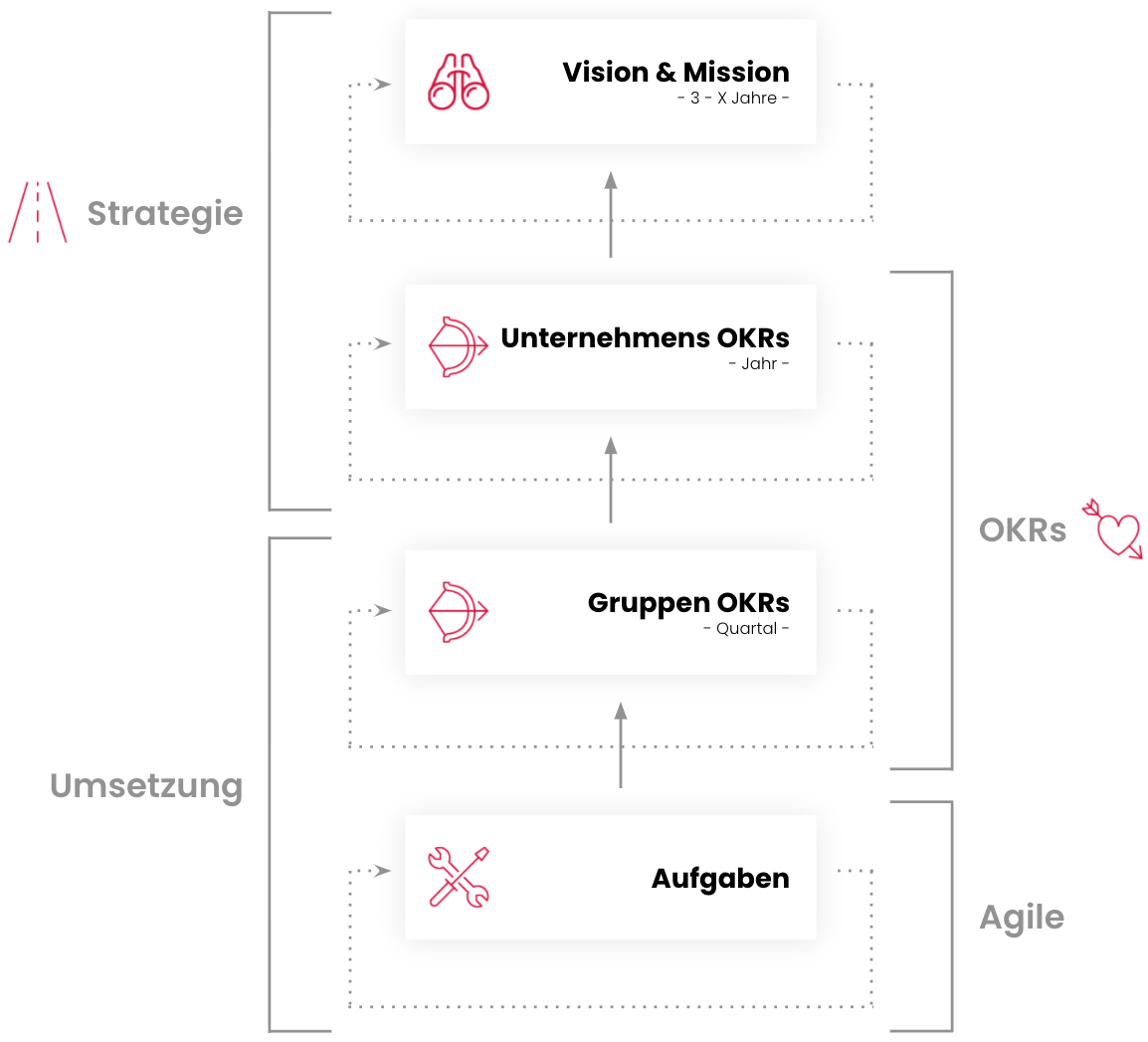
Explanation of the OKR top-down and bottom-up process when OKRs are introduced in a company.
How can OKRs fail in a company?
There seem to be so many benefits, and from the lines above it’s easy to get the impression of how simple it all is. But be warned, there are a few pitfalls to be aware of. We’ll show you a few here:
# 1 Simply forget
A common reason why employees don’t achieve their goals is simply that they have forgotten them because of all the hustle and bustle and a thousand other things. There are always exciting, new and topical issues – but seriously, are they always that important? Do they contribute as much to achieving your vision as your OKRs? Does solving the short-term solution to requirements move you forward just as much as working on topics that have a real impact on your company?
So our tip: every employee, every team discusses and updates their OKRs on a weekly basis. This creates communication, uncovers problems and gets the train back on track.
# 2 Change something quickly
It seems tempting to adapt the current OKR set in the current cycle once again to the current circumstances. But no, don’t do that. There was a clear reason why you developed the OKRs the way you did. Take the experience with you into the next cycle, but don’t change it on the fly. This creates confusion and undermines the authority of the agreed objectives. In the end, everyone could say: “Oh well, we’re not achieving the results, let’s adjust the target instead.” You should not let this cat out of the bag.
# 3 Focus, focus, focus
To make a long story short: A lot doesn’t help a lot with OKR. Organizations are often tempted to simply include all kinds of topics, projects and results in the quarterly OKR set. In the end, a lot happened and yet nothing. A little bit everywhere and yet nothing finished.
If there is one dogma for OKRs, it is this: a maximum of 5 targets with a maximum of 3-5 key results per owner/department/group. Get involved and concentrate on the OKRs that have a real impact on your company. Don’t get distracted and use the method as a filter for what is really important.
In the end, every member of the organization should be able to explain off the top of their head what the annual and quarterly goals are for the organization and the individual. If it’s “I’ll have to look that up first”, then you’ve done something wrong.
# 4 The OKR method is not a control tool, but a management tool
OKR creates transparency and seeks objectivity in the clearly measurable key results. Avoid standing behind your employees’ backs and dictating every single step or trying to understand how the goal will be achieved. Start leading and empower your team to overcome obstacles on the way to achieving the goal. Take a look at our blog post Radically honest – Simply not being an asshole as a leader. It will give you a good impression of what we mean.
OKR only works with self-responsible action, trust and empowerment. Remember that team members ideally define the OKR sets for themselves. They are then committed and must explain at the end of the cycle how and why a result was or was not achieved.
Do not use the weekly check-ins to exert pressure, but look for blockers and obstacles that are preventing progress. Use the confidence level to find out where things are not going well. In doing so, you will discover through dialog how focused and relevant conversations can be. Your OKR method in your company is your friend, your companion, who is always with you in your head – in the entire team.
In the end, it’s not about giving your team, your company specific tasks, but about inspiring your organization to run towards the vision on its own. Think of a soccer coach and a soccer team: does the team win where the coach defines every single step and move, or the team that is well-coordinated and highly motivated because the coach has welded them together and aligned them towards a common goal? You understand …
Get started, fail, learn and start again
As you can guess from the last few paragraphs, it requires discipline in terms of focus, transparency, self-organization, time and commitment. The claim alone that the target achievement is not one hundred percent, but seventy percent, makes it clear how unusual and different OKR is. We Germans in particular find this difficult to deal with. Everything has to be exact and one hundred percent. But no. If a target is achieved at one hundred percent, it only shows that it was set incorrectly. Perhaps a 120 or 150 percent result would also have been possible. Evaluate. Reflect. Understand. Reflect. Share. Learning and starting again for the new cycle.
Be brave and don’t despair. The first OKR sets will be a big disappointment. But you will see results. You will feel the OKR sets speak to you and give you feedback on questions you didn’t even have in mind. OKRs are designed to get you to do more than you knew you were capable of and to learn from the experience.
With each OKR cycle, you become smarter, faster, simpler and clearer. The results will also follow, as you will notice much more quickly and clearly where things are going wrong. And it’s not just you who will learn, but the entire organization. Because as Thomas A. Edison said: “I have not failed. I have only found 10,000 ways that don’t work.”
The most important OKR rules
- Objectives are time-framed route targets with strategic value.
- Key results are not tasks, but measurable waypoints on the way to the goal. They show us whether we are on the right path.
- Quality before quantity. Max. 5 goals with a maximum of 3-5 key results. Trust that focusing will get you ahead faster than fiddling around with everything.
- Appoint a neutral OKR Ambassador to cultivate the method in your organization.
- Start leading and not controlling.
- Keep track of your OKRs on a weekly basis and discuss them.
- Do not change existing OKR sets.
- Have the owners of the OKR sets confirm these bindingly in order to generate maximum motivation.
- If you fail, get up again and carry on.
You can also subscribe to our newsletter and be proactively informed about news on our blog. Register directly here: https://www.teamhero.de/newsletter/
We would like to thank our partner Perdoo www.perdoo.com for their great input.

Books to introduce OKR in companies
Further links
High Output Management by Andrew Grove EN
High Output Management by Andrew Grove EN