


Qualitative personnel planning: the big picture
Personnel planning is a key aspect of modern management. Personnel-intensive companies in particular benefit from good personnel planning, as they can save a lot of time and money in the long term and increase their productivity at the same time. Qualitative personnel planning in particular is playing an increasingly important role.
In the following text, we describe in more detail the differences between the two areas – quantitative and qualitative HR planning – and discuss their advantages and objectives. You will also find out which tools will make qualitative personnel planning easier for you.
What does personnel requirements planning actually mean?
The corporate objective is at the heart of personnel requirements planning. Within personnel requirements planning, the individual need for employees is determined that is necessary to fulfill the company’s objectives in the short and long term. On the one hand, this involves the number of employees and, on the other, their qualifications. This includes hard and soft skills.
The aim of personnel requirements planning is to ensure that the company can respond to requests with confidence at all times and that there are no bottlenecks even when workloads are high. This means that there should always be sufficient and, above all, appropriately trained employees available to deliver consistently high-quality results.
Ideally, they should not be given too little or too much work. This keeps competitiveness at a healthy level. We will discuss the advantages of this separately later on.
What is the difference between quantitative and qualitative personnel requirements planning?
Personnel requirements planning is divided into two relevant components – qualitative and quantitative calculation.
Quantitative personnel requirements planning
As the name suggests, quantitative personnel requirements planning is all about numbers. Primarily, the number of employees or project staff required to manage current and future projects in a targeted manner with full success is recorded. There must be neither underemployment nor bottlenecks.
When calculating quantitative personnel requirements planning, the number of employees required is calculated, but the position, salary and working time model are also taken into account. In addition, very individual calculation bases are sometimes required for each company, which can result in a high level of complexity. With its clever software, Teamhero supports companies with a high staffing density, such as promotion agencies, catering companies, trade fair organizers or personnel service providers, in their planning.
Qualitative personnel requirements planning
Qualitative personnel requirements planning involves discussing which qualifications a company’s employees should have in order to carry out the required tasks to the full satisfaction of the customer.
Among other things, an eye is kept on technical and mental aptitude in the form of school education, professional background and possible further training qualifications. Some employers also require certain physical attributes, for example the ability to transport heavy objects or operate machines. The second aspect, which should by no means be neglected, is soft skills, which are reflected in the individual character of the employee.
During the recruitment process, consideration should always be given to the future requirements that need to be placed on the candidate. This includes, for example, dealing with technologically advanced software solutions that are to be introduced due to their high relevance. It is also important to consider other short, medium and long-term requirements relevant to the industry and to formulate job advertisements carefully.
Why is (qualitative) personnel requirements planning so important?
There is hardly a company today that is not subject to constant change. On the one hand, there is the constantly changing economic situation, and on the other hand, technological development is still progressing at an enormous speed. In order to meet the demands of both the present and the future and remain competitive, it is crucial to be able to react quickly and flexibly to new requirements.
With professional personnel requirements planning, you can prepare for emergencies – such as a decrease or increase in orders or possible industry events. This means you will never find yourself in the position of having to turn down orders due to a lack of available or insufficiently trained personnel.
If you calculate your staffing requirements accurately, you also ensure that your employees are deployed to positions in line with their qualifications and ideally are neither under- nor overstretched. If you carry out your task with an innovative software tool such as Teamhero, you always have an overview of your employee portfolio and can therefore not only plan assignments at short notice, but also offer personnel targeted further training measures. This has a positive effect on employee satisfaction and team spirit on the one hand and increases productivity on the other.
In addition, regular personnel requirements planning can save a lot of money within HR management: Competent and trained employees can be promoted and are therefore less likely to leave, new recruitment no longer has to be carried out unplanned in a hurry and expensive redundancies no longer have to be made.
In a nutshell: The biggest advantages of workforce planning
- High scope for reaction in the short and long term
- Overview of personnel costs and potential savings
- Development and maintenance of a healthy personnel structure
- Optimum customer satisfaction
- Good image and recommendations thanks to consistently high quality
- Optimization of employee satisfaction
- Increasing competitiveness on the market

What are the tasks of (qualitative) personnel requirements planning?
Within the planning horizon, there are two ways of looking at personnel requirements. One of these is dedicated to strategic long-term planning. This usually very extensive and precise planning is used, for example, when restructuring is planned in the company. However, due to the possibility of changes, it should be reviewed regularly.
Operational planning has a much shorter observation period, which is intended for current projects. Consider in advance which of the two you would like to develop for the moment.
The next step is to focus on the company objectives and the areas of responsibility that are relevant to your company. Activities that fall under the relevant job positions provide information about the skills that employees must have in order to fulfill them. Develop a list of the most important hard skills required and discuss the soft skills that make an applicant ideal for the position. The right composition of a team has a significant impact on its performance. Sometimes it makes sense to have similar characters in the team, in some cases different and therefore complementary characteristics are an advantage.
These considerations and questions can help with qualitative requirements planning
Qualitative personnel requirements planning in particular can be extensive, especially for personnel-intensive companies. The following steps and considerations can help you to create a suitable structure:
Consideration of the current situation
Take a look at how your business is positioned economically. Think about which areas you would like to expand in the near or distant future. At this point, it is also important to determine the importance and urgency of digital transformation for your company. This gives rise to the following key questions:
- What expertise should my employees have?
- Which qualifications and skills are already covered by enough employees, and which are still missing?
The development and revision of requirement profiles
This task is at the heart of qualitative personnel planning. You should be able to describe the skills that your employees should have in the individual departments and positions as precisely as possible. A detailed requirements profile for the relevant positions is the basis for further measures. Ask yourself the following questions:
- What expertise should the person in that position have?
- What other knowledge would be an advantage?
When reviewing older profiles, it may also be beneficial to remove skills that are no longer relevant.
- Are software tools or machines now taking over tasks that used to require human input? If so, what are they?
- Are new skills required to operate these systems?
The definition of competence centers
After determining the relevant hard and soft skills of your staff, it is important to skillfully allocate the available know-how to the right areas. Considerations in this regard could be as follows:
- Are all core competencies available frequently enough? Is it possible to step in quickly if staff are absent at short notice?
- Do all departments have equally distributed potential? Where can still be optimized?
- Does it make sense to transfer individual employees in order to create a better balance of skills in individual departments?
The formation of competence centers can be helpful in this regard, especially in larger companies, in order to maintain an overview.
Discussion of measures to promote personnel
It is cheaper and often more efficient than recruiting new staff to offer qualified employees training or other further training opportunities to prepare them for future tasks and challenges. Sometimes it is also the case that certain people in the workforce are made for other tasks and perform better than in their current role. Internal promotions can also have a positive impact on employee engagement.
So ask yourself:
- Do new appointments make sense or are internal new appointments or reshuffles sensible or possible for a qualitative increase in performance?
- Which further training measures provide the teams with the skills they will need in the future?
What are the objectives of (qualitative) personnel requirements planning?
While quantitative planning is still about headcount in figures, qualitative personnel requirements planning takes a closer look at the personnel requirement structures for the positions to be filled. This applies both before new appointments are made, for example at companies in the live entertainment sector, and before certain projects.
It is not uncommon for emergency personnel to have to be rescheduled for other tasks directly on site at short notice. This is where the efficiency of the existing quantitative and, in particular, qualitative personnel planning comes into play. The aim is to ensure that, for example, when staff are absent, colleagues can step in and complete the same tasks in the required quality and time as the original main person responsible. A well-thought-out requirements profile for every position in the company and regular checks to ensure that it is up to date is extremely important for qualitative personnel requirements planning.
Do you want to create an optimal working environment in your company? Qualitative personnel planning is also committed to this goal. Social and intercultural skills are even more important in our society and working world than school grades or the type of school-leaving qualification. The perfect team is made up of experts who fit together on a personal level, support each other and whose skills complement each other. In the same way, such harmonious cooperation can be achieved and the efficiency of work performance can be raised to a desirable level.
Which instruments can be used to determine (qualitative) personnel requirements?
A primary organizational tool within qualitative personnel planning is certainly the job description and job description. They contain all relevant points that are important for personnel selection. They should exist independently of a current personnel search and be updated regularly. With their help, personnel requirements and performance can be presented transparently, from which possible personnel requirements can be derived.
The following information should be disclosed to relevant stakeholders and discussed where appropriate:
- Job title
- Position tasks
- Job targets
- Powers
- Areas of responsibility
- Job requirements
In traditional professions, a requirements profile based on the classification may also be sufficient for qualitative personnel planning. In most cases, however, it requires more extensive work. If the relevant lists are available, the employee requirements are determined within a personnel deployment plan by comparing actual and target figures.
Qualitative personnel planning made easy – with Teamhero
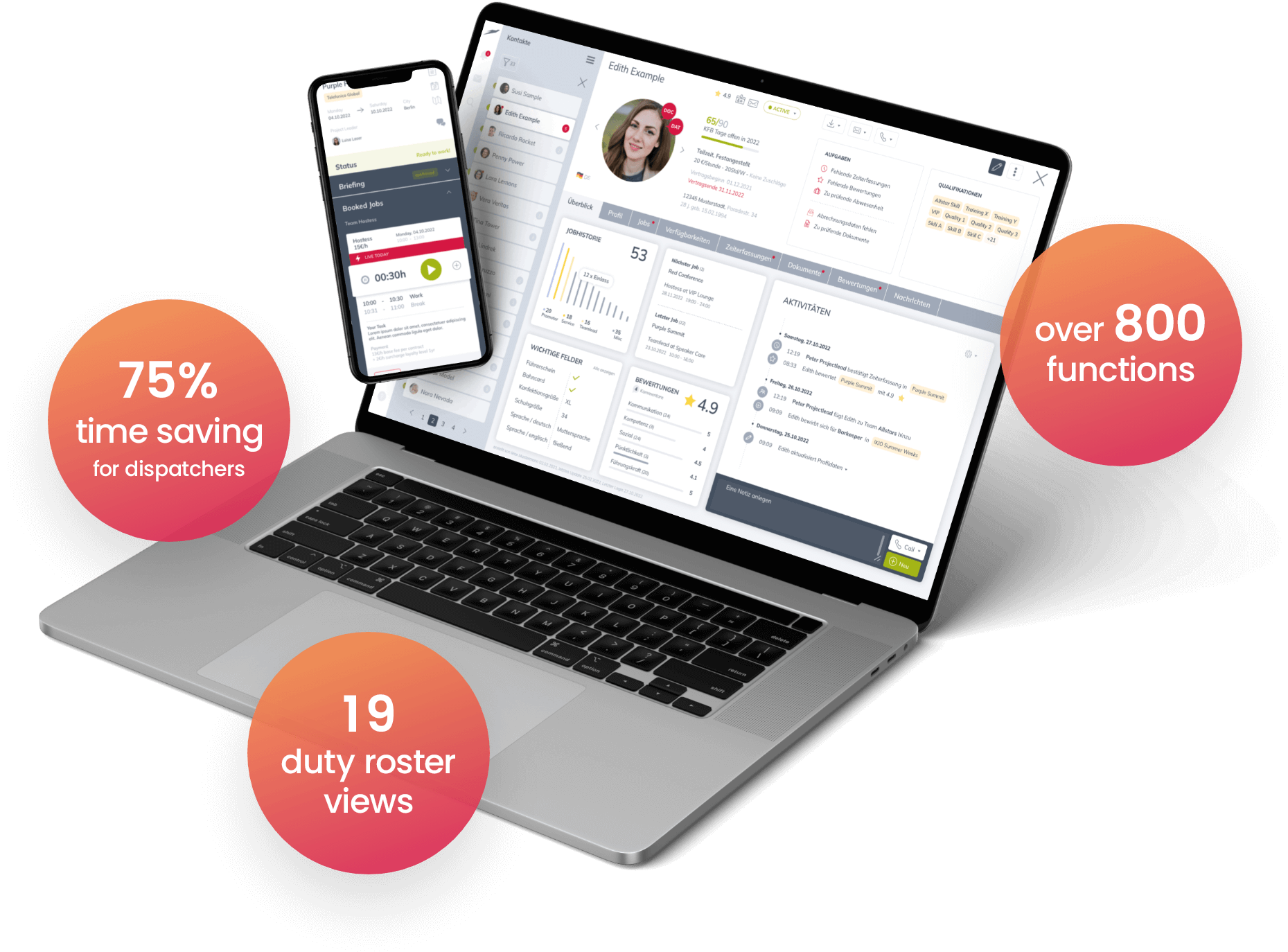
Quality workforce planning can be a complex and time-consuming task, especially for companies with a large workforce. Teamhero offers these companies in particular an outstanding personnel management software solution that makes all processes within personnel planning child’s play.
Selected features at a glance
- Master data management: Benefit from a simple and central personnel file that also allows for individual fields.
- Manage castings and job interviews: Create and manage all appointments and invitations in the same tool.
- Manage applicants: After recruitment, new team members can be transferred directly to the personnel database.
- Personnel database: Easily use an interface within which employees can, for example, specify their desired working times, record their times and apply for internal jobs.
- Document management: Choose from existing templates and create standardized documents in no time at all. Store them centrally and control access rights securely.
- Data export: Create the required overviews, evaluations, sedcards and more in just a few seconds.
Sounds interesting? Then why not test Teamhero for yourself in the next step? Select your preferred time for a non-binding initial consultation with one of our team members. Once all your questions have been answered, we will send you a demo version. We look forward to getting to know you.