


Overtime reduction: Measures to reduce overtime
For many people, overtime has become the norm. However, although some employees see the extra hours as an opportunity for a financial bonus or additional time off, overtime can lead to strain and health problems in the long term.
It is crucial for both employees and employers to develop and implement strategies and measures to reduce and eliminate overtime. In this article, we explain why this is the case and what options are available.
Reduce overtime: Opportunities and strategies
Overtime arises for a variety of reasons: Sometimes there is an urgent project that needs to be completed or unexpected absences in the team. Regardless of the cause, the question arises:
What is the best way to reduce this overtime? What options and strategies are available, and what legal and organizational aspects should employees and employers consider?
Working off overtime – how does it work and what should I bear in mind?
Many people are familiar with the term “overtime compensation”. This refers to the compensation of overtime through time off.
Although the law does not regulate exactly how overtime is to be reduced, collective agreements or employment contracts usually contain corresponding provisions.
Employees cannot decide on their own when to reduce their overtime. This decision lies with the supervisor. This means that the supervisor can theoretically decide from one day to the next that the overtime should be reduced. If employees wish to reduce their overtime at a specific time, they must discuss this with their line manager.
Reduce vacation or overtime: The best course of action
Whether it is better to have overtime paid out or to work off overtime depends on your personal situation.
Many employment experts advise taking time off in lieu for overtime in order to really recover. If overtime is paid out, taxes are also due, as this is normal wages.
However, if employees fall ill while working off their overtime, they are not entitled to make up the lost days, unlike in the case of vacation.
Reduce overtime: Rights and obligations for employees
The right to reduce overtime is firmly anchored in the Working Hours Act. Employees therefore have the right to reduce their overtime in an appropriate manner.
Employees are obliged to document their overtime correctly. An accurate working time account is essential here. It not only serves as proof to the employing company, but also helps employees to keep track of their own hours. In addition, employees should proactively seek dialog with their employer when it comes to reducing overtime.
However, employers also have a duty to ensure that overtime is reduced in a regulated manner. They must therefore ensure that the legal requirements are met and that employees can reduce their overtime in an appropriate manner.
Labor law aspects of overtime reduction
The Working Hours Act and its regulations for overtime
According to Section 3 of the ArbZG, the working day of employees may not exceed eight hours. However, it can be extended to up to ten hours, provided that an average of eight hours per working day is not exceeded within six calendar months or 24 weeks.
The aim of this regulation is to protect employees from overwork and prevent health risks such as burnout or depression. Employees therefore have a legal right to overtime compensation.
Overtime reduction contractually agreed: What to look out for?
It is essential to check the employment or collective agreement to clarify how overtime is handled. In many cases, these contracts contain specific provisions on whether and how they should be compensated.
If, for example, the collective agreement expressly stipulates that overtime must be compensated in cash, compensation in the form of time off is not possible.
In the past, employment contracts often stated that all overtime was already compensated with the normal salary. However, the Federal Labor Court ruled in 2010 that such unclear formulations are not permitted.
The contract must state exactly how much overtime is covered by the salary. For example, the contract could state that 15 percent more than the normal weekly working hours or three hours of overtime per week are already covered by the salary. There is no general rule as to how much overtime may be covered.
An entitlement to overtime reduction only arises if the employing company is aware that this overtime exists.
Consequences under employment law for failure to reduce overtime
The question of reducing this overtime can lead to discussions between employer and employee. In principle, it is up to the employer to decide when and how overtime should be reduced. For example, it can decide that overtime should be reduced during periods with a lower workload. This serves as an effective management tool for optimizing work processes.
It is in the interest of both parties that overtime is reduced. Employers generally do not want an employee to accumulate a large time credit. An indication of the reduction period can be found in the Working Hours Act, which stipulates that the average working time of eight hours per working day may not be exceeded over a period of six months.
If employees do not comply with the order to work overtime, this can be seen as a refusal to work. The consequences under employment law can be a warning and ultimately dismissal.

The importance of reducing overtime for all sides
In today’s dynamic working environment, overtime is often unavoidable. But its accumulation can have far-reaching consequences for both employees and employers.
Effects of excessive overtime on the health and performance of employees
- Health consequences: Excessive working hours can have significant health consequences. These include physical exhaustion, stress, burnout and even chronic illness. A continuous reduction in overtime is therefore not only a question of reducing overtime under labor law, but also a decisive factor for the health and well-being of employees.
- Work-life balance: A good work-life balance is of central importance for mental health. Overtime can disrupt this balance and lead to dissatisfaction, reduced quality of life and family tensions.
- Productivity and motivation: Overworked employees are often unable to complete their tasks with the same efficiency and quality as well-rested colleagues. In addition, the constant extra work can dampen motivation and lead to a drop in morale.
Business benefits of an effective reduction in overtime for companies
- Employee satisfaction and retention: A fair and transparent approach to overtime can increase employee satisfaction. Satisfied employees are often more loyal, which in turn reduces fluctuation and saves recruitment costs.
- Legal security: Compliance with the Working Hours Act and other relevant regulations minimizes the risk of legal disputes. Companies that do not comply with these regulations can face fines, lawsuits and a damaged reputation.
- Efficient resource planning: A systematic reduction in overtime enables companies to plan their resources better. This leads to a more efficient distribution of work, reduced personnel requirements at peak times and ultimately to cost savings.
Significance for companies with a large workforce
Effective overtime reduction is particularly important for companies such as promotion or hostess agencies, security services, nursing stations and sports facilities that manage large numbers of staff in different locations and on different employment contracts.
Such companies are often confronted with flexible working hours, seasonal fluctuations and short-term requirements.
Teamhero: Simplify personnel planning and overtime reduction
Introduction to Teamhero and its functions
Fortunately, efficient digital solutions are now available to optimize personnel planning and management.
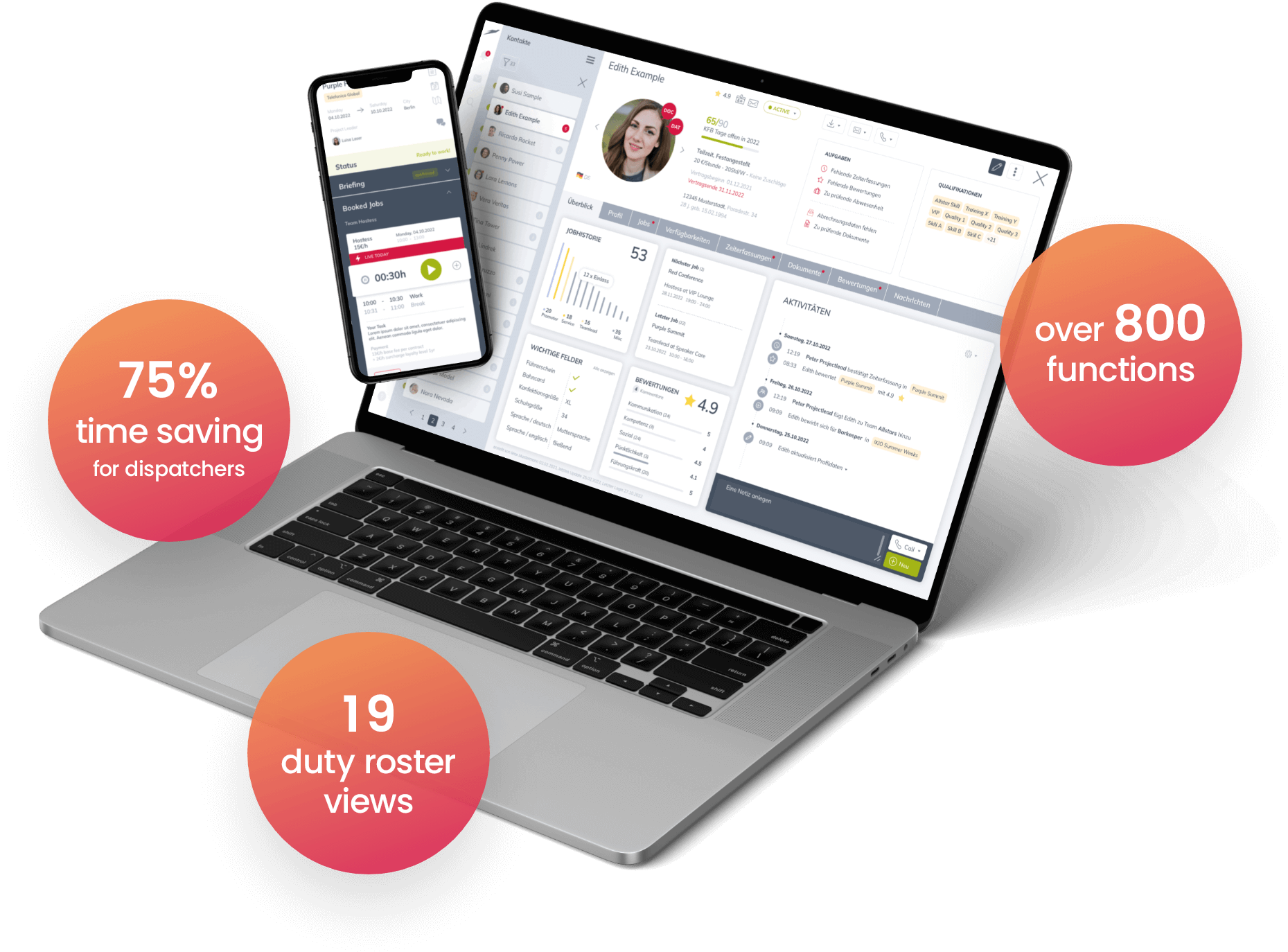
Teamhero is the perfect choice for personnel-intensive companies. Teamhero is not just an online platform, but a real hero when it comes to time tracking. With features such as up-to-the-minute time tracking, check-in and check-out with GPS geolocation via mobile devices and a real-time live mode, Teamhero offers a comprehensive solution for companies of all sizes.
The platform enables employees to record their working times independently, while personnel planners have the option of checking and correcting these times centrally and releasing them for payroll accounting.
How Teamhero supports and optimizes overtime reduction
The Working Hours Act on overtime sets out clear guidelines on the maximum amount of work that may be performed and the break and rest periods that must be observed. Teamhero supports employers in complying with these regulations and fulfilling their duty of care.
By accurately recording the start, duration and end of work as well as break times, companies can ensure that overtime is documented transparently.
Another advantage of Teamhero is the ability to identify overloaded and underutilized areas of the company in good time. This enables an efficient redistribution of resources and ensures a better work-life balance for employees.
A transparent time recording system like Teamhero also promotes harmony within the team, as all employees feel they are being treated more fairly.
Conclusion
Overtime may have become the norm for many, but its long-term effects can be significant for both employees and employers.
An effective reduction in overtime not only protects the health and well-being of employees, but also offers companies economic benefits through efficient resource planning and cost savings.
In this context, Teamhero supports companies as an innovative tool for personnel planning and overtime reduction.
If you or your company want to lead the future with legal certainty and organize overtime reduction efficiently and digitally, Teamhero is your ideal partner. Try Teamhero now and experience how simple and effective personnel planning can be.
Disclaimer
Please note that the texts on this website and the related contributions are provided for general informational purposes only and do not constitute tax or legal advice in the proper sense. For individual cases, we always recommend seeking specific legal advice tailored to the circumstances of the situation. The information is provided to the best of our knowledge and belief, without any guarantee of accuracy, completeness, or validity.