


Personnel support – definition, tasks & opportunities
Smart entrepreneurs have long known that happy employees are half the battle. Employees who enjoy coming to work give their best every day and thus make a significant contribution to achieving the company’s goals.
In this article, we take a brief but in-depth look at the most important issues surrounding the topic of HR support. We define the term, explain the essential tasks and challenges within HR management and provide useful tips for putting it into practice.
What does personnel support mean?
The term HR support defines all relevant HR tasks for team members that go beyond the contractually agreed basic salary. This includes advising employees on all issues relating to day-to-day operations as well as a diverse range of social benefits and measures. Personnel support is also known by the synonyms personnel service or employee support.
HR support is about seeing not only the employee in a team member, but also the person. They have financial and social needs that each company fulfills individually. The aim is to make employees feel valued and to ensure their well-being.
All-round successful HR support is a win-win situation for every company. Happy employees naturally have a stronger bond with the company and skilled workers stay with the company for a long time as a result. Trained HR managers also report a good working atmosphere and a general increase in performance.
Operational HR work as an ongoing task
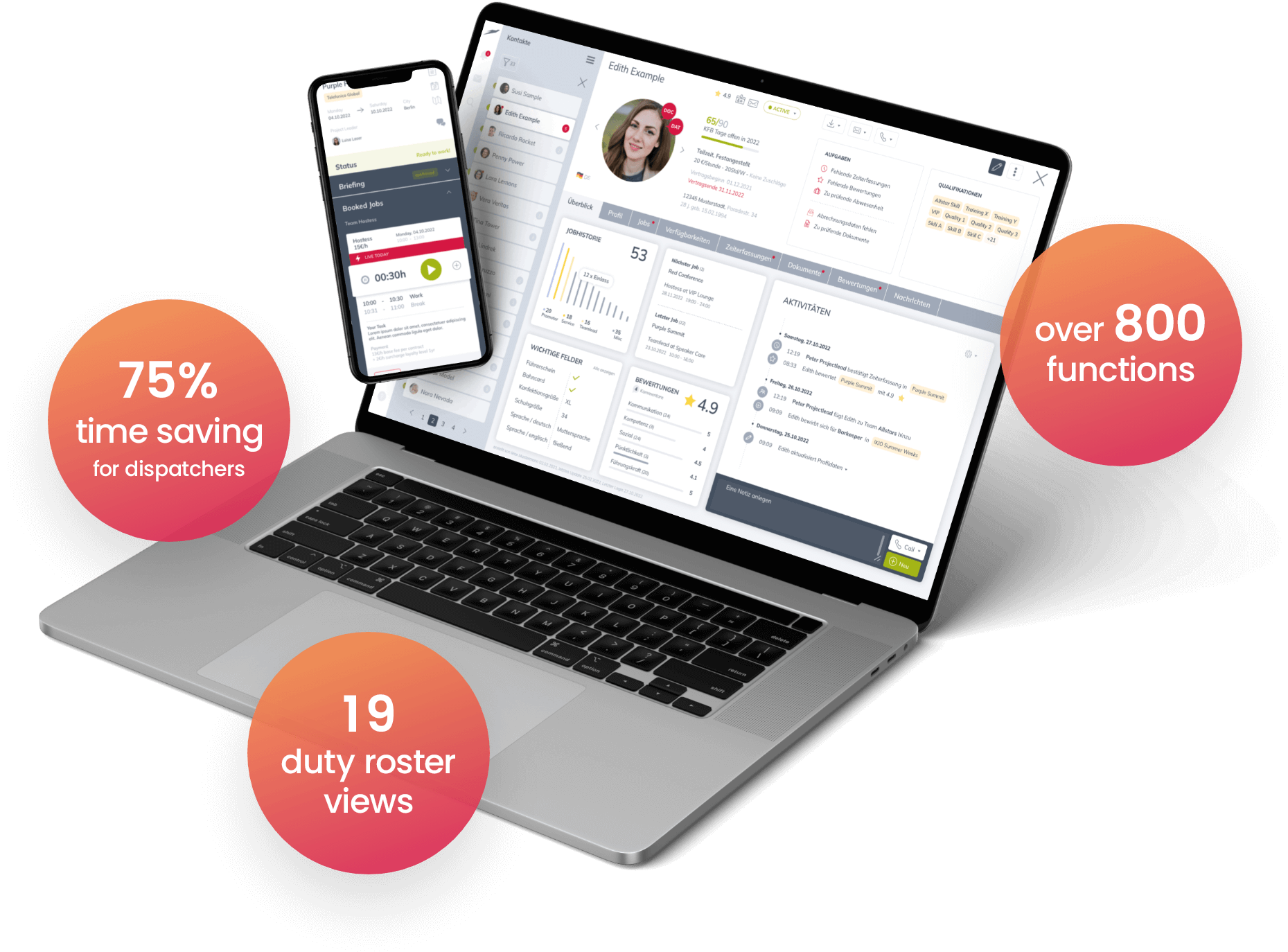
HR advisors are in action every day. They are the fairy godmothers of HR, working in the background to ensure a relaxed everyday life for the workforce. Operational HR support also includes the regular analysis of data in the area of HR management in order to be able to develop continuous improvements in the care of employees. Modern HR software such as Teamhero can be worth its weight in gold at this point, relieving the burden on your own staff and ensuring fast administrative work processes.
What tasks are included in personnel support?
Personnel support primarily covers these four areas:
- Social care
- Social benefits
- Social measures
- Social facilities
Let’s take a closer look at these below.
Social care: financial injections with added value
If applicants are lucky enough to be able to choose between different employers, it is not uncommon for them to opt for the company with the extra benefits within social care. These consist of specific expenses incurred by the company for various services that relieve team members financially and at the same time support them in their everyday lives.
Here are some examples of typical social benefits:
- Vacation pay
- Company pension scheme
- Transportation allowances (e.g. bus and train tickets)
- Meal allowances/flat-rate meals (possibly with access to the company’s own or external canteen)
- Free company doctor
- Fitness surcharge (for local gyms or fitness classes)
- Company apartment
- On-site childcare/surcharge for childcare
- Financial bonus for marriage, birth, company anniversary, etc.
- Discounts (e.g. reduced conditions for travel, sports or cultural facilities, shopping)
Social benefits: Mandatory or voluntary?
Contrary to popular belief, not all social benefits are legally prescribed. Many are granted by companies out of pure goodwill. In principle, a distinction can even be made between three different types of social benefits:
- The statutory benefits always include the employer’s social security contribution.
- Allowances such as travel expenses and meals received by employees on business trips are covered by the social benefits regulated by collective agreements.
- Additional payments that are not legally required are referred to as voluntary social benefits. These include company pension schemes and vacation pay, for example.
Social care as a win-win measure
The term social support includes, in particular, measures to support employees such as training courses and workshops. Most of these take place within the company, but larger companies in particular also cooperate with external training providers. The aim of social support is to promote the individual strengths of employees and support them in achieving their personal and professional goals.
This can also benefit the company by providing it with excellently trained employees who are open to technical challenges and changes and are able to cope with them. This is why quite a few companies cover the costs of their employees’ further training measures completely, while others subsidize them generously.
These facilities are classified as social facilities
Social institutions are institutions of various types. On the one hand, there are the company health insurance funds, or BKK for short. Many years ago, company health insurance funds were reserved for the employees of the respective company. Examples include the Bosch BKK and the SBK Siemens Betriebskrankenkasse. Nowadays, you can choose your statutory health insurance fund yourself and also belong to it as an employee from outside the company.
Another type of social facility is the good old company canteen, from which employees of larger companies in Germany in particular benefit. A selection of tasty and healthy dishes is good for your health. At the same time, employees get their well-deserved break, during which social interaction between colleagues can be encouraged.
What are the challenges in personnel management?
One of the biggest challenges for companies is undoubtedly the fact that HR support concepts have so far been designed for local support on site. Now it is time to rethink and adapt the concepts to various new working conditions.
More and more companies are working from home or even fully remotely. Neither an on-site canteen nor a cooperation partner for training in a specific city makes sense here. New ways need to be found to remunerate employees in other ways and stay in contact with them. This can be a very extensive task, especially for personnel-intensive companies such as trade fair and event organizers, catering companies or personnel service providers.

How should the implementation of new personnel support measures be approached?
Companies must be able to know their employees well, even when communication is primarily virtual. For HR support with added value, it is important to know what employees want and to find out which services actually increase employee satisfaction and do not simply fizzle out.
So before HR managers implement a new idea, the first step is to get an overview of their employee structure. Take a look at who your employees are, form an impression of their training, expertise, work assignments and other essential details. Think about what you would benefit from in the long term.
Then it is important to find out what your employees want by asking your team members, for example, and whether such a measure makes sense at all. Here’s an example: If most of your employees live far away from the company location, it makes little sense to introduce a job bike. Innovative personnel planning software provides excellent services in operational personnel management and is not only uncomplicated in the digitalization and automation of HR processes, but also cost-effective and, between you and me, easy on the nerves.
Conclusion
HR support is an enormously important factor in achieving the company’s goals. Because behind every employee is a person with wishes and needs. The more intensively a company deals with them and accommodates its workforce, the more fruit it will reap from good cooperation.
Newly created working conditions such as working from home, remote working and flexible personnel structures can no longer avoid the complete digitalization of HR processes. At the same time, however, this is also a great opportunity for a massive reduction in workload in the area of HR support and its administrative tasks. Modern HR software provides the foundation for effective and innovative HR processes.
Why you should choose Teamhero
As a customized HR software solution for comprehensive personnel planning and personnel support, Teamhero enables the digital management of extensive HR work processes at the highest level. At the same time, there is no need for extensive training, as Teamhero is uncomplicated and self-explanatory to use.
Unlike other HR software providers, we have focused our development of Teamhero on the challenges of personnel-intensive companies. We can customize the system to your individual needs. If this sounds interesting to you, why not test Teamhero or get in touch with us?