


Digital employment contracts for greater efficiency and legal certainty
The digital transformation affects all areas of the company, including human resources. The administration of employment contracts in particular has been considerably simplified by digital solutions. Digital employment contracts offer an efficient way to reduce administrative work and at the same time contribute to legal security. By using modern tools, companies can automate processes and ensure compliance at the same time.
Legal basis
Since January 1, 2025, the Fourth Bureaucracy Relief Act (BEG IV) in Germany for the conclusion of digital employment contracts. The most important change concerns the Evidence Act, which now permits the text form in accordance with Section 126b of the German Civil Code (BGB) for material contractual terms instead of requiring the written form. This means that employment contracts can be concluded completely digitally, for example by email. Employers must ensure that the electronically signed contract is accessible, storable and printable for both parties. All types of electronic signatures are permitted for open-ended contracts, while fixed-term contracts still require a qualified electronic signature.
Automation of employment contracts
The automation of the creation of employment contracts saves time and reduces sources of error. Digital platforms can be used to create contracts with predefined templates and individual adaptations. HR staff no longer have to manually compile texts or enter changes manually. These tools often offer the option of storing different contract types and automatically retrieving the relevant information from a database. Especially in large companies with a large number of new hires, this automation provides considerable relief. In addition, the contract can be sent to the new employee with just a few clicks, which significantly reduces the time it takes to conclude the contract.
Legal certainty through digital signatures
The legal security of digital employment contracts is guaranteed by the use of electronic signatures. These are regulated in Germany by the Trust Services Act (VDG) and offer the same legal binding force as handwritten signatures. The digital signature enables complete documentation and traceability of the conclusion of the contract. HR managers can thus ensure that all required signatures are recorded correctly without the need for physical copies. This makes things much easier, especially for international contracts or remote employees abroad.
Advantages of digital contract management
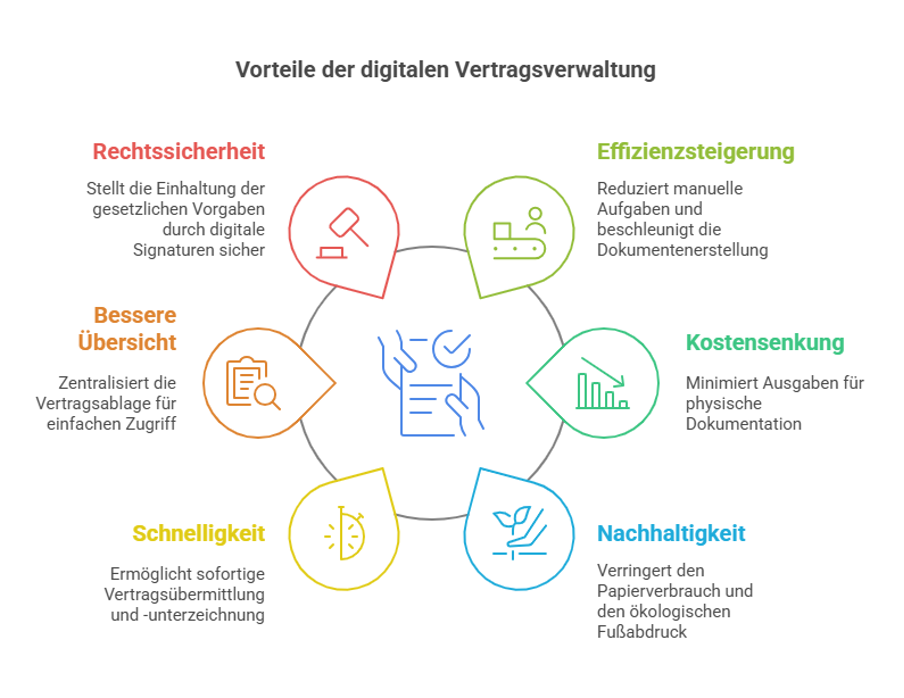
The digital management of employment contracts offers numerous advantages that go far beyond simply increasing efficiency. The automated creation and archiving of contracts reduces administrative effort and minimizes the error rate. Digital platforms make it possible to store contracts centrally, which ensures quick access to all relevant documents. This simplifies administration and ensures that contracts are available anytime and anywhere. In addition, digital employment contracts are better integrated into existing HR systems This enables smooth and time-saving collaboration with other departments.
Data protection and compliance in the digital contract process
Another key aspect of digital employment contracts is data protection. As these contracts contain sensitive information, it is essential that they are stored in a secure system. Digital contract platforms usually offer comprehensive security measures, such as data encryption and protection against unauthorized access. This ensures the protection of employees’ personal data and guarantees compliance with the General Data Protection Regulation (GDPR). Storing contracts digitally also makes it easier to monitor and comply with all relevant retention periods. Compliance requirements can be checked automatically, which increases the company’s legal protection.
| Advantage | Description |
| Security standards | High security standards, data encryption |
| Access controls | Only authorized persons can access the contracts |
| Documentation | Complete traceability of contract amendments |
| Revision security | All changes and signatures are unique and cannot be manipulated |
| GDPR compliance | Ensuring compliance with the General Data Protection Regulation |
| Long-term storage | Digital storage enables compliance with legal retention periods |
These additional points illustrate how digital contract platforms not only increase legal security, but also easily fulfill data protection and documentation requirements.
Further formal simplifications
Since 2025, several important simplifications have been introduced to reduce the bureaucratic burden for companies and and HR professionals:
- Authorized representatives, legal representatives and legal advisors can send scans of applications and declarations to be submitted in writing electronically.
- The signature requirement for written declarations by companies and their representatives has been abolished, which simplifies the administrative burden.
- Employment contracts and other relevant documents can now also be submitted via central digital platforms, allowing several institutions to be served simultaneously.
- The option to transmit personnel files and other confidential HR documents electronically has been extended.
- The deadlines for the electronic submission of contracts and notifications to authorities have been extended to provide more flexibility.
These simplifications help HR departments to make their work processes even more efficient and easily comply with legal requirements.
Disclaimer
Please note that the texts on this website and the related contributions are provided for general informational purposes only and do not constitute tax or legal advice in the proper sense. For individual cases, we always recommend seeking specific legal advice tailored to the circumstances of the situation. The information is provided to the best of our knowledge and belief, without any guarantee of accuracy, completeness, or validity.