


Shift models: What shift systems are there?
Many companies rely on shift models to maintain operations around the clock or to cushion production peaks. But what shift systems are there actually? And how do they affect employees and employers?
In this article, we take a look at the most common shift models and explain their advantages and disadvantages. We take a look at classic two-shift and three-shift systems, as well as more modern concepts such as flexible shift models. In doing so, we consider both the perspective of employees and the needs of companies.

What are shift models?
Shift models are working time systems in which employees work in fixed blocks of time, known as shifts. These systems enable companies to extend their operating hours beyond normal business hours or even ensure 24-hour operation through a fully continuous shift model. In a shift system, different groups of employees take turns to ensure that jobs are continuously filled. Each group works at specific times, which can change regularly. This can include early, late and night shifts, but also more complex rotation systems. Shift models are used in many sectors, such as production, healthcare, catering and retail. The specific design of shift models can vary greatly and depends on the company’s own requirements and the legal framework.
Why are shift models necessary at all?
Shift models have become indispensable in many areas of the modern economy and society. They fulfill several important functions:
- Continuous operation:
In some industries, 24/7 operation is required. Hospitals, power plants or security services cannot simply “call it a day”. Many services also need to be available around the clock, for example in retail or catering. - Optimum use of resources:
Expensive machines and systems are used more efficiently through shift work, which reduces production costs. - Global competition:
International business relationships often require contact persons at different times of the day. - Flexibility:
Shift models enable companies to react to fluctuations in demand. - Work-life balance:
For some employees, flexible working hours offer advantages in terms of work-life balance. - Legal requirements:
In certain areas, laws stipulate continuous staffing, for example in the healthcare sector.
Shift models offer employers flexibility in personnel planning and can give employees the opportunity to achieve a better work-life balance. However, they also come with challenges, which we will discuss later.
Legal requirements for shift models
Shift work in Germany is subject to clear legal regulations, which are primarily set out in the Working Hours Act (ArbZG). In principle, the 8-hour day applies to shift workers, whereby an extension to up to 10 hours is possible, provided that an average of 8 hours per working day is not exceeded within six calendar months or 24 weeks. Night work, defined as work between 11 p.m. and 6 a.m., requires special protective measures: Night workers are entitled to regular occupational health checks and appropriate compensation, either in the form of paid days off or a supplement. Employers must also observe rest breaks and rest periods: After 6 hours of work at the latest, a 30-minute break is mandatory, and 45 minutes for more than 9 hours. There must be at least 11 hours of rest between two work shifts. Stricter protective regulations apply to young people and expectant and nursing mothers. Works councils have a right of co-determination when designing shift schedules in order to protect the interests of employees.
What shift models are there (with examples)?
There are various shift models that are used depending on the industry and company requirements. Below we present the most common shift models and explain their characteristics.
Two-layer model
The two-shift model divides the working day into two shifts, typically an early shift and a late shift. A common example would be an early shift from 6:00 am to 2:00 pm and a late shift from 2:00 pm to 10:00 pm. This model is characterized by its simple organization and clear structures for employees. It allows employees to plan their private lives well, as working hours remain relatively constant. However, it does not cover night hours, which can be problematic in some industries. There is also a risk of overload during peak times, as there is no additional shift available to cushion peak times.
Three-shift model
The three-shift model extends the two-shift model to include a night shift, thus enabling 24-hour operation. A typical example would be: early shift from 6:00 am to 2:00 pm, late shift from 2:00 pm to 10:00 pm and night shift from 10:00 pm to 6:00 am. The major advantage of this model is the continuous operational readiness and the more even distribution of the workload throughout the day. However, it also places a greater burden on employees due to night work. Planning becomes more complex, as three shifts now have to be coordinated and the effects on employees’ biorhythms have to be taken into account.
Fully continuous shift model
This model ensures operation 7 days a week, 24 hours a day, without interruptions. An example would be the 4-group model, in which group A has the early shift, group B the late shift, group C the night shift and group D the off-shift. The groups rotate through the different shifts on a weekly basis. The main advantage is maximum plant utilization and regular blocks of free time for employees. However, it also means a high workload due to the changing shifts and places complex planning requirements on the Human resources department. Reconciling work and private life can be made more difficult by the changing working hours.
Part-time shift model
This model combines full-time and part-time staff in order to be able to react flexibly to fluctuations in demand. For example, full-time employees could take on 8-hour shifts, while part-time employees cover 4-6-hour shifts during peak times. The great flexibility is the biggest advantage of this model. It is particularly attractive for employees with work-life balance requirements. However, it requires an increased coordination effort and can lead to possible inequalities between full-time and part-time employees, which can affect team dynamics.
Flexible shift model
In this model, employees can choose their own working hours within certain limits. One example would be a core time from 10:00 to 15:00, which is mandatory, and flexitime from 6:00 to 10:00 and 15:00 to 20:00, during which employees can work flexibly. This model promotes a high level of employee satisfaction and a better work-life balance. However, it can lead to challenges in team coordination and carries the risk of understaffing at certain times. Employers must therefore pay particular attention to ensuring operational processes.
Which shift model example is the right one?
The choice of the right shift model depends on various factors, such as the industry, the operational requirements and the needs of the employees. When deciding on a shift model, employers should consider both business aspects and the health and satisfaction of their employees.
The advantages and disadvantages of shift models
Shift work is a must in many industries and has specific advantages and disadvantages for both employers and employees. We take a closer look at these below.
Advantages of shift work
For employers
- Higher productivity: Shift work allows companies to use their equipment and resources around the clock, which leads to increased productivity.
- Flexibility: Shift models make it possible to react more flexibly to fluctuations in demand and market requirements.
- Cost efficiency: Optimum utilization of machines and systems can reduce costs and increase competitiveness.
- Customer service: In service industries, shift work enables extended customer service, often around the clock.
For employees
- Higher pay: Shift work, especially night and weekend shifts, is often remunerated with bonuses.
- Flexible time off: Some shift models offer longer contiguous blocks of free time, which allows for more flexible time off planning.
- Less traffic: Employees working off-peak shifts can avoid traffic jams and save time.
- Compatibility with family responsibilities: Certain shift models can make it easier to look after children or relatives in need of care.
Disadvantages of shift work
For employers
- Higher personnel costs: Surcharges for night and weekend work as well as possible health-related follow-up costs can increase personnel expenses.
- Complex planning: The organization of shift schedules requires more administrative effort.
- Potential loss of productivity: Employee productivity can fall, especially during night shifts.
- Higher turnover: Shift work can lead to increased employee turnover, which in turn causes costs for new hires and training.
For employees
- Health risks: Shift work, especially night work, can disrupt the biorhythm and lead to sleep problems, digestive problems and other health problems.
- Social restrictions: Irregular working hours can affect social life and make it difficult to participate in regular leisure activities.
- Family challenges: Reconciling shift work with family commitments can be difficult, especially when it comes to childcare.
- Mental stress: The constant change in working hours can lead to stress and mental strain.
Measures to minimize the disadvantages
To reduce the negative effects of shift work, the following measures can be useful:
- Ergonomic shift planning: development of shift plans that take employees’ biological rhythms into account.
- Health promotion: offering health programs and advice to help employees cope better with shift work.
- Flexible models: Introduction of flexible shift models that meet the individual needs of employees.
- Regular review: Continuous evaluation and adaptation of shift models to changing needs.
- Training courses: Offer training courses for employees to help them cope better with the challenges of shift work.
Shift work offers both opportunities and challenges for employers and employees. While it offers economic benefits and flexible working time models, it also harbors health and social risks. Thorough planning, regular reviews and the implementation of supporting measures are useful to maximize the benefits and minimize the disadvantages. Ultimately, it is the responsibility of both parties to work together to find solutions that meet both operational requirements and the well-being of employees.
Shift models: organizing work flexibly
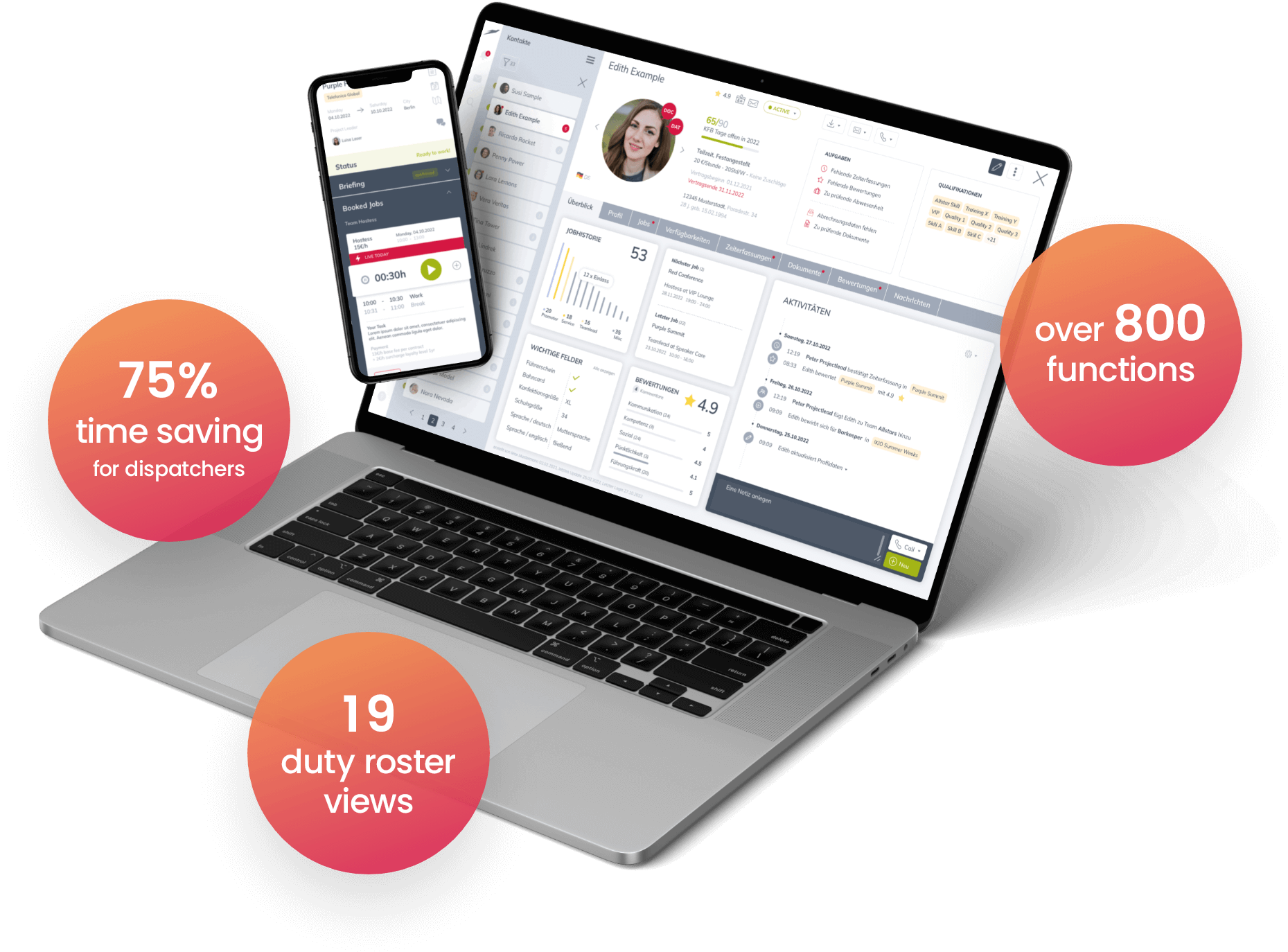
Implementing and managing shift models can be a challenge for companies, especially when it comes to managing large numbers of employees. Modern personnel management systems such as Teamhero can provide valuable support here. Specially developed for personnel-intensive companies, Teamhero facilitates the implementation of various shift models through powerful functions for shift planning and time recording. The software enables clear and flexible planning of shifts, takes into account employee wishes and legal requirements and offers precise tools for recording working hours. With features such as digital check-in and check-out, geolocation and a live mode for a complete overview, Teamhero helps employers to organize shift work efficiently while keeping an eye on the needs of their employees. In this way, the challenges of shift work can be turned into an opportunity for increased productivity and employee satisfaction.
FAQs on shift models
What is a shift model?
A shift model is a working time concept in which employees work in fixed periods of time (shifts) to ensure that jobs are continuously filled.
What types of shift models are there?
There are various shift models, including the two-shift model, three-shift model, fully continuous shift model, part-time shift model and flexible shift models.
What is the difference between a two-shift and a three-shift model?
The two-shift model generally comprises an early and a late shift, while the three-shift model also includes a night shift.
What does fully continuous shift model mean?
A fully continuous shift model enables uninterrupted operation around the clock, 7 days a week, through the rotation of several employee groups.
What are the advantages and disadvantages of shift work for employers?
Advantages include higher productivity and better plant utilization. Disadvantages can be higher personnel costs and more complex planning.
How does shift work affect employees?
Shift work can lead to higher pay and flexible leisure activities, but it also entails health risks and can have a negative impact on social life.
How can the stress caused by shift work be reduced?
Through ergonomic shift planning, health promotion, flexible models and regular reviews of shift schedules.
What are the legal requirements for shift work?
The Working Hours Act regulates maximum working hours, break times and rest periods. Employers must take these into account when planning shifts.
How can personnel management software help with the implementation of shift models?
Software such as Teamhero provides support with functions for rostering, time recording and compliance with legal requirements.
What needs to be considered when introducing a new shift model?
It is important to involve employees, take into account operational requirements, comply with legal requirements and, if necessary, obtain the consent of the works council.
Disclaimer
Please note that the texts on this website and the related contributions are provided for general informational purposes only and do not constitute tax or legal advice in the proper sense. For individual cases, we always recommend seeking specific legal advice tailored to the circumstances of the situation. The information is provided to the best of our knowledge and belief, without any guarantee of accuracy, completeness, or validity.